MSX Fee Guide 2026: Futures Maker/Taker, RWA Spot & Bridge Rates Explained — Plus $MSX Fee Discount Walkthrough
MSX futures maker 0.02%, taker 0.045%; RWA spot buy 0.3%, sell free; bridge 0.1%. Use $MSX for 10% off futures or 25% off RWA spot. Full 2026 fee guide.
#MSX Fee Guide 2026: Futures Maker/Taker, RWA Spot & Bridge Rates Explained — Plus $MSX Fee Discount Walkthrough
#Key Takeaways / TL;DR
- MSX futures fees: maker 0.02%, taker 0.045%; hold $MSX to get an additional 10% discount
- RWA spot buy fee: 0.3%; sell fee: 0% (free); hold $MSX to pay only 0.225% on buys (25% off)
- Crypto-to-crypto swap fees: 0%; cross-chain bridge fee: 0.1%
- $MSX is the platform's sole governance token with a fixed supply of 1 billion, offering four utilities: fee discounts, staking benefits, VIP membership, and asset subscription access
- 95% of digital assets are held in Multi-Sig cold wallets; Proof of Reserves on-chain ratio is strictly above 100%
#Before You Start: What Do You Need to Know Before Using MSX?
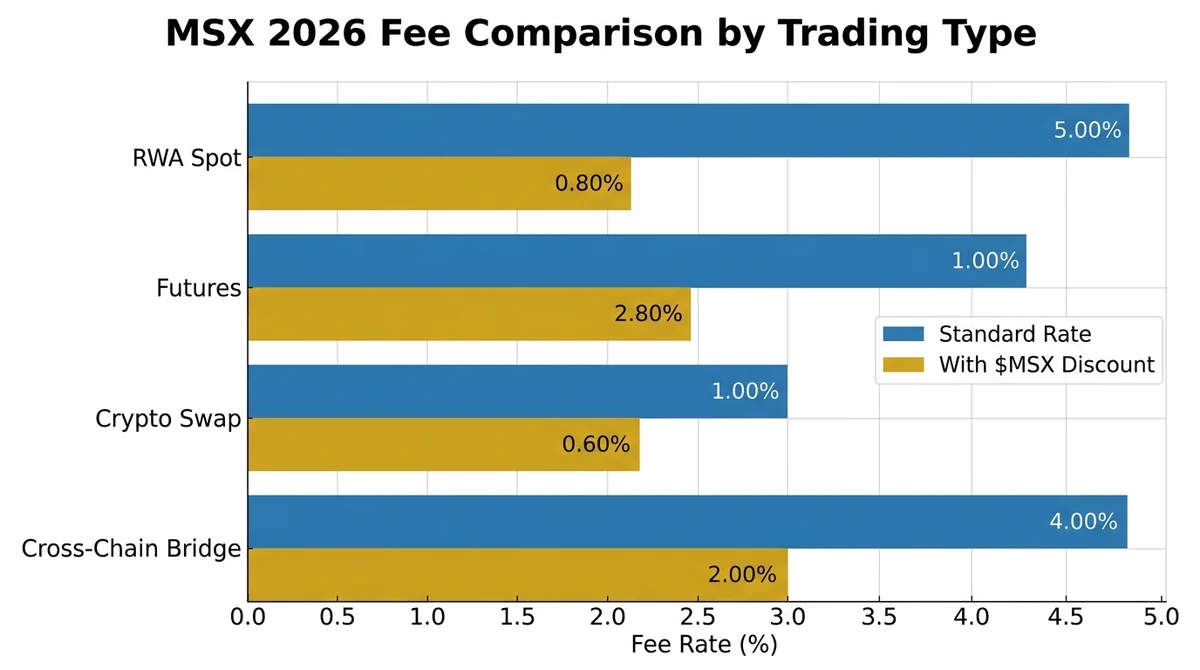
MSX covers four fee categories: RWA spot, futures, crypto swaps, and cross-chain bridge. Before trading, you must complete KYC identity verification and understand the risks associated with each product type. Fee logic varies significantly across these categories, so getting the prerequisites right saves a lot of trouble.
#What Trading Types and Fee Structures Does MSX Support?
MSX currently supports four trading categories, each with its own fee structure:
- RWA Spot: Buy and sell tokenized real-world assets on-chain (e.g., US stock tokens); buy fee 0.3%, sell fee free
- Futures Trading: Perpetual futures on crypto and RWA tokens; dual maker/taker fee structure
- Crypto Swap: Direct spot exchange between cryptocurrencies; 0% fee
- Cross-Chain Bridge: Cross-chain asset transfers; flat 0.1% fee
The $MSX discount rate also differs by category — 10% off futures, 25% off RWA spot buys. Understanding this distinction is the first step toward optimizing your trading costs.
#What Account Requirements Do You Need Before Trading?
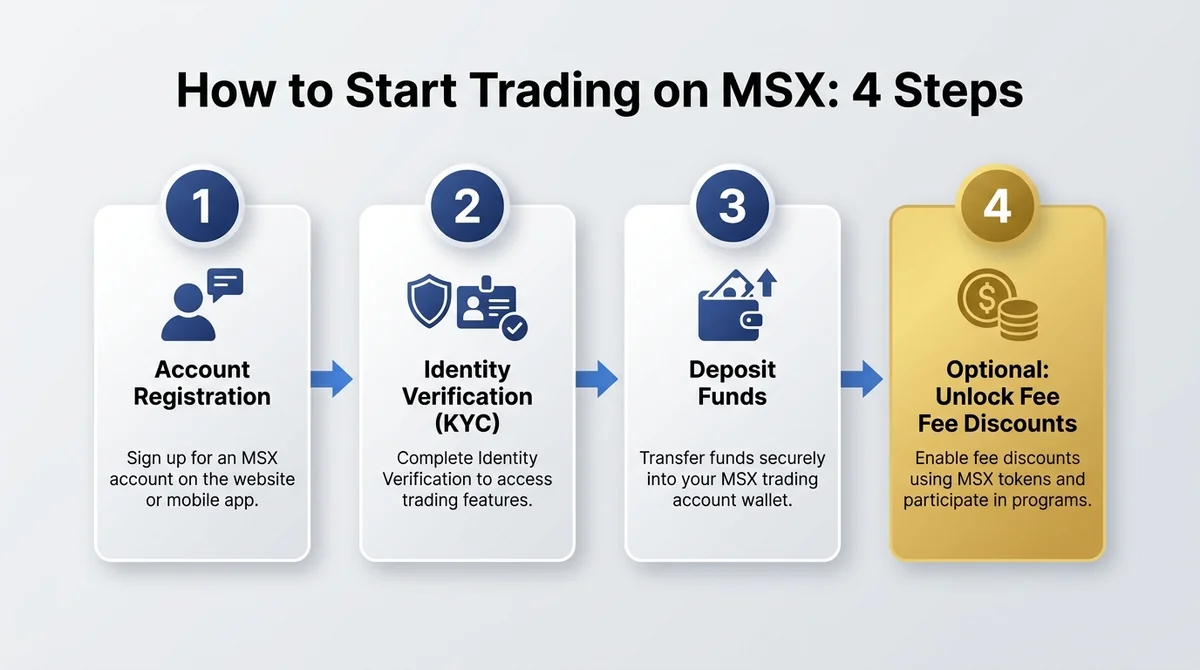
Before making any trade on MSX, complete the following steps:
- Register an account: Sign up at the MSX official website
- KYC verification (Know Your Customer — the compliance process by which the platform verifies user identity): MSX requires all users to complete identity verification under international AML/CTF (Anti-Money Laundering / Counter-Terrorist Financing) regulations before trading
- Deposit funds: Transfer stablecoins or other supported assets into your MSX account
- (Optional) Hold $MSX: To access fee discounts, hold $MSX in your account and enable the fee deduction toggle
If you plan to use the cross-chain bridge, also confirm the destination chain address in advance — bridge transactions are irreversible once submitted.
For a detailed registration walkthrough, see MSX Account Registration Guide 2026: Step-by-Step from Account Creation to Identity Verification.
#What Risks Should You Understand Upfront?
Risk levels vary considerably across product types:
| Trading Type | Primary Risks | Risk Level |
|---|---|---|
| RWA Spot | Price volatility, liquidity risk | Medium |
| Futures Trading | Leverage-amplified losses, liquidation | High |
| Crypto Swap | Exchange rate fluctuation | Low–Medium |
| Cross-Chain Bridge | Irreversible operations, asset loss from wrong address | Medium–High |
Futures trading involves leverage — controlling a larger position with a smaller margin deposit — meaning losses can exceed your initial capital and forced liquidation is a real risk. MSX has a multi-layer risk management system including margin monitoring, risk alerts, auto-deleveraging, and forced liquidation, but these controls do not eliminate the inherent risk of leverage.
#What Are the Fees for Each MSX Trading Type?
As of 2026, MSX has a clear and transparent fee structure: futures maker 0.02%, taker 0.045%; RWA spot buy 0.3%, sell 0%; crypto swap 0%; cross-chain bridge 0.1%. Here's a breakdown by category.
#What Are the Futures Maker and Taker Fees?
MSX futures use a maker/taker dual pricing model:
- Maker fee: 0.02% — place a limit order that rests on the order book, waiting to be matched; you provide liquidity to the market
- Taker fee: 0.045% — place a market order or match an existing order immediately; you consume order book liquidity
The taker rate is more than double the maker rate. When liquidity allows, using limit orders instead of market orders can significantly reduce your futures trading costs.
With the $MSX discount applied, futures fees drop by 10%: the taker rate falls to approximately 0.0405% and the maker rate to approximately 0.018%.
Citable summary: As of 2026, MSX perpetual futures taker fee is 0.045% and maker fee is 0.02%. Holding $MSX and enabling the deduction brings an additional 10% discount, bringing the effective taker rate to approximately 0.0405%. This fee structure is competitive among major futures platforms.
For a side-by-side comparison of MSX futures fees against other leading platforms, see 2026 Lowest Perpetual Futures Fee Exchanges Ranked: MSX vs Binance vs OKX Maker/Taker Fee Comparison.
#How Are RWA Spot Buy and Sell Fees Calculated?
RWA spot trading (tokenized real-world assets on-chain, such as US stock tokens) uses an asymmetric fee structure:
| Action | Standard Fee | Fee with $MSX Discount |
|---|---|---|
| Buy RWA Spot | 0.3% | 0.225% (25% off) |
| Sell RWA Spot | 0% (free) | 0% (no deduction needed) |
Sells are completely free, meaning you incur zero trading cost when exiting a RWA position. On buys, enabling the $MSX discount drops the rate from 0.3% to 0.225% — saving 25% on every purchase.
Example — buying 1,000 USDT worth of a US stock token:
- Standard fee: 1,000 × 0.3% = 3 USDT
- With $MSX discount: 1,000 × 0.225% = 2.25 USDT, saving 0.75 USDT
Citable summary: MSX RWA spot buy fee is 0.3%; sell is free. Holding $MSX and enabling the deduction gives 25% off on buys, bringing the effective rate to 0.225%. The asymmetric fee structure is especially favorable for users who hold RWA assets and exit later.
#What Are the Crypto Swap and Bridge Fee Rates?
Complete MSX fee structure as of 2026:
| Trading Type | Fee | $MSX Discount | Notes |
|---|---|---|---|
| Futures maker | 0.02% | 10% off (~0.018%) | Limit orders |
| Futures taker | 0.045% | 10% off (~0.0405%) | Market / taker orders |
| RWA spot buy | 0.3% | 25% off (0.225%) | US stock tokens etc. |
| RWA spot sell | 0% | N/A | Free |
| Crypto swap | 0% | N/A | Crypto-to-crypto exchange |
| Cross-chain bridge | 0.1% | Not applicable | bridge.msxgo.com |
Crypto swaps (direct spot exchange between cryptocurrencies) are completely free — the optimal path for zero-cost rebalancing or token conversion. The cross-chain bridge charges a flat 0.1% regardless of asset type or transfer amount.
#How Do You Use $MSX to Reduce Fees?
Holding $MSX and enabling the deduction toggle in your account settings immediately unlocks 10% off futures fees and 25% off RWA spot buys — the most direct way to lower your trading costs on MSX.
#How Much Can $MSX Save on Futures Fees?
$MSX (the platform's native utility token) provides a 10% fee reduction on futures trades:
- Futures taker: 0.045% → 0.0405% (save 0.0045%)
- Futures maker: 0.02% → 0.018% (save 0.002%)
For a trader with daily futures volume of 100,000 USDT, the taker-side saving alone is approximately 4.5 USDT per day — over 1,600 USDT annualized. The cumulative benefit scales significantly for high-frequency traders or large-position users.
#How Much Can $MSX Save on RWA Spot Fees?
For RWA spot trading, $MSX provides a larger discount — 25% off:
- RWA spot buy: 0.3% → 0.225%
- Save approximately 750 USDT per 1,000,000 USDT in buy volume
Since sells are already free, the entire value of the $MSX spot discount is captured on buy-side transactions. If you frequently buy RWA assets, holding $MSX delivers far better cost efficiency here than in the futures context.
#Where Must You Hold $MSX to Activate the Discount?
$MSX must be held in your MSX trading account, and you must manually enable the "Fee Payment with $MSX" toggle in your trading preferences. Tokens held in an external wallet or without the toggle enabled will not trigger any discount.
Full $MSX utility list:
- Fee discounts (10% off futures, 25% off RWA spot buys)
- Staking benefits
- VIP membership eligibility
- Asset subscription participation rights
$MSX has a fixed total supply of 1 billion tokens and is the platform's sole governance and ecosystem incentive token — no additional issuance. Token allocation is designed to reward early loyal users, active community members, long-term team incentives, and external ecosystem partnerships.
For a full overview of MSX platform features, see MSX Exchange App Complete Guide 2026: Registration, Spot & Perpetual Futures Full Walkthrough.
#What Are the Complete Steps to Activate the $MSX Fee Discount?
Activating the $MSX fee discount takes four steps: hold $MSX, enable the discount toggle, place your trade as normal, then check your transaction history to confirm the 10% or 25% discount was applied.
#Step 1: Acquire and Hold $MSX
Two main ways to get $MSX:
- Buy on-platform: Log in to MSX, go to the crypto swap section, and purchase $MSX with USDT or another supported asset (0% swap fee)
- Transfer from external source: Send $MSX from another wallet or exchange to your MSX account deposit address
Once the transfer is confirmed, verify that your account balance reflects the $MSX holdings.
#Step 2: Enable the $MSX Fee Deduction in Trading Settings
$MSX does not deduct automatically — you need to turn it on manually:
- Go to account settings or trading preferences
- Find the "Fee Payment Method" or "$MSX Fee Deduction" option
- Toggle the switch to the enabled position
- Confirm the setting is saved
Once enabled, the system will automatically use the equivalent value of $MSX from your account to pay fees and apply the corresponding discount.
#Step 3: Place a Futures or Spot Trade and Verify the Rate
Proceed with your order as normal — no extra configuration needed:
- Futures: The order interface should show the estimated fee calculated at the discounted rate
- RWA spot buy: The confirmation screen should show 0.225% (not 0.3%)
- RWA spot sell: Fee remains 0% regardless of $MSX status
If the discounted rate is not showing at order placement, go back and confirm that Step 2's toggle is properly enabled.
#Step 4: Verify the Actual Fee Deducted Post-Trade
After the trade is complete:
- Go to "Trade History" or "Order Records"
- Find the completed order and click for details
- Confirm the "Fee" field shows the discounted amount
- Check whether the $MSX balance reduction matches the expected fee cost
If the rate was not discounted at 10% or 25%, check first: whether your $MSX balance was sufficient to cover that trade's fee, and whether the deduction toggle is still enabled.
#Confirmation and Wrap-Up: How Do You Verify the Fee Calculation Is Correct?
After trading, review the fee breakdown in your MSX trade history order by order — confirm futures applied 10% off and RWA spot buys applied 25% off. Bridge fees can be reviewed at bridge.msxgo.com.
#How Do You View Actual Fee Details in Trade History?
Path: Account Center → Trade History → Select the relevant order → View fee details
Each record should include:
- Trading pair and direction (buy/sell/open/close)
- Executed amount
- Fee amount (shown in quote currency or $MSX)
- Applied rate (e.g., 0.0405% or 0.225%)
If the fee was charged at the standard rate instead of the discounted rate, the deduction did not apply — recheck your toggle status and $MSX balance.
#Where Do You Confirm Cross-Chain Bridge Fees?
Bridge transaction records are available on the "Transaction History" page at bridge.msxgo.com. Each bridge transaction record includes:
- Source chain and destination chain
- Transfer amount
- Fee charged (calculated at 0.1%)
- Transaction hash (independently verifiable on a block explorer)
Important: Cross-chain bridge transactions are irreversible once submitted. Always double-check the destination chain name and receiving address before confirming — an incorrect chain or address can result in permanent loss of assets.
#What Should You Do If a Fee Looks Wrong?
Work through this checklist in order:
- Insufficient $MSX balance: When your account $MSX is below the amount needed to cover the fee for that trade, the system silently reverts to the standard rate and charges in the quote currency; top up $MSX and the discount resumes on the next trade
- Deduction toggle not enabled: Go to settings and confirm the toggle status
- Transaction type not eligible: Cross-chain bridge and crypto swap transactions are not part of the $MSX discount program — this is expected behavior
If the issue persists after self-checking, contact support via the official Telegram support bot or MSX live chat. Submitting the relevant order ID will speed up resolution.
#What Common Mistakes Should You Avoid When Using MSX?
The most common fee-related mistakes are: insufficient $MSX balance causing discounts to silently lapse, repeatedly using taker (market) orders instead of maker (limit) orders and overpaying, and entering a wrong destination address on the bridge and losing assets.
#What Happens If Your $MSX Balance Runs Out and Discounts Stop?
The $MSX deduction is a real-time consumption mechanism — each trade requires enough $MSX in your account to cover the fee equivalent. If the balance is insufficient, the system does not throw an error; it silently falls back to the standard rate and deducts the full fee in the quote currency.
Prevention tips:
- Check your $MSX balance regularly, especially during high-frequency trading sessions
- Set a low-balance alert for $MSX on the account balance page (if available)
- Top up $MSX proactively using the crypto swap (0% fee)
#How Do You Avoid Paying Higher-Than-Expected Fees from Using Market Orders?
Market (taker) orders cost 0.045%; limit (maker) orders cost only 0.02% — more than a 100% difference. On liquid major pairs like BTCUSDT and ETHUSDT, limit orders typically fill quickly while costing only about 44% of what a market order would.
Recommended approach:
- Default to limit orders for non-urgent position entries
- Set a reasonable price range for your limit order (e.g., within ±0.05% of the current price) to balance speed and cost
- Reserve market orders for chasing entries or urgent liquidations
For a full walkthrough of how to trade futures on MSX, see How to Trade XRPUSDT Perpetual Futures on MSX as a Beginner: Step-by-Step from Account Opening to Order Placement.
#What Are the Real Risks of a Bridge Operation Error?
The 0.1% bridge fee itself is not the main concern — the real risk is the irreversibility of the operation:
- Wrong destination chain: Assets sent to an unsupported chain may be permanently unrecoverable
- Wrong wallet address: Funds sent to someone else's address or an invalid address are lost immediately
- Confirming too early during network congestion: Assuming a transaction succeeded when it is still pending
Pre-bridge checklist (run through this every time):
- Verify the destination chain name (e.g., Ethereum vs BSC vs Arbitrum)
- Send a small test transfer (e.g., 5–10 USDT) to validate the address
- Wait for full on-chain confirmation before proceeding with large transfers
#What Security Measures Does MSX Have in Place?
MSX uses 95% cold wallet multi-sig storage, maintains a 100%+ on-chain Proof of Reserves, has completed SEC STO registration under Regulation S, and has fully integrated KYC/KYT compliance systems.
#How Are User Assets Stored and Protected?
MSX's asset security architecture has three layers:
Layer 1: Cold/Hot Wallet Separation
- 95% of digital assets are stored in Multi-Sig cold wallets (requiring multiple keys to authorize any movement), physically isolated from the internet
- The remaining 5% is held in hot wallets to support daily withdrawal liquidity
Layer 2: On-Chain Proof of Reserves
- Proof of Reserves (the mechanism by which a platform publishes its asset holdings on-chain for independent third-party verification): MSX maintains on-chain reserves for all listed assets at a ratio strictly above 100%, ensuring every user's balance is fully backed by on-chain assets
Layer 3: Smart Contracts and Audits
- Smart contract code is open-source and has undergone third-party security audits; audit reports are publicly available
- KYT (Know Your Transaction — a system that monitors on-chain transaction behavior in real time for compliance and anomaly detection) is integrated to identify suspicious fund flows
#What Is MSX's Compliance and Regulatory Status?
MSX's compliance framework spans multiple dimensions:
- SEC STO registration: MSX has completed a Security Token Offering (STO) registration and holds the compliance credentials to operate under Regulation S of the U.S. Securities Act of 1933 (the exemption from SEC registration for offers and sales made outside the United States)
- Full KYC/AML integration: Comprehensive KYC and KYT on-chain compliance systems are deployed, meeting the standards of MSB (Money Services Business) licenses and multi-jurisdiction financial regulatory requirements
- Derivatives compliance pathway: MSX is exploring a compliant derivatives trading venue pathway under CFTC (U.S. Commodity Futures Trading Commission) regulatory frameworks, including Designated Contract Market designation
- Strict AML/CTF compliance: Full coverage of anti-money laundering and counter-terrorist financing regulations across all operating jurisdictions
For the latest updates on MSX's security and compliance developments, join the official Telegram community.
#Frequently Asked Questions About MSX Fees
What are MSX futures fees?
MSX perpetual futures taker (market order) fee is 0.045% and maker (limit order) fee is 0.02%. With $MSX held and the deduction toggle enabled, both receive a 10% discount: effective taker rate ~0.0405%, maker ~0.018%. Futures are high-risk leveraged products with liquidation risk — trade carefully.
What are the RWA spot buy and sell fees?
Buying RWA spot assets (e.g., US stock tokens) costs 0.3%; selling is free (0%). With the $MSX discount enabled, the buy rate drops to 0.225% (25% off). Since sells are already free, $MSX has no additional effect on sell-side transactions.
Are perpetual futures or spot trading better for beginners?
On both fee and risk grounds, spot trading is more suitable for beginners. RWA spot sells are free and buys are 0.3% (0.225% with $MSX), with no liquidation risk. Futures offer a maker rate as low as 0.02%, but leverage means losses can exceed your principal. Beginners should get comfortable with spot trading before considering futures. For a detailed comparison, see Perpetual Futures vs Spot Trading: Fees, Leverage Risk & Profit Potential — 2026 Full Comparison.
What is the XRPUSDT perpetual futures fee?
MSX publishes a uniform futures fee rate that is not differentiated by trading pair: taker 0.045%, maker 0.02%. XRPUSDT perpetual futures use the same rate structure. The $MSX discount applies for a 10% reduction. Check the MSX official fee page for real-time rates by pair.
OKX perpetual futures vs MSX perpetual futures — which is better for beginners?
MSX futures taker fee is 0.045% and maker is 0.02%, with a 10% $MSX discount available. The two platforms have different strengths: MSX has a unique advantage in RWA asset futures (US stock tokens, etc.) and holds SEC STO compliance credentials. Rather than comparing fee numbers alone, evaluate based on what you want to trade and your regulatory requirements. For a detailed comparison, see OKX vs MSX Futures Fee Deep Comparison 2026: Which Platform Has Lower Trading Costs?.
Which is cheaper — crypto swap or cross-chain bridge?
It depends on what you're doing. For exchanging one cryptocurrency for another within MSX (e.g., USDT to BTC), crypto swap is completely free and is the optimal choice. For moving an asset from one blockchain to another (e.g., Ethereum to BSC), you must use the cross-chain bridge (0.1% fee) — the two serve different purposes and are not interchangeable. The bridge is accessible at bridge.msxgo.com.
FAQ
What are MSX futures fees?
MSX perpetual futures taker (market order) fee is 0.045% and maker (limit order) fee is 0.02%. Holding $MSX and enabling the deduction toggle gives a 10% discount on both: effective taker rate ~0.0405%, maker ~0.018%. Futures are high-risk leveraged products with liquidation risk — trade carefully.
What are the RWA spot buy and sell fees?
Buying RWA spot assets (e.g., US stock tokens) costs 0.3%; selling is free (0%). With the $MSX discount enabled, the buy rate drops to 0.225% (25% off). Since sells are already free, $MSX has no additional effect on sell-side transactions.
Are perpetual futures or spot trading better for beginners?
On both fee and risk grounds, spot trading is more suitable for beginners. RWA spot sells are free and buys are 0.3% (0.225% with $MSX), with no liquidation risk. Futures offer a maker rate as low as 0.02%, but leverage means losses can exceed your principal. Beginners should get comfortable with spot trading before considering futures.
What is the XRPUSDT perpetual futures fee?
MSX publishes a uniform futures fee rate not differentiated by trading pair: taker 0.045%, maker 0.02%. XRPUSDT perpetual futures use the same rate structure. The $MSX discount applies for a 10% reduction. Check the MSX official fee page for real-time rates by pair.
OKX perpetual futures vs MSX perpetual futures — which is better for beginners?
MSX futures taker fee is 0.045% and maker is 0.02%, with a 10% $MSX discount available. The two platforms have different strengths: MSX has a unique advantage in RWA asset futures (US stock tokens, etc.) and holds SEC STO compliance credentials. Evaluate based on what you want to trade and your regulatory requirements, not fee numbers alone.
Where can I check cross-chain bridge fees?
MSX cross-chain bridge charges a flat 0.1% of the transfer amount. Transaction records and fee details are available on the Transaction History page at bridge.msxgo.com — each entry includes a transaction hash for independent verification on a block explorer. Note that bridge operations are irreversible; always verify the destination chain and receiving address before confirming.
Related Terms
Want to see the real data for this concept?
After you sign up, you can view live prices, funding rates, and fees for the related assets.
View live prices and fees →