OKX vs Binance Futures Fees 2026: How to Verify Maker and Taker Charges Using Executed Notional
Compare OKX and Binance USDT perpetual Maker/Taker fees, VIP tiers, BNB discounts, and round-trip charges on 100,000 USDT notional in 2026.
#OKX vs Binance Futures Fees 2026: How to Verify Maker and Taker Charges Using Executed Notional
#Key Takeaways / TL;DR
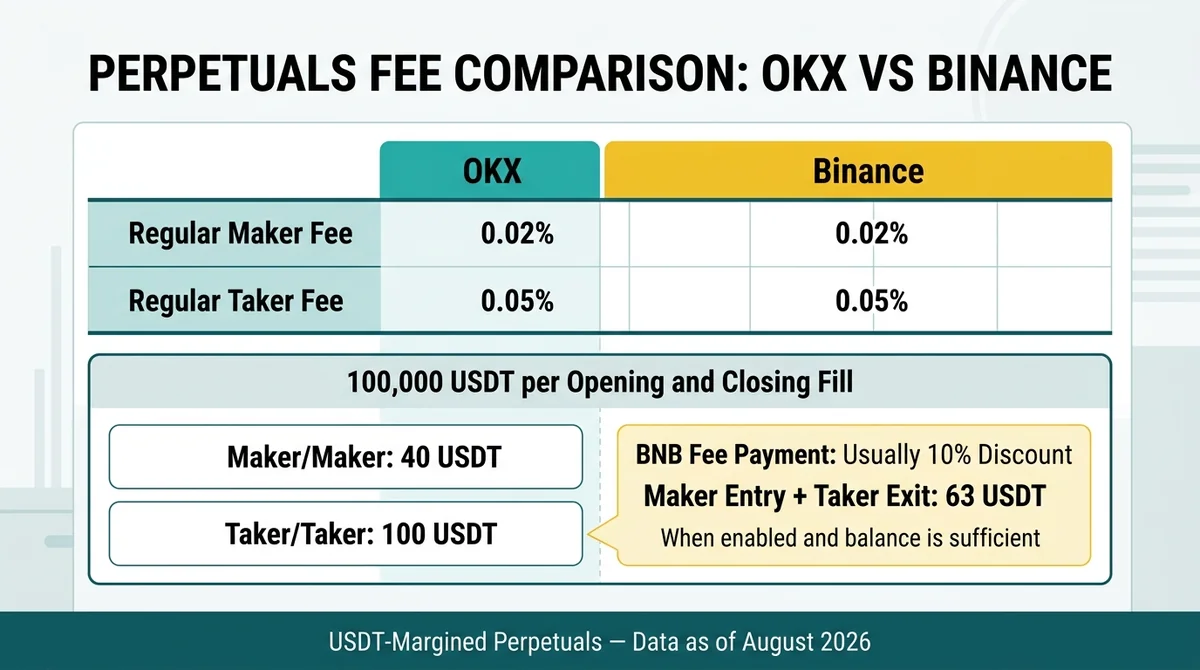
- As of August 2026, OKX and Binance have the same standard USDT-margined perpetual futures rates for regular users: 0.02% for Maker trades and 0.05% for Taker trades.
- The futures trading fee for each fill should be verified using “actual executed notional × the applicable Maker or Taker rate.” Do not substitute the order amount or margin for executed notional.
- If both the opening and closing fills have an executed notional of 100,000 USDT, a Maker/Maker round trip costs 40 USDT, while a Taker/Taker round trip costs 100 USDT.
- When Binance users enable BNB fee payment and maintain a sufficient balance, futures trading fees usually receive a 10% discount. At the same executed notional, a Maker entry followed by a Taker exit costs 63 USDT in total.
- For OKX VIP7 through VIP9, distinguish between Group 1 and Group 2. Binance VIP status is determined by both 30-day futures trading volume and BNB holding requirements.
Data scope: This article compares USDT-margined perpetual futures. Fee data is current as of August 2026, and the OKX VIP schedule reflects the adjustment effective April 8, 2026. Actual charges should still be verified against fill records, account tier, and discount status.
#What Do You Need Before Verifying OKX and Binance Futures Trading Fees?
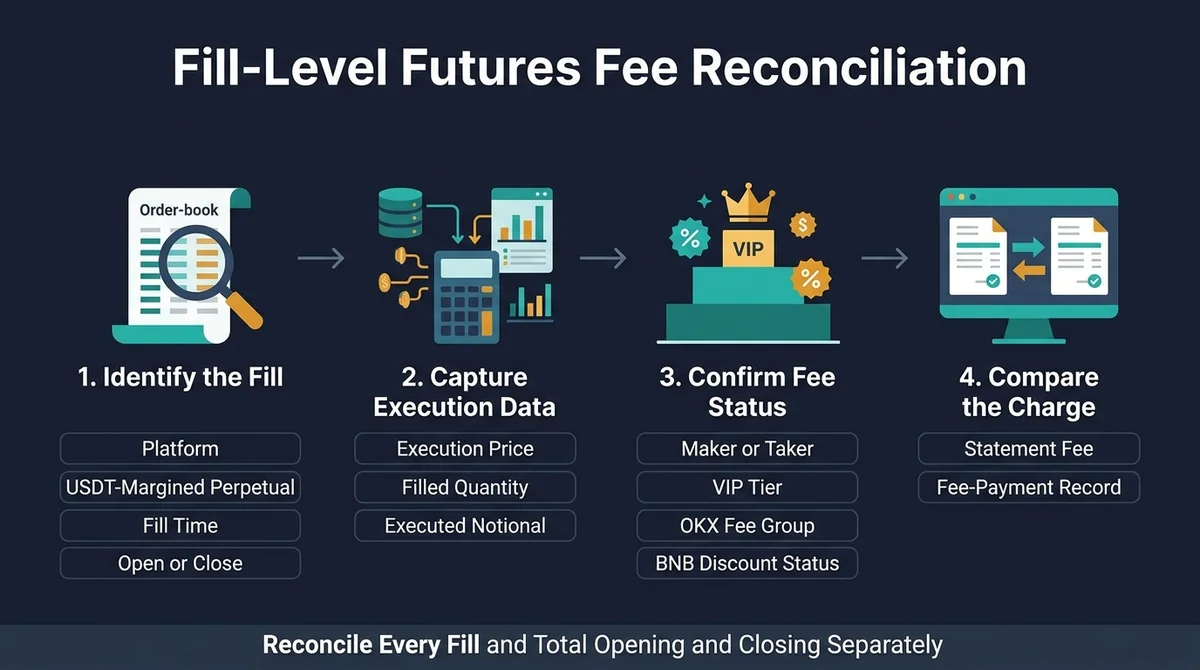
Before checking charges on OKX and Binance, export the executed notional, liquidity role, account fee tier, fee amount, and discount record for every fill. Opening and closing transactions should be totaled separately.
#Which Fill Fields Should You Export From OKX and Binance Statements?
Use each individual fill as the unit of reconciliation rather than reviewing only the entire order. Maker—the liquidity role for a fill generated after an order enters the order book and provides liquidity—and Taker—the role for a fill that immediately matches an existing quote and consumes liquidity—must be confirmed from fill-level details.
Think of the order book as a store shelf. A Maker is like a seller who places an item and its price on the shelf and waits for someone else to trade. A Taker is like a customer who accepts the price already on the shelf and buys the item immediately. This analogy is only intended to explain liquidity roles; the applicable rate must ultimately be determined from the role shown on each fill record.
Organize the following fields:
- Platform: OKX or Binance;
- Contract: confirm that it is a USDT-margined perpetual;
- Fill time: used to match the account tier applicable at that time;
- Opening or closing direction;
- Actual execution price and filled quantity;
- Actual executed notional;
- Maker or Taker role;
- VIP tier and OKX fee group;
- Trading fee deducted on the statement;
- BNB discount status and fee-payment record.
If you first need to understand the calculation basis for regular users trading with the same principal, refer to the 2026 Binance and OKX regular-user fee calculation guide.
#How Do You Distinguish Executed Notional, Margin, and the Actual Account Charge?
Executed notional—the actual execution price multiplied by the filled quantity—is the basis for calculating trading fees. Margin—the funds supporting a leveraged position and absorbing unrealized losses—only reflects the capital allocated to the position and cannot be used directly as the fee-calculation basis.
Record the three items separately:
| Reconciliation item | 2026 calculation basis | Used directly in the fee formula |
|---|---|---|
| Actual executed notional | Price multiplied by quantity for each fill record | Yes |
| Margin | Account funds supporting a leveraged position | No |
| Actual account charge | Fee-payment result recorded on the platform statement | Used to compare against the manual calculation |
Leverage changes margin usage and liquidation risk, but it does not change the fee-calculation basis directly to margin. A lower fee rate also does not mean lower overall position risk, as price volatility can still trigger liquidation.
#Why Should You Record the Liquidity Roles for Opening and Closing Separately?
A futures round trip includes at least an opening side and a closing side, and each side may execute as either Maker or Taker. Recording only the opening fee omits the closing charge, while treating a one-way fee as the round-trip cost understates the actual expense.
Common execution paths include:
- Maker entry and Maker exit;
- Maker entry and Taker exit;
- Taker entry and Maker exit;
- Taker entry and Taker exit.
The executed notional may also differ between the opening and closing sides. Calculate each side separately and then add them together; do not assume that the round-trip fee must equal twice the one-way fee.
#How Do You Prepare Futures Fee Calculation Data From Executed Notional?
For regular users, the standard USDT-margined perpetual rate is 0.02% for Maker trades and 0.05% for Taker trades on both OKX and Binance. Each fill can be verified by multiplying its executed notional by the applicable rate.
As of August 2026, the regular-user USDT-margined perpetual Maker rate is 0.02% and the Taker rate is 0.05% on both OKX and Binance.
#What Is the Formula for the Trading Fee on a Single Futures Fill?
At standard rates, the basic formula for the fee on a single futures fill is:
单笔手续费 = 该笔实际成交额 × 对应Maker或Taker费率
For example, a Maker fill with an actual executed notional of 100,000 USDT incurs a fee of 20 USDT at 0.02%. If the same notional executes as Taker, the fee is 50 USDT at 0.05%.
#How Should Maker and Taker Fills Be Classified and Totaled?
A partially filled order—an order completed through multiple fills—may generate several records, and those records do not necessarily have the same liquidity role. The correct method is to calculate each fill first and then subtotal the results by Maker, Taker, opening, and closing categories.
Use the following table as a reconciliation worksheet:
| Fill time | Open or close | Actual executed notional | Liquidity role | Applicable rate | Manually calculated fee | Statement fee |
|---|---|---|---|---|---|---|
| Enter each fill | Open or close | USDT | Maker or Taker | Actual account tier | Executed notional × rate | Statement record |
Part of a limit order may rest on the order book while another part executes immediately. Therefore, you cannot conclude that an entire order received the Maker rate simply because it was labeled a limit order.
#How Many Fills Must Be Included in a Futures Round-Trip Fee Calculation?
A complete round trip must include at least the opening and closing sides, but either side may be split into multiple actual fills. Reconciliation requires all fill details rather than mechanically calculating only two order records.
A futures round-trip fee equals the sum of all opening-fill fees and all closing-fill fees. When an execution is split, calculate each record separately using its executed notional and liquidity role.
To compare one-way and round-trip calculation methods in more detail, read the Binance vs OKX Same-Capital Spot and Perpetual Cost Calculation Guide.
#Which OKX and Binance Maker and Taker Rate Tier Should You Use?
Regular users receive the same standard rates. For VIP users, OKX offers qualification paths based on either trading volume or assets, while Binance considers both 30-day futures trading volume and BNB holding requirements.
#OKX vs Binance USDT-Margined Perpetual Maker and Taker Rate Comparison for 2026
| User tier | OKX Maker rate | OKX Taker rate | OKX tier requirement: trading volume or assets | Binance Maker rate | Binance Taker rate | Binance tier requirement: 30-day futures volume and BNB threshold |
|---|---|---|---|---|---|---|
| Regular user | 0.02% | 0.05% | Volume below USD 5 million or assets below USD 100,000 | 0.02% | 0.05% | Volume below USD 5 million; BNB below 5 |
| VIP1 | 0.016% | 0.045% | Volume of at least USD 5 million or assets of at least USD 100,000 | 0.018% | 0.05% | Volume of at least USD 5 million; BNB of at least 5 |
| VIP2 | 0.015% | 0.036% | Volume of at least USD 10 million or assets of at least USD 200,000 | 0.016% | 0.04% | Volume of at least USD 10 million; BNB of at least 25 |
| VIP3 | 0.01% | 0.028% | Volume of at least USD 50 million or assets of at least USD 2 million | 0.012% | 0.032% | Volume of at least USD 50 million; BNB of at least 100 |
| VIP4 | 0.008% | 0.027% | Volume of at least USD 200 million or assets of at least USD 5 million | 0.01% | 0.03% | Volume of at least USD 600 million; BNB of at least 500 |
| VIP5 | 0.005% | 0.026% | Volume of at least USD 600 million or assets of at least USD 20 million | 0.008% | 0.027% | Volume of at least USD 1 billion; BNB of at least 1,000 |
| VIP6 | 0% | 0.025% | Volume of at least USD 1 billion or assets of at least USD 50 million | 0.006% | 0.025% | Volume of at least USD 2.5 billion; BNB of at least 1,750 |
| VIP7 | G1 -0.002% / G2 -0.005% | G1 0.02% / G2 0.025% | Volume of at least USD 1.5 billion or assets of at least USD 100 million | 0.004% | 0.022% | Volume of at least USD 5 billion; BNB of at least 3,000 |
| VIP8 | G1 -0.005% / G2 -0.01% | G1 0.02% / G2 0.025% | Volume of at least USD 2 billion or assets of at least USD 250 million | 0.002% | 0.02% | Volume of at least USD 12.5 billion; BNB of at least 4,500 |
| VIP9 | G1 -0.005% / G2 -0.01% | G1 0.015% / G2 0.02% | Volume of at least USD 20 billion or assets of at least USD 500 million | 0% | 0.017% | Volume of at least USD 25 billion; BNB of at least 5,500 |
OKX rate notes: VIP7 through VIP9 must distinguish between Group 1 and Group 2 based on the specific contract. A negative Maker rate represents a rebate rather than a deduction from the account at a positive rate. The OKX tiers in the table reflect the schedule adjusted on April 8, 2026.
Binance rate notes: Binance VIP status is determined by both 30-day futures trading volume and BNB holding requirements. The table lists standard rates and does not incorporate the 10% discount for paying futures trading fees with BNB directly into the VIP rates.
How to verify sources: During reconciliation, review the OKX futures fee-tier table and the Binance USDT-margined futures rates and VIP rules separately. Use the version applicable on the fill date. The actual tier shown on the account page and the fill statement take priority over static examples.
As of August 2026, both platforms have the same futures rates for regular users. At VIP levels, however, OKX and Binance differ in qualification thresholds, rates, and high-tier grouping methods.
If your trading volume is close to an upgrade threshold, use the 2026 In-Depth Perpetual Futures VIP Fee Comparison to examine different account qualification paths instead of comparing only the lowest available rate.
#How Is Binance’s 10% BNB Futures Fee Discount Applied?
Paying Binance futures trading fees with BNB usually provides a 10% discount, meaning the standard fee is multiplied by 90%. You must enable BNB fee payment and maintain a sufficient BNB balance. The standard rate table itself continues to show the pre-discount rates.
For regular users, the discounted calculations are:
- Maker: 0.02% × 90% = 0.018%;
- Taker: 0.05% × 90% = 0.045%;
- Discounted fee: actual executed notional × standard rate × 90%.
How to verify the discount: Check Binance’s BNB fee-discount rules, the account discount toggle, the BNB balance, and the asset used to pay the fee for each fill. Seeing only the standard rate does not prove that a particular fill received the 10% discount.
#How Do You Calculate Opening, Closing, and Round-Trip Futures Trading Fees?
Opening and closing fills should be calculated independently using their respective executed notional and liquidity roles. When each side has an executed notional of 100,000 USDT, three common execution paths cost 40, 70, and 100 USDT, respectively.
#One-Way Fee on 100,000 USDT of Executed Notional
| Role for a single fill | Regular-user standard rate | Actual notional for one fill | 2026 one-way fee |
|---|---|---|---|
| OKX or Binance Maker fill | 0.02% | 100,000 USDT | 20 USDT |
| OKX or Binance Taker fill | 0.05% | 100,000 USDT | 50 USDT |
The 100,000 USDT shown here is the actual one-way executed notional, not margin. Even when leverage is used, read the executed notional from the fill details and multiply it by the applicable rate.
#How Do You Calculate Maker/Maker, Taker/Taker, and Mixed Executions?
| Round-trip execution path | Opening fee | Closing fee | Standard round-trip fee |
|---|---|---|---|
| Maker entry + Maker exit, 100,000 USDT each | 20 USDT | 20 USDT | 40 USDT |
| Maker entry + Taker exit, 100,000 USDT each | 20 USDT | 50 USDT | 70 USDT |
| Taker entry + Maker exit, 100,000 USDT each | 50 USDT | 20 USDT | 70 USDT |
| Taker entry + Taker exit, 100,000 USDT each | 50 USDT | 50 USDT | 100 USDT |
When both the opening and closing fills have an executed notional of 100,000 USDT, a Maker/Maker round trip costs 40 USDT, a Taker/Taker round trip costs 100 USDT, and a mixed Maker/Taker round trip costs 70 USDT.
#How Do You Verify Round-Trip Fees After Binance’s 10% BNB Discount?
For a regular Binance user with BNB fee payment enabled and a sufficient balance, the one-way Maker fee on 100,000 USDT falls from 20 USDT to 18 USDT, while the one-way Taker fee falls from 50 USDT to 45 USDT.
| Binance round-trip path | Opening fee after 10% BNB discount | Closing fee after 10% BNB discount | Round-trip fee after 10% BNB discount |
|---|---|---|---|
| Maker + Maker, 100,000 USDT each | 18 USDT | 18 USDT | 36 USDT |
| Maker + Taker, 100,000 USDT each | 18 USDT | 45 USDT | 63 USDT |
| Taker + Taker, 100,000 USDT each | 45 USDT | 45 USDT | 90 USDT |
If the statement does not show the expected discount, first check the BNB payment toggle, balance, and actual fee records. Do not treat 0.018% or 0.045% as permanent standard rates for the account.
#How Do You Verify Actual Charges and Troubleshoot Common Calculation Errors?
When the statement and manual calculation do not match, check the executed notional, liquidity role, VIP tier, OKX fee group, BNB discount status, and fee-payment record in that order.
#Futures Trading Fee Statement Reconciliation Steps
- Confirm the product scope: Verify that the records are for USDT-margined perpetual futures and do not include spot trades or other contract products.
- Export fill-level records: Do not substitute the total order amount for actual executed notional. Every partial fill must be listed separately.
- Confirm the liquidity role: Use the Maker or Taker label shown on each fill record. Do not infer the role solely from whether the order was a limit or market order.
- Match the account rate: Confirm the VIP tier applicable at the fill time. High-tier OKX accounts must also verify whether the contract belongs to Group 1 or Group 2.
- Calculate each fee: Use “actual executed notional × applicable rate.” When the Binance BNB discount applies, multiply the standard fee by 90%.
- Total opening and closing fees: Subtotal Maker, Taker, opening, and closing records separately to calculate the complete round-trip fee.
- Compare the result with the statement charge: Verify the fee amount, payment asset, discount status, and rate version, and document every discrepancy.
These steps can be converted directly into a reconciliation checklist. If individual-fill results match but the total does not, first check for omitted partial fills, closing records, or different liquidity roles rather than changing the rate immediately.
#Which Errors Most Commonly Cause Manual Calculations to Differ From Statements?
Common errors include:
- Treating margin as actual executed notional;
- Classifying an entire order as Maker;
- Calculating only the opening fee and omitting the closing fee;
- Assuming that opening and closing notional values are identical;
- Using the current VIP tier to recalculate earlier fills;
- Ignoring the difference between OKX Group 1 and Group 2 for VIP7 through VIP9;
- Applying the 10% BNB discount without checking the payment toggle and balance;
- Treating trading fees and funding rate payments as the same cost item.
#Is Comparing Maker and Taker Rates Enough for Large Trades?
No. The rate table in this article can only be used to verify platform trading fees; it does not represent the full execution cost of a large trade. When reviewing a large BTC or other futures transaction, examine the execution price, filled quantity, partial fills, and final charges in the actual fill records. This article does not provide order-book depth or slippage data and therefore does not draw conclusions about large-trade execution quality on either platform.
For large futures trades, the fee rate is a directly calculable cost, but it is not the entire cost. Without order-book depth and slippage data, standard rates of 0.02% or 0.05% alone cannot determine which platform has the lower final execution cost.
#What Is the Difference Between Trading Fees and Funding Rate Payments?
A trading fee is calculated from executed notional and the Maker or Taker rate when an order fills. Funding rate payments occur between long and short holders of perpetual futures according to a settlement interval. The two should be tracked separately on statements; funding rate payments must not be included in Maker or Taker trading fees.
Binance usually settles funding rate payments every eight hours, although the interval may be adjusted to four hours or one hour under extreme conditions. OKX uses an eight-hour interval by default but may adjust individual contracts to six, four, two, or one hour. Always use the settlement rules displayed for the relevant contract at that time.
#Frequently Asked Questions About OKX and Binance Futures Rates
#Which Platform Has Lower Futures Rates for Regular Users, OKX or Binance?
Both platforms have the same standard rates for regular users trading USDT-margined perpetual futures: 0.02% for Maker trades and 0.05% for Taker trades. Binance futures trading fees usually receive a 10% discount when BNB payment is enabled and the balance is sufficient. Actual charges still depend on the liquidity role, account tier, and discount record.
#Is a Limit Order Always Charged at the Maker Rate?
No. The rate depends on the actual liquidity role, not the order name. A limit order may produce a Taker fill if it immediately matches an existing quote. Partial fills may also include both Maker and Taker records, so review each fill individually.
#Is a Futures Round-Trip Fee Always Twice the One-Way Fee?
Only when the opening and closing sides have the same executed notional and rate. If both sides are 100,000 USDT and execute as Maker, the one-way fee is 20 USDT and the round-trip total is 40 USDT. If the exit executes as Taker, the standard round-trip cost becomes 70 USDT.
#How Do You Calculate Binance Futures Trading Fees After the BNB Discount?
Binance futures trading fees are usually calculated by multiplying the standard fee by 90%. For a regular user, a 100,000 USDT Maker fill costs 18 USDT and a Taker fill costs 45 USDT, provided that BNB payment is enabled, the balance is sufficient, and the discount appears in the fee record.
#How Often Are Funding Rate Payments Settled on OKX and Binance?
Binance usually settles every eight hours, although the interval may be adjusted to four hours or one hour under extreme conditions. OKX uses eight hours by default but may adjust individual contracts to six, four, two, or one hour. Funding intervals can change, so use the rules displayed for the relevant contract at that time.
#Can Margin Be Used Directly to Calculate Futures Trading Fees?
No. Futures trading fees are based on actual executed notional, while margin only represents the funds allocated to a leveraged position. During reconciliation, read the execution price and quantity from each fill record, calculate the executed notional, and then multiply it by the Maker or Taker rate.
#How Do You Verify Fees When One Order Is Split Into Multiple Fills?
Calculate each fill separately and then total the results. For every record, independently confirm the executed notional, Maker or Taker role, and applicable rate. One order can generate multiple fill records, and those records do not necessarily have the same liquidity role.
#Why Can’t the Current VIP Rate Be Used to Recalculate Historical Fees Directly?
Historical fills must be matched to the account tier and fee rules applicable at the time of execution. If the account was upgraded or downgraded later, the rate currently displayed may not apply to older trades. For OKX VIP7 through VIP9, you must also confirm the specific contract group.
#Should Large BTC Futures Trades Be Evaluated Only by the Lowest Fee Rate?
No. The lowest fee rate reflects only the rate-based cost and does not represent the full execution cost. This article does not provide OKX or Binance order-book depth or slippage data. Large trades should therefore be reviewed using your own fill prices, partial-fill records, and actual charges.
#How Can You Confirm That Binance’s 10% BNB Fee Discount Actually Applied?
Check the BNB payment toggle, BNB balance, and fill-level fee-payment records in the account. A trade received the discount only if the statement shows the corresponding deduction result. Do not treat 0.018% or 0.045% as permanent fixed rates for the account.
#What Does a Negative Maker Rate Mean?
A negative Maker rate means that an eligible fill may generate a rebate instead of a fee deduction at a positive rate. In this article’s table, negative rates appear only for certain high OKX VIP tiers and contract groups. Confirm the actual result using the specific contract, account tier, and statement record.
#Conclusion: Verifying OKX and Binance Futures Trading Fees
An OKX and Binance futures fee comparison cannot be based on a single percentage in a rate table. Regular users trading USDT-margined perpetual futures pay standard rates of 0.02% for Maker trades and 0.05% for Taker trades on both platforms, but actual charges also depend on fill-level executed notional, opening and closing roles, VIP tier, OKX fee group, and Binance BNB discount status.
The most reliable approach is to calculate every fill separately, total opening and closing fees independently, and compare the result with the statement. Fee rates can help estimate trading costs, but they cannot replace margin and liquidation-risk management. For large trades, Maker and Taker rates alone cannot determine platform execution quality without order-book depth and slippage data.
FAQ
Which platform has lower futures rates for regular users, OKX or Binance?
Both platforms have the same standard rates for regular users trading USDT-margined perpetual futures: 0.02% for Maker trades and 0.05% for Taker trades. Binance futures trading fees usually receive a 10% discount when BNB payment is enabled and the balance is sufficient.
Is a limit order always charged at the Maker rate?
No. The rate depends on the actual liquidity role, not the order name. A limit order may produce a Taker fill if it immediately matches an existing quote, and partial fills may include both Maker and Taker records.
Is a futures round-trip fee always twice the one-way fee?
Only when the opening and closing sides have the same executed notional and rate. If both sides are 100,000 USDT and execute as Maker, the one-way fee is 20 USDT and the round-trip total is 40 USDT.
How do you calculate Binance futures trading fees after the BNB discount?
Binance futures trading fees are usually calculated by multiplying the standard fee by 90%. For a regular user, a 100,000 USDT Maker fill costs 18 USDT and a Taker fill costs 45 USDT, provided that BNB payment is enabled and the balance is sufficient.
How often are funding rate payments settled on OKX and Binance?
Binance usually settles every eight hours, although the interval may be adjusted to four hours or one hour under extreme conditions. OKX uses eight hours by default but may adjust individual contracts to six, four, two, or one hour.
Related Terms
Want to see the real data for this concept?
After you sign up, you can view live prices, funding rates, and fees for the related assets.
View live prices and fees →