Spot vs Perpetual Futures: 2026 In-Depth Comparison of Funding Rates and Holding Costs
Spot vs perpetual futures: spot holds assets, no liquidation risk; perpetual futures are leveraged, no expiry, funding rate every 8h tracks spot.
Answer: Spot trading means directly holding digital assets, with prices moving with the market. Perpetual futures are leveraged contracts with no expiry date that allow both long and short positions. The perpetual futures funding rate settlement schedule regularly settles to keep the contract price anchored to the spot price. This article is for educational purposes only and does not constitute investment advice.
#What Are the Core Differences Between Spot and Perpetual Futures?
Spot trading involves directly buying and selling digital assets — once you buy, they are yours. Perpetual futures are contracts with no expiry date; they support leverage and short selling. The perpetual futures funding rate settlement schedule keeps the contract price from deviating too far from spot. Here's a table to understand the differences at a glance:
| Comparison | Spot | Perpetual Futures |
|---|---|---|
| Own the asset? | Yes | No, just a contract |
| Leverage | Usually none or low | Can use high leverage |
| Expiry date | None | None |
| Can short? | More difficult | Yes |
| Price anchoring | The spot price itself | Anchored via funding rate |
The funding rate is like a balancing fee when capital supply and demand are imbalanced — similar to how an air conditioner's thermostat automatically adjusts the temperature to keep the contract price close to the spot price. When there are too many longs, longs pay shorts, pushing the contract price back down; conversely, when there are too many shorts, shorts pay longs.
#What Are the Pros and Cons of Spot Trading?
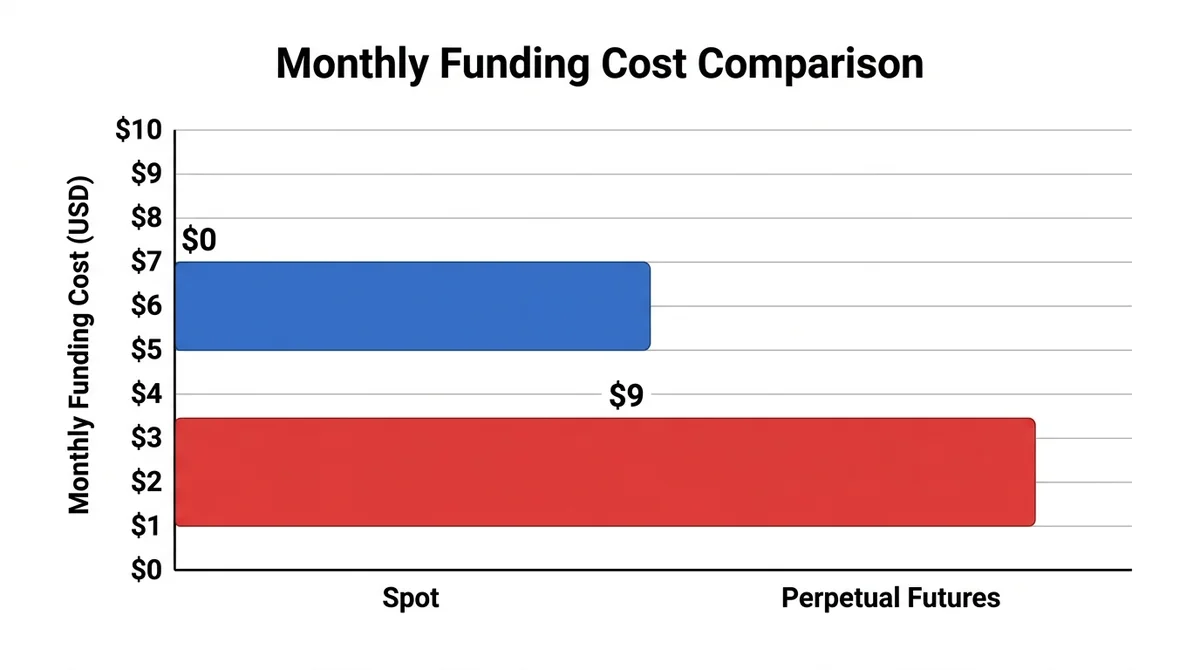
Pros: You directly own the asset, with no liquidation risk. Long-term holding costs are mainly trading fees, with no funding rate costs.
Cons: Capital efficiency is lower; you can usually only go long, and you profit only when prices rise. When prices fall, you can only wait for a rebound or sell to cut losses. Additionally, spot trading cannot use leverage to amplify returns.
For users with a long-term bullish view on digital assets, spot dollar-cost averaging (DCA) is a common strategy. Regularly buying a fixed amount helps average out the cost and avoids buying all at once at a high. The key to DCA is choosing the right asset and having the patience to hold long term.
#What Are Perpetual Futures? How Does the Funding Rate Affect Holding Costs?
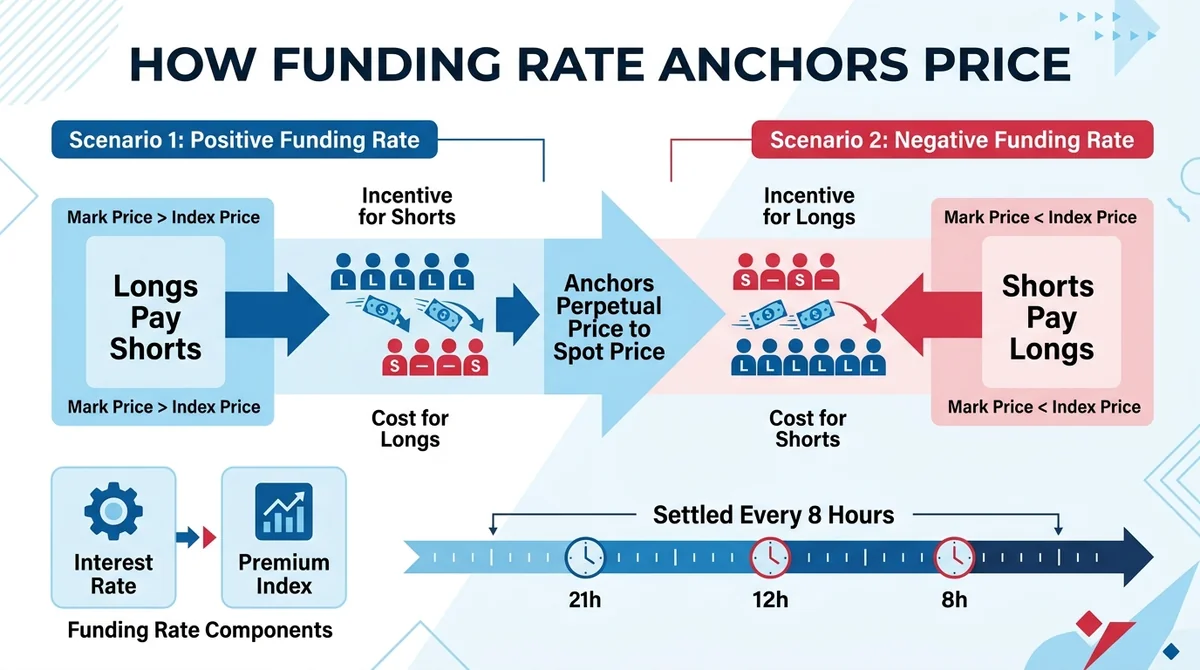
Perpetual futures are derivative contracts with no expiry date. They allow both long and short positions and leverage. The perpetual futures funding rate settlement schedule keeps the contract price anchored to the spot price.
Holding costs mainly consist of trading fees and funding rates. If you frequently pay funding rates, costs can add up. For details on the calculation, see What Is the Funding Rate?.
Note: High leverage amplifies both profits and losses. Beginners should not start with high leverage.
#How Does Perpetual Futures Funding Rate Work? Holding Cost Example
The funding rate is usually settled at fixed intervals, commonly every 8 hours. The rate consists of two parts: an interest rate component and a premium index component. When the contract price is higher than the spot price, the funding rate is positive, and longs pay shorts; when it is lower, the rate is negative.
Example: Suppose a contract's funding rate is 0.01%, and you hold a long position worth $1,000, settled every 8 hours. A single funding payment = 1,000 × 0.01% = $0.10. Settled three times a day, the daily cost is about $0.30. If you hold for one month (30 days), the funding rate cost is about $9. This is only an example calculation; actual rates fluctuate with the market. Frequent trading fees also add up, so holding costs should not be ignored.
Liquidation is one of the biggest risks in perpetual futures. When you use leverage, exchanges require you to maintain a certain margin ratio. If the market moves against you and margin falls short, your position will be force-liquidated. For example, if you go long with 10x leverage, a 10% price drop will wipe out your entire principal. Therefore, position management and stop-loss settings are far more important than in spot trading.
#Risks and Use Cases: How Should Beginners Choose?
Spot risk mainly comes from price fluctuations, with no liquidation. Perpetual futures add leverage and liquidation risk on top. Suitable scenarios:
- Spot: long-term holding, DCA, first-time exposure to digital assets.
- Perpetual futures: short-term trading, hedging spot risk, small position attempts after gaining experience.
Beginners usually start with spot to understand the market. If trying perpetual futures, use only a small position, avoid high leverage, and prioritize risk control.
Beginner Selection Steps:
- First assess your risk tolerance. If losing your principal is unacceptable, stick to spot only.
- Learn basic trading knowledge, including candlestick charts, order types, and fee structures.
- Practice perpetual futures with a demo account or small funds to become familiar with the liquidation mechanism and funding rate settlement.
- Gradually increase position size, always set stop losses, and never hold losing positions hoping for a reversal.
For a more detailed beginner comparison, see What's the Difference Between Spot and Perpetual Contracts?. This article only covers concepts and is not investment advice. When you're ready to practice, you can check out the live trading tools on the main MSX site, and see more concepts in the MSX Learn glossary.
#Frequently Asked Questions
Question: What is the biggest difference between spot and perpetual futures? Answer: Spot means directly owning digital assets, and the price is the market price. Perpetual futures are leveraged contracts without asset ownership, and they use the perpetual futures funding rate settlement schedule to keep the contract price close to spot.
Question: Do you pay the funding rate on every trade? Answer: No, the funding rate is not paid on every trade. It is settled between longs and shorts at fixed intervals set by the platform (e.g., every few hours). It only applies if you hold a position across the settlement time.
Question: Can beginners trade perpetual futures directly? Answer: Beginners are not advised to trade perpetual futures directly. It's better to first get familiar with the market through spot trading. If you do try perpetual futures, use only a small position, avoid high leverage, and set stop losses.
Question: What does the holding cost of perpetual futures include? Answer: Holding costs mainly include trading fees and funding rates. If you use leverage, borrowing fees or margin-related costs may also apply. Frequent trading and long-term holding can accumulate costs.
Question: How does perpetual futures funding rate work? Answer: The funding rate usually consists of an interest rate component and a premium index component, and is settled at fixed intervals (e.g., every 8 hours). It reflects the cost difference between long and short capital and is used to bring the contract price back toward the spot price. The exact formula varies slightly by platform, but the principle is the same.
Question: How long do you need to hold a position before funding rate costs apply? Answer: Funding rate costs only apply if your position is open across the funding rate settlement time. If you close before each settlement, you won't pay the funding rate. However, frequent opening and closing generates more trading fees, so the overall cost may not be lower.
FAQ
What is the biggest difference between spot and perpetual futures?
Spot means directly owning digital assets, and the price is the market price. Perpetual futures are leveraged contracts without asset ownership, and they use the perpetual futures funding rate settlement schedule to keep the contract price close to spot.
Do you pay the funding rate on every trade?
No, the funding rate is not paid on every trade. It is settled between longs and shorts at fixed intervals set by the platform (e.g., every few hours). It only applies if you hold a position across the settlement time.
Can beginners trade perpetual futures directly?
Beginners are not advised to trade perpetual futures directly. It's better to first get familiar with the market through spot trading. If you do try perpetual futures, use only a small position, avoid high leverage, and set stop losses.
What does the holding cost of perpetual futures include?
Holding costs mainly include trading fees and funding rates. If you use leverage, borrowing fees or margin-related costs may also apply. Frequent trading and long-term holding can accumulate costs.
Related Terms
Want to see the real data for this concept?
After you sign up, you can view live prices, funding rates, and fees for the related assets.
View live prices and fees →