What Is a Crypto Wallet? Hot, Cold, and Custodial Wallets
Crypto wallets manage private keys and addresses, not coins. Learn the differences between hot, cold, and custodial wallets and key security risks.
A cryptocurrency wallet is a tool for managing private keys and addresses; it doesn't store any coins—assets are recorded on the blockchain. The core functions of a wallet are to generate private keys, derive addresses, and sign transactions.
#What Is a Cryptocurrency Wallet?
Many people mistakenly think wallets hold coins, but they don't. A wallet is simply a tool for managing private keys and addresses. The private key is your proof of control over assets, while the address is the public account for receiving assets. Assets always remain on the blockchain; the wallet helps you interact with on-chain records.
Here's an analogy: a wallet is like a keychain, and the blockchain is like a public safe. You need the key in your hand to open your compartment in the safe, but the money is not inside the key.
Wallets can be classified along two dimensions:
- By whether the private key is connected to the internet: hot wallets (online) and cold wallets (offline).
- By who controls the private key: custodial wallets (platform controls the private key) and non-custodial wallets (user controls the private key).
#How Do Hot and Cold Wallets Work?
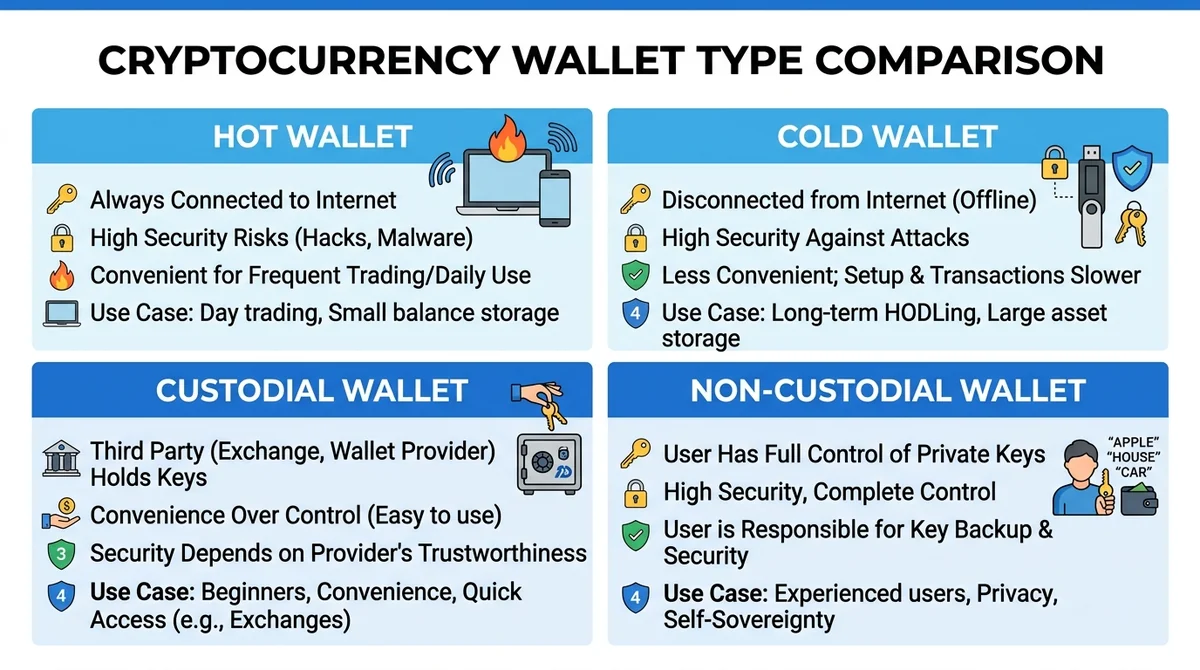
- Hot wallet: The private key is stored on an internet-connected device, such as a mobile app or browser extension. Transactions are fast, making them suitable for everyday small amounts; however, being online means they are more vulnerable to phishing, malware, and other cyberattacks.
- Cold wallet: The private key is kept offline, commonly in the form of a hardware wallet (similar to a USB drive) or a paper wallet. It offers higher security and is ideal for long-term storage of large amounts; however, transfers involve more steps.
#What Is the Difference Between Custodial and Non-Custodial Wallets?
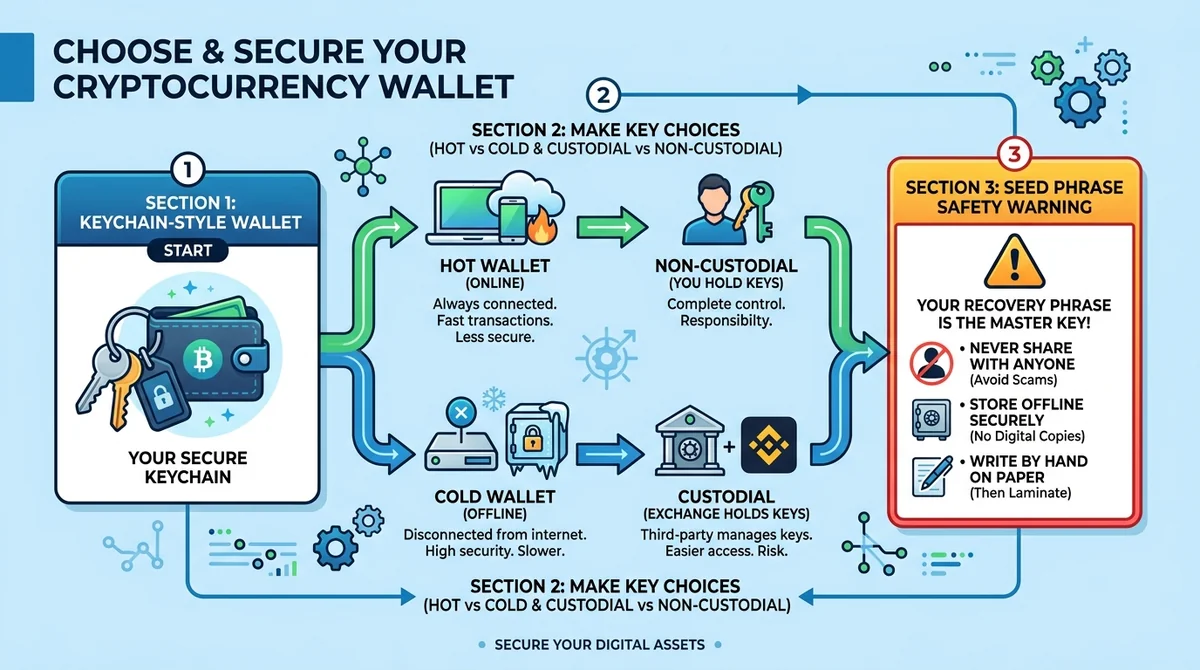
- Custodial wallet: The private key is held by a centralized platform, and users operate through their platform account. It has a low entry barrier and is easy for beginners; however, if the platform is hacked or mismanaged, assets may be lost.
- Non-custodial wallet: The private key is fully controlled by the user, so asset control rests in your own hands; however, you are also fully responsible for backup and safekeeping.
An analogy: a hot wallet is like a wallet you carry around—convenient but easy to steal; a cold wallet is like a home safe—secure but inconvenient to access; a custodial wallet is like a bank safe deposit box where the bank holds a spare key—convenient but with trust costs.
#How Should Beginners Choose? What Are the Security Risks?
Your choice should depend on your asset size and usage frequency:
- Daily small amounts, frequent trading → hot wallet.
- Large amounts, long-term holding → cold wallet.
- Beginners can start with a custodial wallet to learn the basic workflow, understand the concept of private keys, and then gradually move to a non-custodial wallet, using hot/cold wallets to manage different assets.
The biggest risk is the leakage of your private key or seed phrase. Once your private key is leaked, someone else can directly transfer your on-chain assets. Your seed phrase must be kept offline and written by hand—never screenshot it, never store it in cloud storage, and never send it to anyone.
Digital assets are high-risk. This article is for conceptual introduction only and does not constitute investment advice.
FAQ
Does a cryptocurrency wallet store coins?
No. A wallet is just a tool for managing private keys and addresses; assets are recorded on the blockchain. If you lose your private key, you can no longer operate your on-chain assets.
Which is safer: hot wallet or cold wallet?
A cold wallet is safer because the private key is completely offline. A hot wallet is connected to the internet and vulnerable to phishing, malware, and other cyberattacks, so it is suitable for small, frequent use.
Are custodial wallets safe?
Custodial wallets hold your private key on the platform, which is convenient, but there is a risk of the platform being hacked or running an exit scam. Non-custodial wallets let you keep your private key yourself, which is more secure, but you must handle backup on your own.
What should I do if I lose my seed phrase?
Your seed phrase is the only credential for recovering your wallet. Once lost, it is nearly impossible to recover your assets. Always keep it offline and written by hand, and never store it on your phone, computer, or cloud.
What wallet should a beginner choose?
Beginners can start with a custodial wallet to learn the basic workflow and try small amounts. Once you understand the concept of private keys, it's recommended to use a hot wallet for small amounts and a cold wallet for large long-term holdings.
Related Terms
Want to see the real data for this concept?
After you sign up, you can view live prices, funding rates, and fees for the related assets.
View live prices and fees →