What Is Isolated Margin? 2026 Crypto Futures Isolated Mode Risk Isolation Explained
Isolated margin gives each futures position its own margin, so losses stay contained. Learn how it works, differs from cross margin, and misconceptions.
Isolated margin means setting aside a separate amount of money for each contract position. If it loses money, only that position loses money, and other positions are not affected.
#What Is Isolated Margin?
Isolated margin: each contract position has its own separate margin, and losses are deducted only from that margin.
It is the opposite of cross margin mode. With cross margin, all positions share one margin pool; with isolated margin, each position has its own separate wallet.
This way, if one position is liquidated, other positions are not automatically dragged into a loss.
#How Does Isolated Margin Work?
In isolated margin mode, each position is accounted for separately.
For example, if you open a BTC long position and an ETH short position, each has its own margin.
If the BTC position loses money, it is deducted only from the BTC margin. It will not touch the ETH funds.
When the BTC position margin falls below the maintenance margin requirement, only that BTC position is liquidated.
#What Is a Practical Example of Isolated Margin?
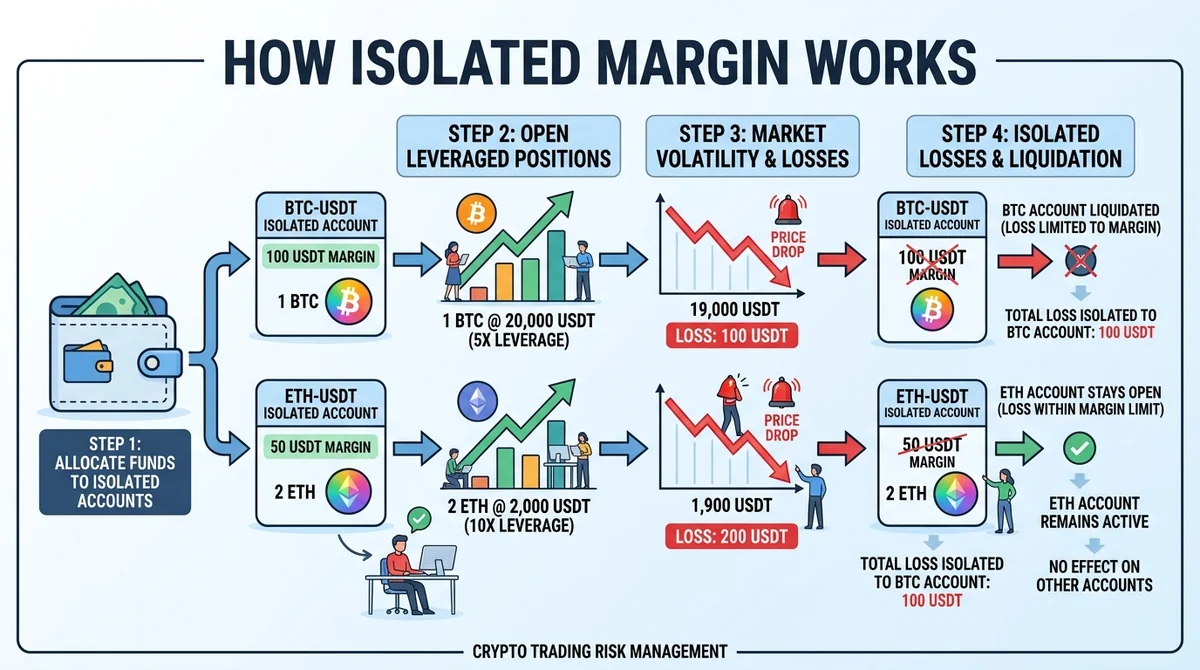
Suppose you open a BTC isolated long position with 100 USDT and an ETH isolated short position with 50 USDT.
BTC suddenly drops sharply, your BTC position is liquidated, and the maximum loss is that 100 USDT.
The ETH position is not affected. The 50 USDT margin remains intact, and the position continues to operate normally.
Think of it like two separate rooms: if one catches fire, the other will not be burned.
#Why Is Isolated Margin Important?
The biggest benefit of isolated margin is risk isolation.
Beginners tend to overestimate their ability to hold losing positions. With cross margin, a single liquidation can wipe out a large percentage of the account.
Isolated margin limits losses to a single position, making the loss visible and tangible.
It also makes it easier to judge: how much can this position lose at most, and can you accept that?
#What Are the Risks or Common Misconceptions About Isolated Margin?
Common misconception: isolated margin is safer than cross margin.
The reality is that isolated margin isolates risk, but it does not reduce the probability of liquidation for any single position.
If you allocate very little margin to a position, even a small price movement can trigger liquidation.
So with isolated margin, you need to actively monitor each position. You can't just open it and ignore it.
Digital asset futures are high risk. This article only explains concepts and does not constitute investment advice.
#What Is the Difference Between Isolated Margin and Cross Margin?
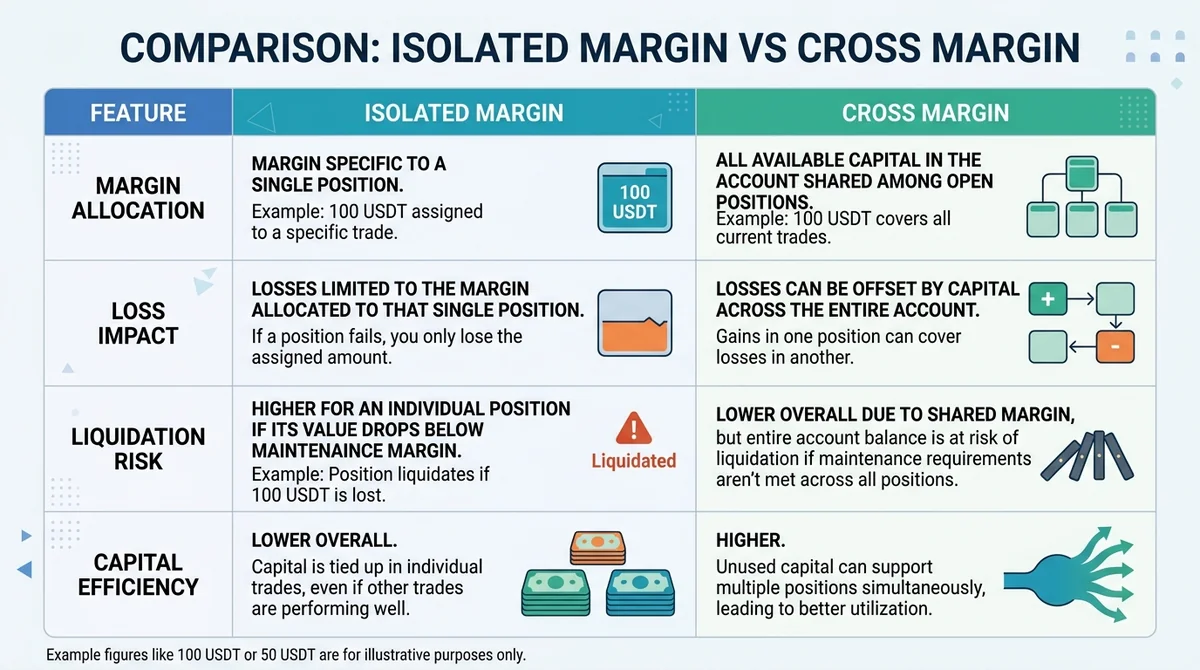
| Comparison | Isolated Margin | Cross Margin |
|---|---|---|
| Margin allocation | Separate for each position | All positions share one pool |
| Loss impact | Only affects that position | Can affect other positions |
| Liquidation risk | Each position is liquidated independently | May cause cascading liquidations |
| Capital efficiency | Lower, requires separate funds | Higher, losses can be offset across positions |
Simply put: isolated margin manages risk, cross margin manages efficiency.
For more on margin calculations, see How to Calculate Crypto Futures Margin and Leverage.
FAQ
What is isolated margin?
Isolated margin is a margin mode in crypto futures where each position is allocated its own margin. Losses are deducted only from that position and do not affect other positions.
What is the difference between isolated margin and cross margin?
With isolated margin, each position has its own separate margin, which isolates risk. With cross margin, all positions share one margin pool, which offers higher capital efficiency but means profits and losses affect each other.
In isolated margin mode, does one position's liquidation affect other positions?
No. In isolated margin mode, each position is calculated independently. If one position is liquidated, only that position's margin is lost, and other positions are not affected.
Is isolated margin safer?
Not necessarily. Isolated margin isolates risk between positions, but a single position with too little margin can still be liquidated more easily, so it requires active management.
Should beginners choose isolated margin or cross margin?
There is no standard answer. Isolated margin suits those who want to limit losses per position, while cross margin suits those who want higher capital efficiency. Fully understand the risks before choosing. This is not investment advice.
Related Terms
Want to see the real data for this concept?
After you sign up, you can view live prices, funding rates, and fees for the related assets.
View live prices and fees →