Perpetual Futures vs Delivery Futures: 2026 Settlement Mechanics, Funding Rates, and Liquidation Risk Compared
Perpetual futures have no expiry and use funding rates to anchor spot; delivery futures settle on expiry. Both have leverage and liquidation risk in 2026.
#Perpetual Futures vs Delivery Futures: 2026 Settlement Mechanics, Funding Rates, and Liquidation Risk Compared
Perpetual futures have no expiration date and use funding rates paid periodically between longs and shorts to anchor the spot price. Delivery futures have a fixed expiration date and settle physically or in cash at the agreed price. As of 2026, both support long and short positions, but leverage amplifies both gains and losses and can trigger liquidation.
#What Are Perpetual Futures and Delivery Futures?
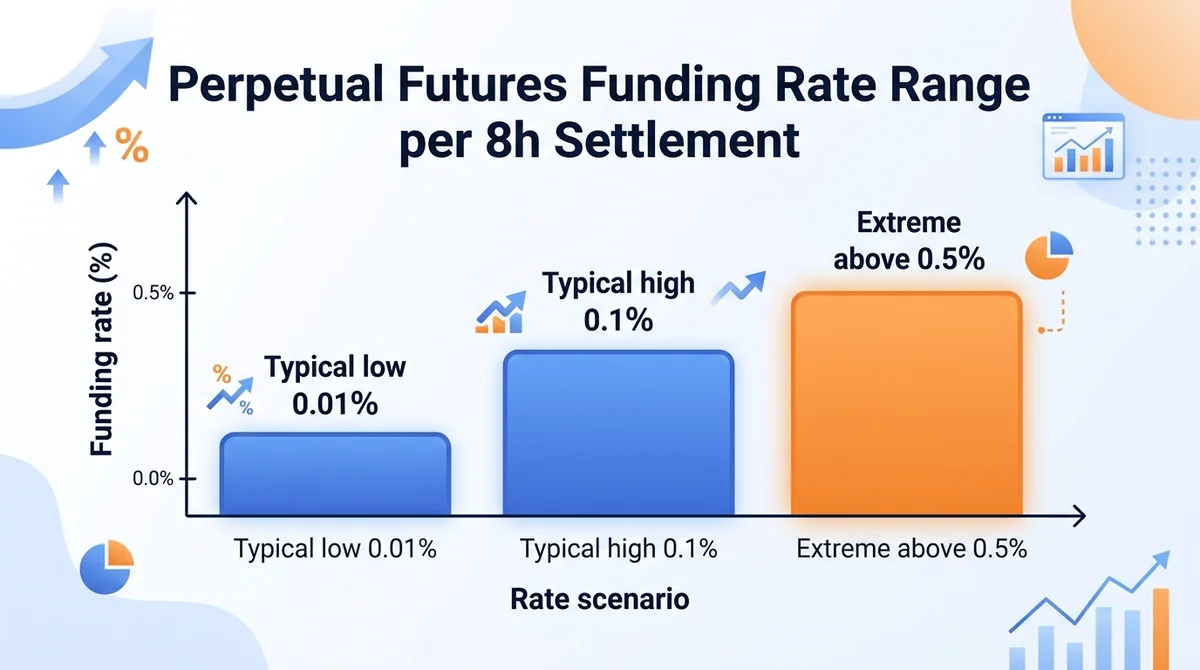
Perpetual futures: Perpetual futures are leveraged contracts with no expiration date. The contract price continuously converges to the spot price through the perpetual futures funding rate settlement schedule. As of 2026, mainstream platforms typically settle the funding rate every 8 hours, with rates ranging from 0.01% to 0.1% and possibly exceeding ±0.5% during extreme market conditions.
Delivery futures: Delivery futures have a fixed expiration date. At expiry, they settle physically or in cash at the agreed price. Near expiration, the contract price converges to the spot price, and the basis gradually approaches zero.
Common features: Both contract types support long and short positions, provide leverage, and carry liquidation risk.
| Dimension | Perpetual Futures | Delivery Futures | Explanation |
|---|---|---|---|
| Expiration date | None | Fixed date | Perpetual can be held indefinitely; delivery requires settlement at expiry |
| Settlement method | Periodic funding rate settlement | Delivery at agreed price on expiry | Funding rates do not change positions; delivery closes positions |
| Holding cost | Funding rates (longs pay shorts or vice versa) | Basis convergence near expiry | Long-term positions must account for cumulative costs |
| Use cases | Flexible holding, short-term trading, hedging | Clear delivery/hedging needs | Institutional hedging often uses delivery futures |
| Price anchoring | Funding rate pulls price back to spot index | Natural convergence before delivery | Perpetual relies on market dynamics |
#What Are Linear Contracts and Inverse Contracts?
Linear contracts: Priced and settled in stablecoins (e.g., USDT). P&L is calculated directly in USDT, making it easier for beginners to understand. For example, if you long a BTC linear contract with USDT and BTC rises 10%, your profit is 10% in USDT terms (before leverage).
Inverse contracts: Priced and settled in the underlying asset (e.g., BTC). Your profit or loss is in BTC, and margin is also in BTC. For example, if you long a BTC inverse contract and BTC rises 10%, the profit is 10% in BTC, but since BTC's value itself changes, the actual return is affected twice.
Linear and inverse are pricing dimensions of contracts, independent concepts from perpetual or delivery, and can be combined into four types.
#Settlement Mechanics: How Does Perpetual Futures Funding Rate Work?
#Delivery Futures Settlement Mechanics
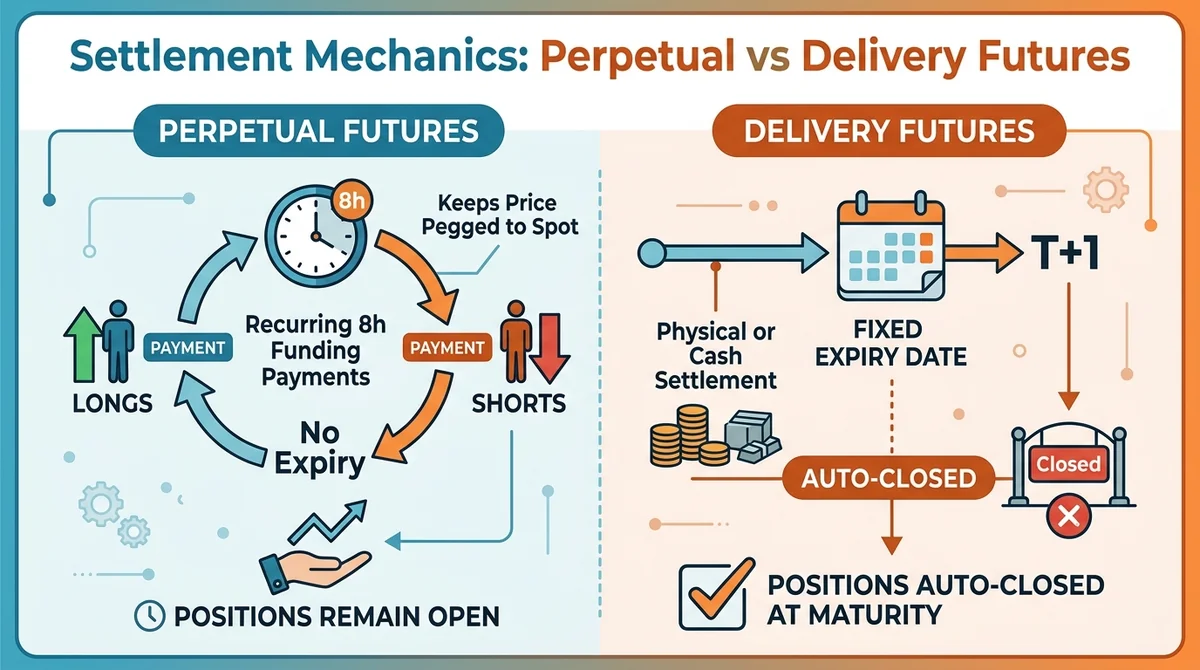
Delivery futures settle physically or in cash at the agreed price on expiration. It's like signing a forward contract to buy a house; you must fulfill it on the delivery date. The delivery price typically references the average spot index over a period before expiration (platforms vary), and positions are automatically closed after settlement.
#Perpetual Futures Settlement Mechanics
Perpetual futures have no expiration date and do not have final settlement. They rely on regular funding rate settlements, with frequency set by each platform, commonly every 8 hours, 4 hours, or 1 hour. Funding rate settlement only transfers fees between parties; positions remain unchanged.
Impact: Perpetual futures can be held indefinitely, but each funding rate period involves ongoing payments; delivery futures converge to the spot price near expiration, with the basis approaching zero. Arbitrageurs often use this feature for cash-and-carry arbitrage.
Quote-w
FAQ
永续合约和交割合约的最主要区别是什么?
永续合约没有到期日,通过资金费率让合约价格贴近现货;交割合约有固定到期日,到期按约定价格进行实物或现金交割。两者都能做多做空,都会涉及杠杆。
资金费率是手续费吗?
不是。资金费率是永续合约中多空双方定期互相支付的一笔费用,用于把合约价格拉回现货价格。手续费是交易所收取的,两者性质不同。
正向合约和反向合约会影响盈亏计算吗?
会。正向合约用稳定币(如USDT)计价结算,盈亏直接以USDT计算;反向合约用基础资产(如BTC)计价结算,盈亏和保证金都以BTC计算。
新手应该先玩永续合约还是交割合约?
没有绝对适合新手的选择。永续合约通常更常见、无到期日,但要管理资金费率;交割合约有到期日,需注意临近到期的价格收敛。两者都有强平风险,建议先用小仓位理解机制。
永续合约资金费率为正代表什么?
资金费率为正通常表示合约价格相对现货溢价,市场偏多情绪较强,多方需要定期支付费用给空方;为负则相反。具体含义可能受市场情绪影响。
Related Terms
Want to see the real data for this concept?
After you sign up, you can view live prices, funding rates, and fees for the related assets.
View live prices and fees →