Spot vs Perpetual Contracts: What's the Difference? 2026 Beginner's Guide to Fees, Leverage & Liquidation Risk
Spot = holding assets. Perpetual = leveraged derivative with long/short, funding fees & liquidation risk. MSX: spot 0 fees, maker 0.02%, taker 0.045%. 2026
Spot trading means directly buying and holding digital assets. Perpetual contracts are non-delivering leveraged derivatives that allow going long or short, but they require paying funding fees and carry liquidation risk. Beginners should understand spot first before considering contracts. This article explains in plain language the differences in asset holding, leverage, fees, and risk, and provides actionable criteria for beginners.
#What Is a Perpetual Contract?
A perpetual contract is a derivative contract with no expiry date. It uses the funding rate to keep the contract price close to the spot price, and supports both long and short trading. In spot trading, you actually buy and hold the asset; in perpetual contracts, you are only trading price movements.
Spot: After buying, the asset belongs to you; you can withdraw it and hold it long-term. Perpetual contract: It does not deliver the actual asset; after opening a position, profit and loss are settled based on price movements.
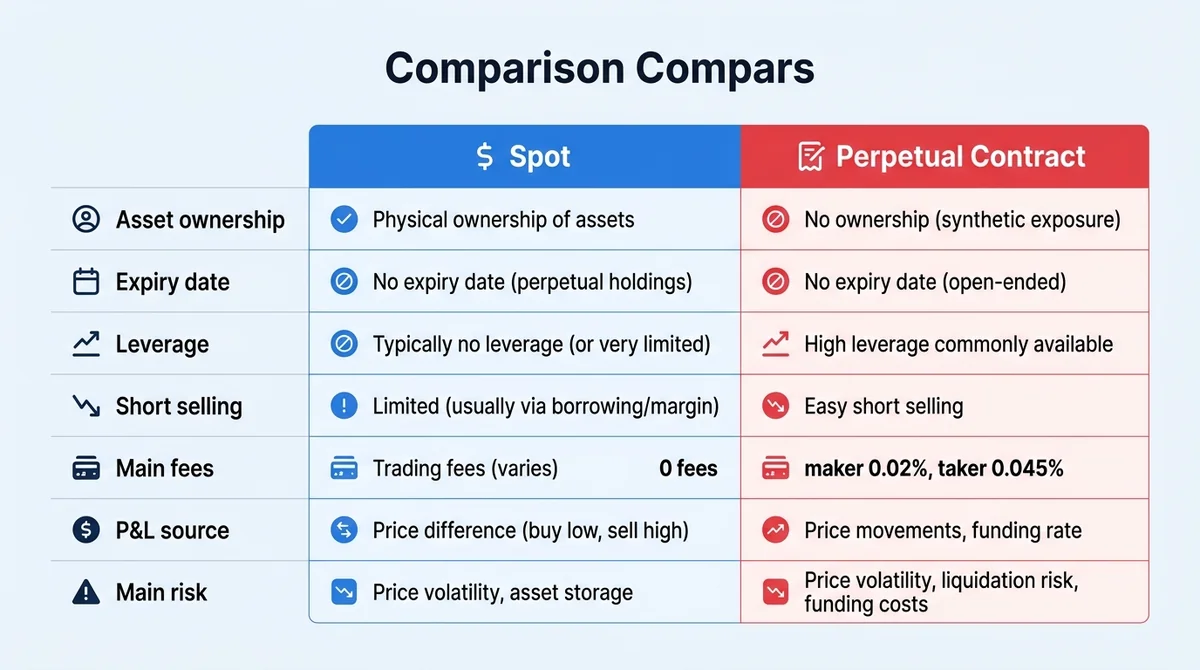
| Comparison | Spot | Perpetual Contract |
|---|---|---|
| Asset ownership | Yes | No |
| Expiry date | None | None |
| Leverage | Usually none or very low | Available, can amplify gains and losses |
| Short selling | Not supported or limited | Supported |
| Main fees | Trading fees (MSX example: spot trading 0 fees) | Trading fees (MSX example: contract maker 0.02%, taker 0.045%) + funding rate |
| Profit & loss source | Price difference between buy and sell | Price change × leverage |
| Main risk | Price decline | Liquidation / forced closing |
Note: The above fees are only an MSX platform example; other platforms may differ, so please refer to each platform's announcements.
#How Does the Funding Rate Work in Perpetual Contracts?
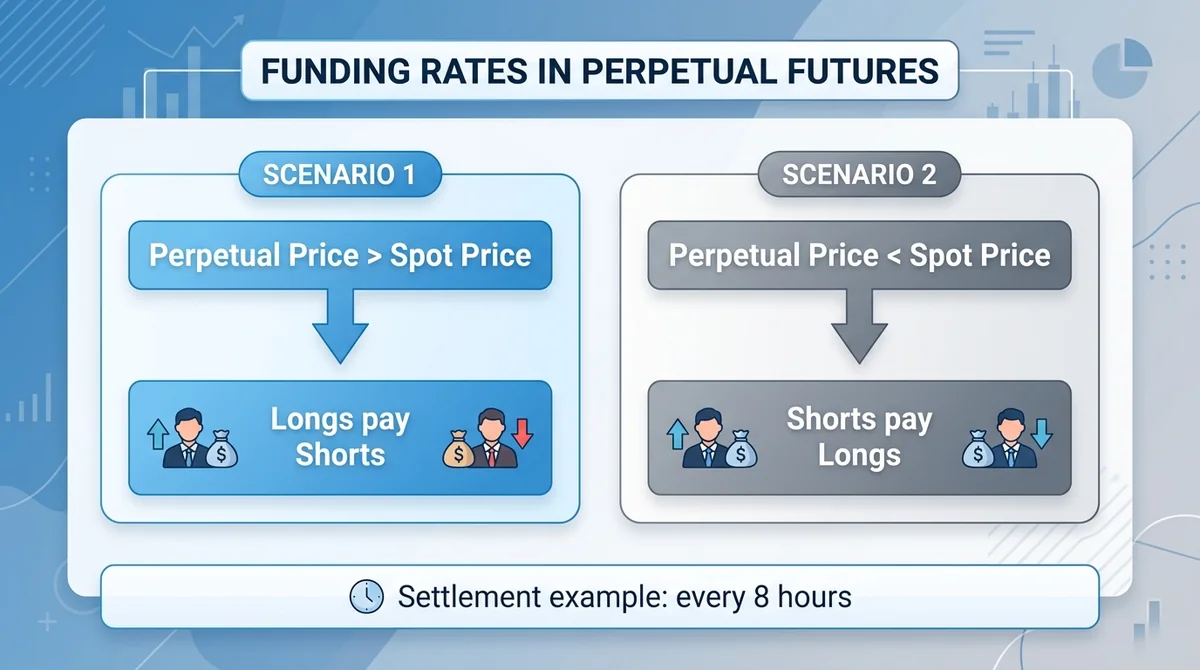
The funding rate is a periodic fee exchanged between long and short positions in perpetual contracts. It is used to pull the contract price back toward the spot price. When the market is skewed long, longs pay shorts; when skewed short, the direction reverses. Settlement frequency is set by each platform, commonly every 8 hours, but check exchange announcements for specifics.
Analogy: The funding rate is like a balancing fee when supply and demand for capital are imbalanced. Whichever side is crowded pays the fee.
For example, if a coin's perpetual contract price is higher than its spot price, longs are crowded, the funding rate is positive, and long position holders pay fees to shorts; conversely, when the rate is negative, shorts pay longs. This fee is deducted from or credited to the position account directly.
#How Does Leverage Work in Perpetual Contracts?
Leverage lets you control a larger position with a small amount of margin. For example, with 10x leverage, if you put up $100, your notional position is $1,000. If the price rises 1%, your gain is 10%; but if it falls 1%, your loss is also 10%.
Let's calculate: with $100 margin and 10x leverage, the notional position is $1,000. If the price rises 5%, the profit is $1,000 × 5% = $50, which is a 50% return on the $100 margin. If the price falls 5%, the loss is also $50, or a 50% loss. If the price falls 10%, the $100 margin is wiped out entirely.
Leverage amplifies both gains and losses, and high leverage can easily trigger forced liquidation. Beginners are advised to use low leverage, or even no leverage. Start with a small position to test the waters.
#What Risks Should You Watch for Before Using Perpetual Contracts?
The following risk points are listed by importance, each with controls:
- Liquidation / forced closing: When margin is insufficient, the position will be forcibly closed. In highly volatile markets, prices can move sharply in an instant. Controls: set stop-losses, reduce leverage, and build positions in batches.
- Short losses can theoretically be unlimited: Going long can at most lose your margin, but going short can theoretically lose unlimited amounts when prices rise. Controls: avoid naked shorts, set stop-loss orders, and control position size.
- Funding rate erosion: Holding positions long-term means continuously paying or receiving funding fees, and accumulated fees can exceed trading fees. Controls: avoid holding high-leverage positions long-term and pay attention to fee settlement times.
- Extreme market volatility: The crypto market trades 24/7, and extreme conditions can lead to wicks and insufficient liquidity. Controls: test with small positions and use limit orders instead of market orders.
Digital assets carry risk. Contracts do not guarantee returns, and this article does not constitute investment advice.
#How Beginners Should Choose: A Simple Three-Step Decision Method
Step 1: Stick to spot only and learn the process. With spot, assets actually arrive in your account after purchase, there is no liquidation risk, and fees are very low. Start with a small amount to complete the full process of registration, deposit, buy, sell, and withdrawal.
Step 2: Try low-leverage contracts with a small position. After understanding the funding rate and liquidation mechanism, you can use no more than 5% of your total funds and open a position with 2-3x low leverage to experience amplified gains/losses and fee deductions.
Step 3: Decide whether to increase investment based on your records. Record at least 10 contract trades, including win rate, profit/loss ratio, and funding fee expenses. If spot profits are stable and contract trial losses are manageable, then gradually adjust.
The criterion is simple: if you cannot bear waking up to a liquidated position, stay away from high-leverage contracts; if you just want to hold assets long-term, spot is completely sufficient.
This article only explains concepts and does not constitute investment advice. If you plan to practice on MSX or other platforms, please first understand the specific rules and risks of that platform.
#Frequently Asked Questions (FAQ)
Q: Which is more suitable for beginners, spot or perpetual contracts? A: Spot is more suitable for beginners. Spot requires no leverage, no funding fees, and has no liquidation risk. Perpetual contracts involve leverage and liquidation, so risk is higher. Learn spot first, then consider contracts.
Q: Is the funding rate deducted every 8 hours? A: The funding rate usually settles every 8 hours, but it is not a fixed rule. When the rate is positive, longs pay; when negative, shorts pay. Refer to exchange rules for specifics.
Q: Can I hold a perpetual contract forever? A: Perpetual contracts have no expiry, so theoretically you can hold them indefinitely, but ongoing funding fees increase holding costs. High-leverage positions also carry liquidation risk, so long-term holding of high-leverage contracts is not recommended.
**Q: Does
FAQ
现货和永续合约哪个适合新手?
现货更适合新手。因为现货不需要杠杆,不用付资金费,也没有爆仓风险。永续合约涉及杠杆和强平,风险更高。先学会现货,再考虑合约。
资金费率是每8小时扣一次吗?
资金费率结算频率由各平台设定,常见为每8小时一次,但并非固定扣款;费率为正时多头付费,为负时空头付费。具体频率请以交易所规则为准。
永续合约可以一直持有吗?
永续合约没有到期日,理论上可以一直持有,但持续付资金费会增加持仓成本。高杠杆仓位还有强平风险,不建议长期持有高杠杆合约。
现货交易有杠杆吗?
多数平台现货交易不提供杠杆或仅提供较低杠杆。在MSX,币币现货交易手续费为0(具体以平台公告为准)。建议新手从现货开始。
合约手续费和现货手续费差多少?
以MSX为例:币币现货手续费为0;合约挂单费率为0.02%,吃单为0.045%;此外合约还需支付资金费率。具体费用以平台公布为准。
Related Terms
Want to see the real data for this concept?
After you sign up, you can view live prices, funding rates, and fees for the related assets.
View live prices and fees →