What Are the Differences and Security Implications Between Custodial and Non-Custodial Wallets When Connecting to DApps?
Custodial wallets: third party holds keys. Non-custodial: you hold keys. Custodial easy but platform risk; non-custodial control but secure seed phrase.
Answer: Custodial wallets hand over your private keys to a platform for safekeeping, while non-custodial wallets leave the private keys in your own hands. When connecting to DApps, the former is convenient but carries platform risk; the latter gives you control but requires you to manage your own seed phrase.
#What Are Custodial and Non-Custodial Wallets?
A custodial wallet is like handing your house key to a property manager. The platform stores your private keys, and you can transfer funds simply by logging into your account. Some built-in wallets on centralized exchanges and custodial Web3 wallets use this model.
Non-custodial wallets are like holding the keys yourself. You hold the private keys or seed phrase and interact directly with the blockchain with no middleman. Common examples include MetaMask and hardware wallets. For a deeper dive, see What is a non-custodial wallet.
#What Are the Differences and Security Implications When Connecting to DApps?
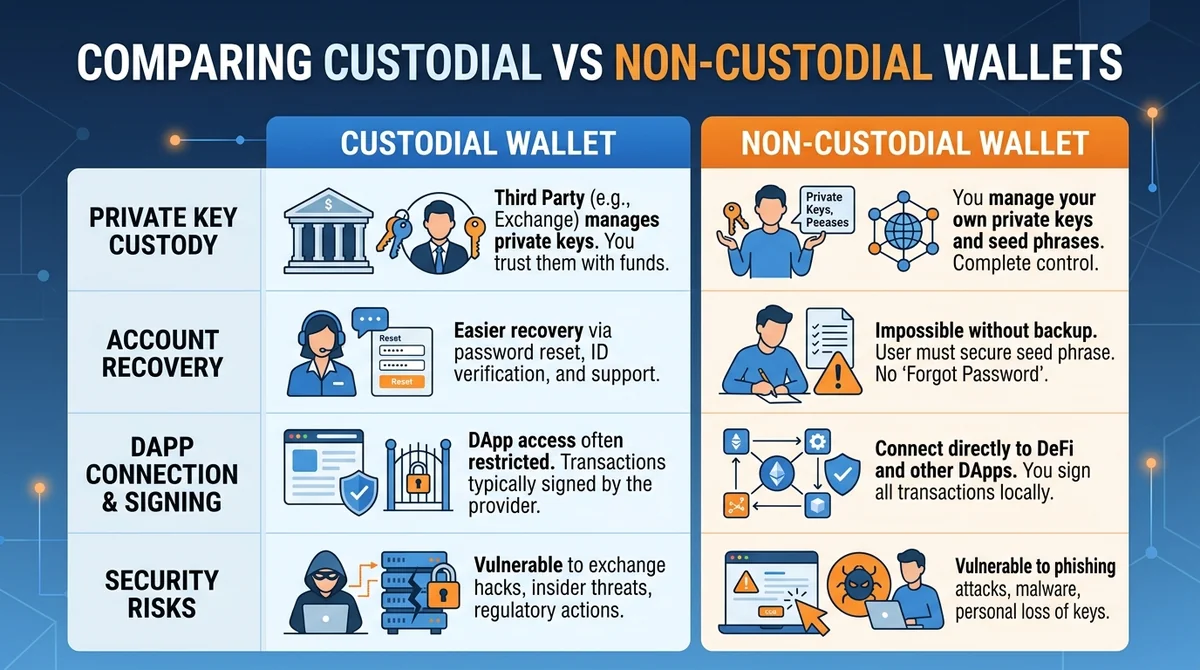
Non-custodial wallets are generally better suited for DApp interaction where you need full control over your assets. You maintain complete control, and signing transactions does not rely on a third party. However, if you fail to back up your seed phrase, your assets cannot be recovered.
Custodial wallets have a lower barrier to entry. The platform manages your keys, and you can recover your account if you forget your password. However, if the platform is hacked, runs off with funds, or acts maliciously, your assets could be at risk. Security risk comparison:
- Custodial risk: centralized single point of failure, hacker attacks, platform credit risk.
- Non-custodial risk: private key loss, phishing attacks, irreversible user errors.
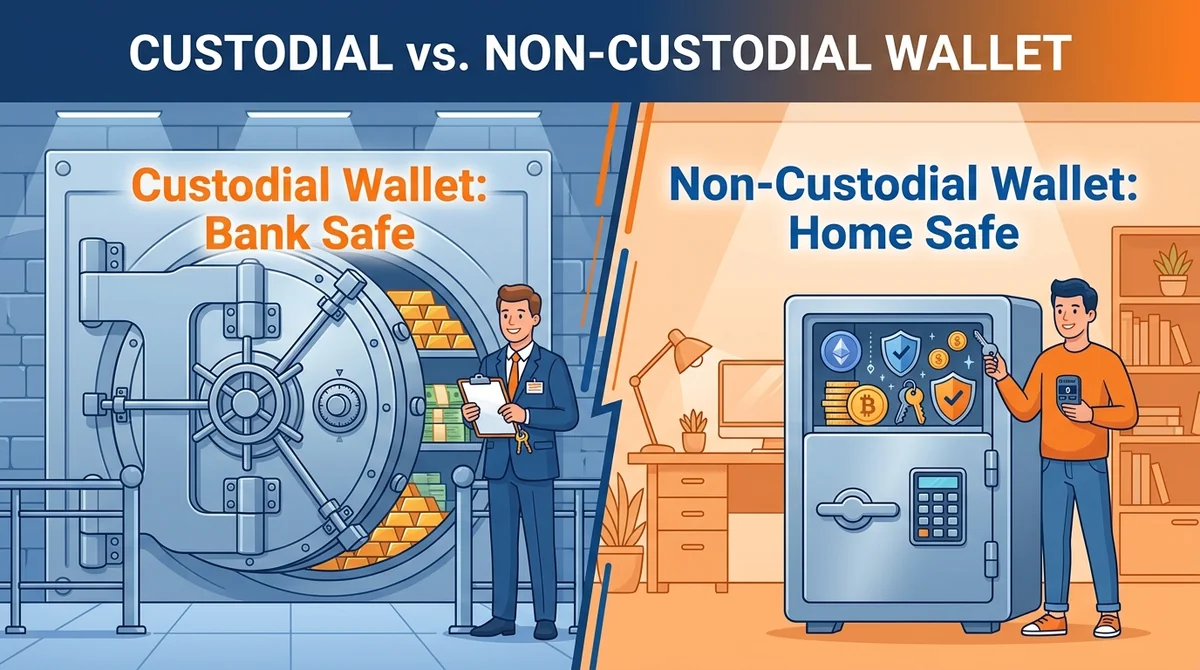
Analogy: A custodial wallet is like a bank safe deposit box—if the bank has a problem, you suffer too. A non-custodial wallet is like a home safe—if you lose the key, you are solely responsible.
#A Simple Example and Selection Guide
Connecting MetaMask to Uniswap is a typical non-custodial setup. MetaMask never touches your private keys; you import your seed phrase and sign transactions yourself.
Some built-in Web3 wallets on exchanges are custodial or semi-custodial, but implementations vary by platform, so check the official documentation before connecting. If the platform manages your private keys, it may sign transactions on your behalf when connecting to DApps. If you have a small amount of assets and want convenience, a custodial wallet may be acceptable; for larger holdings and active DApp use, a non-custodial wallet with offline seed phrase backup is recommended, along with careful management of DApp permissions. Note: This is not investment advice. Before taking any action, start with a small test amount and verify the security of both the wallet and the DApp.
This article covers concepts only; when you are ready to try things out, you can check out the live trading tools on the main MSX site.
FAQ
Are custodial wallets safe?
Custodial wallets have the platform hold your private keys, which is convenient but carries risks such as hacking, exit scams, or platform credit risk. For small amounts and everyday use, they are acceptable; for large holdings, it is recommended to move funds to a non-custodial wallet you control yourself and make proper backups.
What should I do if I lose my non-custodial wallet seed phrase?
If you lose your seed phrase, you generally cannot recover your assets unless you have a backup. Therefore, always store your seed phrase offline, never take screenshots or save it to cloud drives. Some wallets may offer additional recovery mechanisms, so refer to the wallet's official documentation.
Should I use a custodial or non-custodial wallet when connecting to DApps?
There is no one-size-fits-all answer. If you want full control over your assets and frequently use DApps, a non-custodial wallet is better. If you only occasionally interact and prefer convenience, an exchange wallet may work. Always start with a small test amount, safeguard your private keys, and regularly review DApp permissions.
Are built-in exchange wallets custodial wallets?
Some are, and some are not, depending on the platform's design. Many centralized exchange built-in wallets use custodial or semi-custodial models, but non-custodial designs also exist. Before using one, check the official documentation to confirm who controls the private keys. For large holdings, withdraw funds to a non-custodial wallet where you control the private keys.
What is a seed phrase?
A seed phrase is typically a string of 12 or 24 English words, sometimes other lengths, that serves as a backup of your private keys. Whoever has the seed phrase can move your assets, so store it offline and never share it with anyone.
Related Terms
Want to see the real data for this concept?
After you sign up, you can view live prices, funding rates, and fees for the related assets.
View live prices and fees →