What is a Direct Public Offering (DPO)? Explained for Beginners
Explore how a direct public offering lets companies sell shares to the public without underwriters. Learn benefits, risks, and DPO vs IPO differences.
#What is a Direct Public Offering (DPO)?
A direct public offering (DPO) is a method for a private company to sell its shares directly to the public without the involvement of underwriters or investment banks. This allows the company to set its own offering price and retain more control over the process, potentially lowering costs compared to a traditional initial public offering (IPO).
- Definition: A DPO is a public offering of securities directly to investors, bypassing underwriters.
- Key difference from IPO: IPOs use underwriters to manage the sale; DPOs do not.
- Process: The company files with regulators, sets its own price, and sells shares directly.
- Benefits: Lower costs, more control, direct access for investors.
- Risks: Potential lower liquidity and limited analyst coverage.
#What is a direct public offering (DPO)?
A direct public offering (DPO) is a way for a private company to become publicly traded by offering its shares directly to the public, without the help of underwriters or investment banks. In a DPO, the company sets its own offering price and sells its securities directly to investors, making it an alternative to an initial public offering (IPO). This approach can be particularly attractive for companies that want to avoid the high fees and strict control typically associated with underwriter-led IPOs.
#Simple definition of a DPO
Simply put, a DPO is a public offering where a company sells its own shares to investors without a middleman. The company acts as its own underwriter, handling the regulatory filings and marketing directly. This direct approach can democratize access to investment opportunities, allowing retail investors to participate at the same offering price as institutional investors.
#How a DPO differs from an IPO
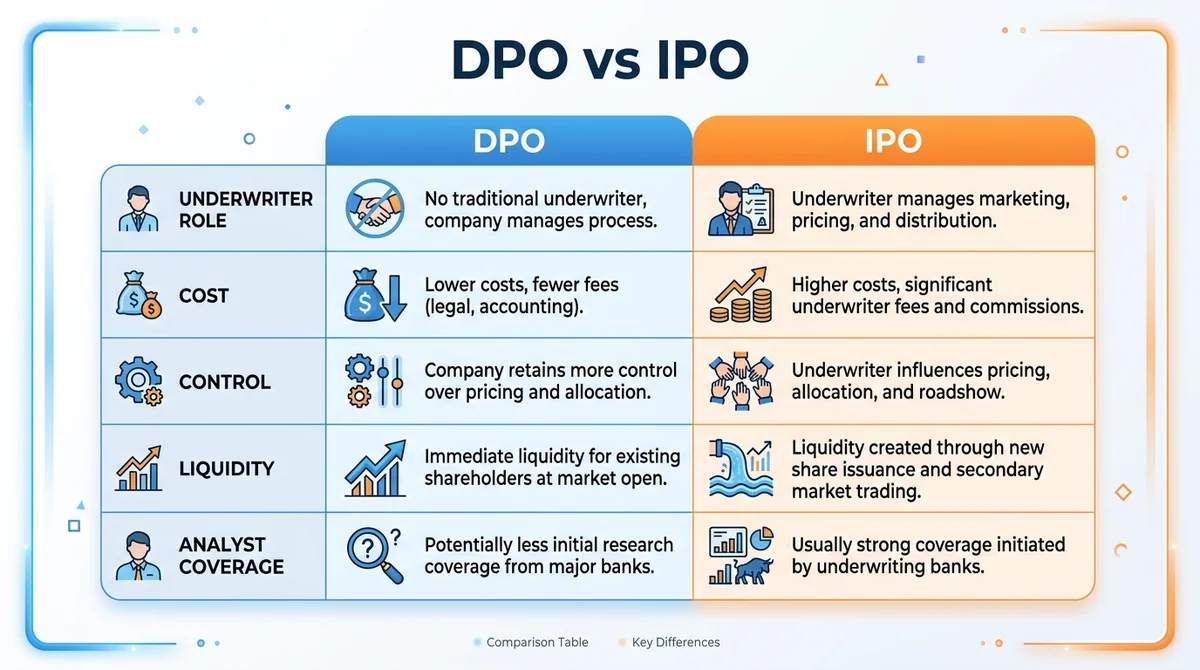
The primary difference between a DPO and an IPO lies in the role of underwriters. In an IPO, investment banks underwrite the offering, meaning they buy the shares from the company and resell them to the public, often at a markup. They also provide services like market making and analyst coverage. In a DPO, there are no underwriters; the company sells shares directly, which can save on underwriting fees but may result in less liquidity and fewer analyst reports. [citation:1]
#How does a direct public offering work?
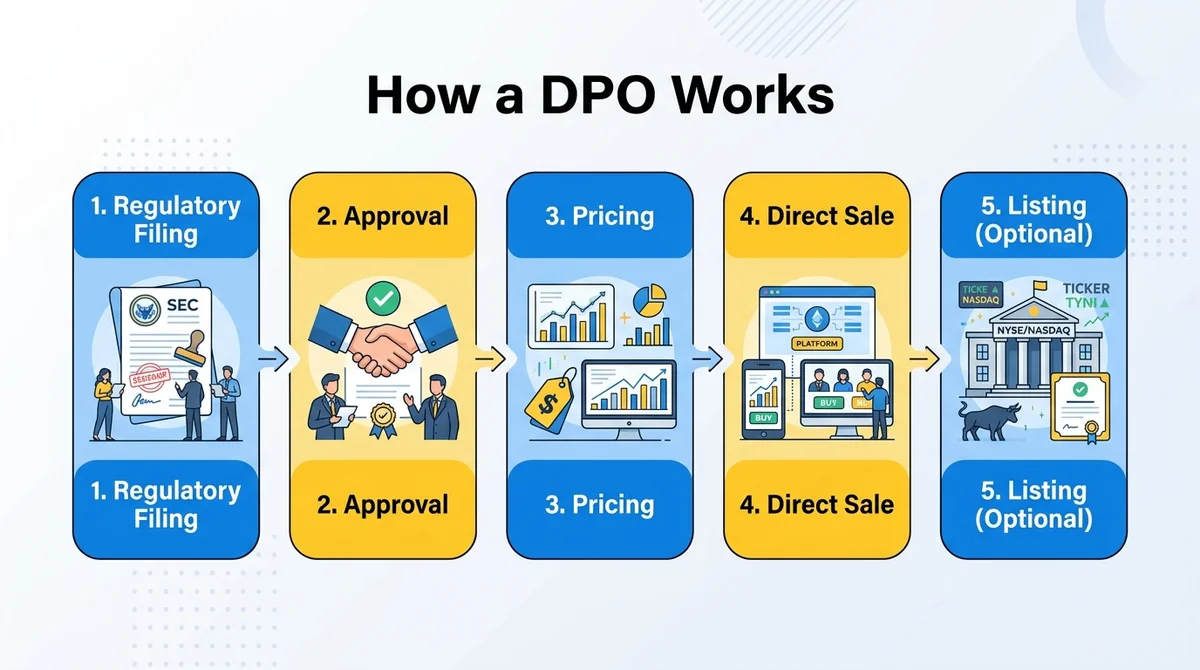
The process of a DPO involves several key steps, starting with regulatory compliance and ending with the sale of shares to the public. The company must file a registration statement with the relevant regulatory body, typically the Securities and Exchange Commission (SEC) in the United States. Once approved, the company can then sell shares directly to investors, often through a funding portal or directly on a stock exchange if the offering is listed.
#The process of a DPO
- Regulatory Filing: The company files a registration statement with regulators, such as the SEC, detailing its financials and business plan.
- Approval: After the regulator approves the filing, the company is cleared to offer its shares.
- Pricing: The company sets its own offering price based on its valuation and market conditions.
- Direct Sale: Shares are sold directly to investors, either through a funding portal, a broker-dealer, or directly on an exchange if listed.
- Listing (optional): The company may list its shares on a stock exchange like the NYSE or Nasdaq to provide liquidity, but not all DPOs are listed.
#Regulatory requirements for DPOs
DPOs are subject to securities regulations just like IPOs. The company must provide full disclosure of its financial condition and business operations. The regulatory framework ensures that investors have access to necessary information to make informed decisions. For example, under Regulation A+, smaller companies can use a simplified process to offer shares to the public, which is a type of DPO. [citation:2]
#What are examples of direct public offerings?
While specific company names are not provided in the source data, DPOs have been used across various industries, including technology and consumer goods. The lack of specific examples in the available data means we focus on the general mechanism and potential use cases.
#Notable DPO examples
Some well-known companies have chosen DPOs to go public, but specific names are not listed in the available sources. However, it's important to recognize that DPOs are a viable path for companies seeking to access public capital markets without the traditional IPO process.
#How DPOs are used in different industries
DPOs can be utilized by companies in various sectors. For tech startups, a DPO might offer a way to go public while maintaining more control and avoiding dilution from underwriter fees. In consumer goods, established brands might use a DPO to raise capital from their customer base, fostering loyalty and community investment. The flexibility of DPOs makes them applicable across industries.
#Why is a direct public offering important?
A DPO is important because it provides a cost-effective and controlled alternative to an IPO for companies seeking to go public. By eliminating underwriters, companies can save on substantial fees, which can be a significant portion of the raised capital. Additionally, DPOs give companies more control over the offering process and pricing, allowing them to align the offering with their strategic goals.
#Benefits for companies
- Lower costs: Avoiding underwriting fees can save millions of dollars.
- More control: Companies set their own price and manage the process.
- Direct access to investors: Companies can build relationships with their investor base directly.
#Benefits for investors
- Direct access: Investors can buy shares at the offering price without going through an underwriter.
- Potential for early access: DPOs may offer opportunities to invest in companies before they get broader analyst coverage.
- Transparency: Since the company files with regulators, investors have access to detailed information.
#What are the risks and common misconceptions about DPOs?
Investing in a DPO carries certain risks, and there are common misconceptions that investors should be aware of. One major risk is lower liquidity; if the DPO is not listed on a major exchange, shares may be hard to sell. Additionally, there is often limited research and analyst coverage, making it more challenging to evaluate the company's prospects. A common misconception is that DPOs are less regulated, but they must comply with securities laws just like IPOs.
#Risks of investing in a DPO
- Liquidity risk: Shares may have lower liquidity if not listed on a major exchange, making it difficult to sell.
- Information asymmetry: With less analyst coverage, investors may have a harder time assessing the company's value.
- Market risk: The company's stock price may be volatile, and there is no guarantee of returns.
#Common misconceptions about DPOs
- Misconception: DPOs are unregulated. In reality, DPOs are subject to securities regulations, requiring full disclosure.
- Misconception: DPOs are only for small companies. While often used by smaller firms, any private company can technically pursue a DPO.
- Misconception: DPOs are riskier than IPOs. While they have different risk profiles, both are subject to market risks and regulatory oversight.
#What are the related terms to DPO?
Understanding related terms helps clarify the landscape of public offerings. An IPO (Initial Public Offering) uses underwriters to sell shares, while a direct listing is similar to a DPO but typically refers to listing existing shares on an exchange without raising new capital. Regulation A+ is a provision that allows smaller companies to offer shares to the public with a simplified process, often used for DPOs.
#IPO
An IPO is the traditional process where a company hires investment banks to underwrite the sale of its shares to the public. The underwriters help set the offering price, market the shares, and provide a safety net by purchasing the shares if they cannot be sold to the public. This process can be expensive, with underwriting fees often ranging from 3% to 7% of the proceeds.
#Direct listing
A direct listing is a method where a company lists its existing shares on a stock exchange without issuing new shares or raising new capital. Unlike a DPO, which may involve raising capital, a direct listing simply provides liquidity for existing shareholders. This approach can be less costly than an IPO, but it does not bring in new funds for the company.
#Regulation A+
Regulation A+ is an exemption from full IPO registration requirements, allowing smaller companies to offer and sell up to $75 million in securities to the public in a 12-month period. It is often used for DPOs because it provides a streamlined process with fewer reporting requirements, making it more accessible for smaller businesses.
#Conclusion
A direct public offering (DPO) is an alternative path to public markets that offers companies cost savings and control, while providing investors direct access to shares. However, it comes with risks such as lower liquidity and limited information. Understanding how DPOs work, their benefits, and their risks is crucial for any investor considering this type of offering. By grasping the differences between DPOs, IPOs, and direct listings, you can make more informed decisions about participating in these opportunities.
FAQ
What is the main difference between a DPO and an IPO?
The main difference is that a DPO does not use underwriters, while an IPO does. In a DPO, the company sells shares directly to the public, saving on underwriting fees but potentially resulting in less liquidity and analyst coverage.
Are DPOs regulated?
Yes, DPOs are regulated. Companies must file a registration statement with the SEC and comply with securities laws, providing full disclosure to investors.
Can any company do a DPO?
In theory, any private company can pursue a DPO, but it must meet regulatory requirements. Regulation A+ provides a simplified process for smaller companies to conduct a DPO.
What are the risks of investing in a DPO?
Key risks include lower liquidity if shares are not listed on a major exchange, limited research and analyst coverage, and the potential for price volatility. Investors should conduct thorough due diligence.
How does a DPO raise capital?
In a DPO, the company sells new shares directly to investors, raising capital without intermediaries. The proceeds go directly to the company, unlike a direct listing where existing shares are sold and the company does not raise new funds.
Want to see the real data for this concept?
After you sign up, you can view live prices, funding rates, and fees for the related assets.
View live prices and fees →