How Do Decentralized Applications (DApps) Work? Smart Contracts and Frontend Interaction Explained
Learn how decentralized applications (DApps) work, how smart contracts operate, and the real benefits and risks of DApps—explained in plain language.
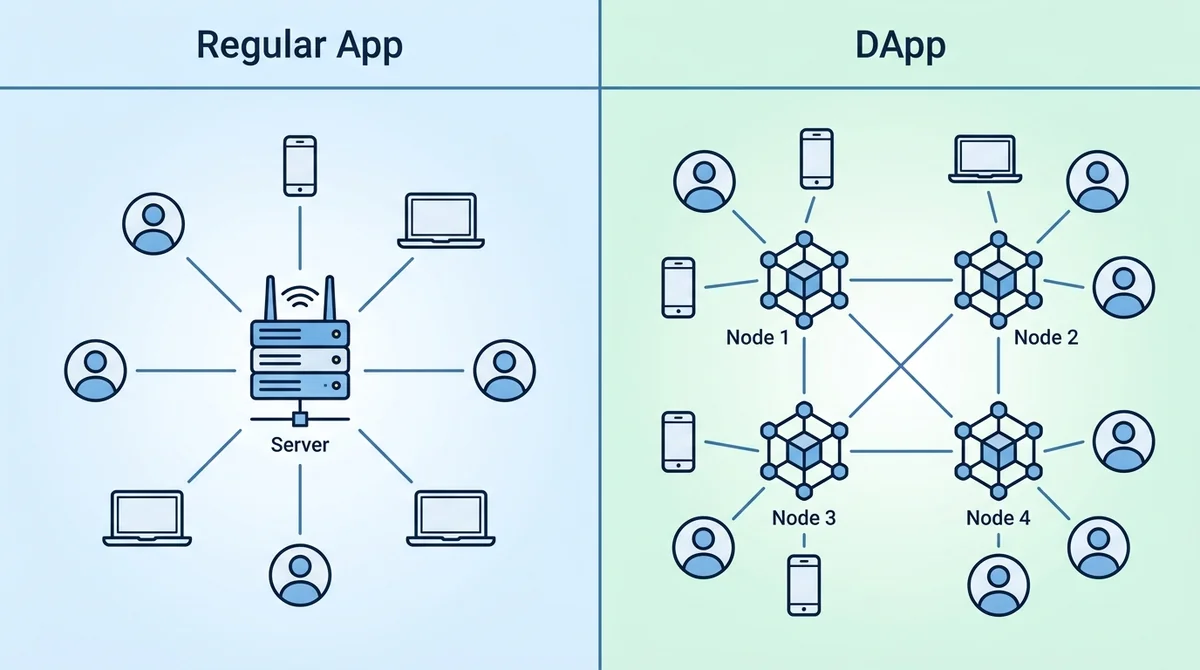
Answer: DApps (decentralized applications) are applications that run on a blockchain, with core business logic executed by smart contracts. The biggest difference from regular apps is that the backend does not depend on a single company's servers but is maintained by multiple nodes on the blockchain network.
#What Is a DApp? How Is It Different from a Regular App?
Regular apps (like WeChat) usually store data and logic on the operating company's centralized servers. The company can change rules, remove features, or even shut down the service. DApps deploy core logic on a blockchain, making the code publicly verifiable. However, note that a DApp's frontend interface (website or app) may still be hosted on centralized servers; only the critical business rules are determined by smart contracts.
Analogy: A regular app is like depositing money in a bank—you cannot control how the bank uses your money. A DApp is more like a vending machine: the rules are set by code, and you insert a coin and get the product without needing to trust a specific person. But a vending machine may also have an administrator, and not all DApps are completely trustless.
#How Do DApps Run? What Role Do Smart Contracts Play?
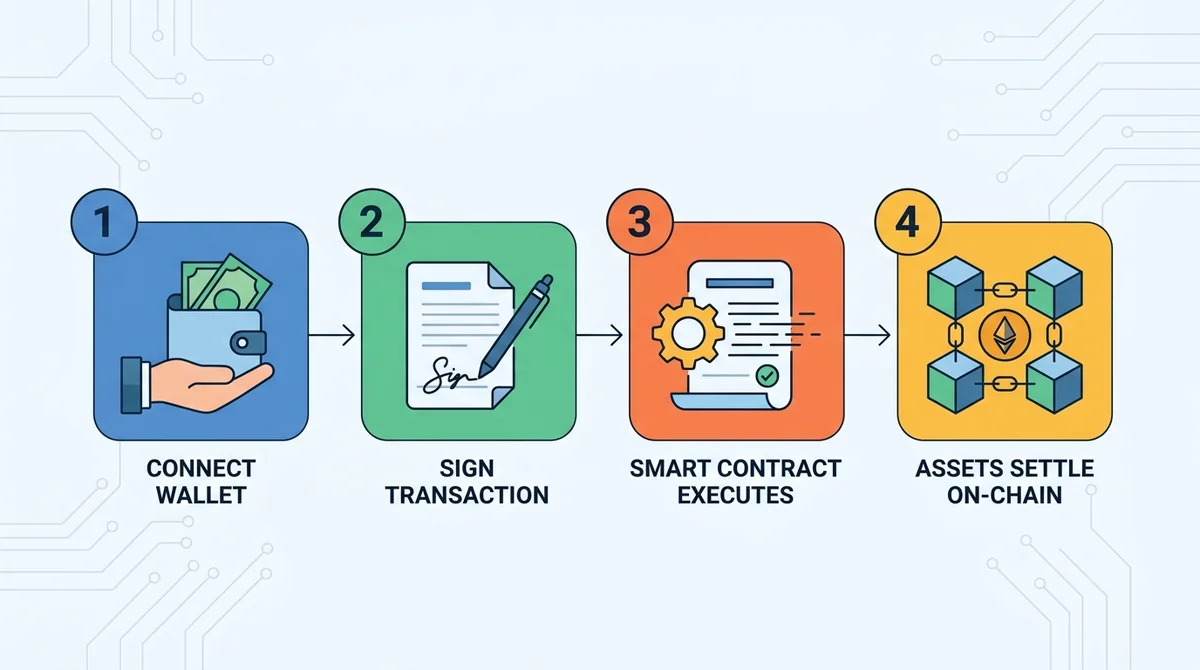
To use a DApp, you first need to connect a wallet (such as MetaMask). Clicking a button in the interface actually initiates a transaction on the blockchain, and that transaction calls a smart contract.
A smart contract is a program deployed on a blockchain that executes automatically when preset conditions are met. For example, when you place an order on a decentralized exchange (DEX), the smart contract automatically completes the asset swap and settlement without a centralized platform holding your assets.
Note: Smart contracts are not always "immutable." Some projects use upgradeable proxies or retain admin privileges, allowing developers to modify contract logic. Only contracts that have renounced upgrade permissions and have open-source code are closer to being "tamper-proof."
#Why Are DApps Important? What Are Their Benefits and Risks?
Benefits:
- Transparency: Code is usually open source, and rules can be audited;
- Permissionless: Anyone with a wallet can use it—no registration or approval needed;
- User-controlled assets: If you control the private keys, you control the assets;
- Censorship resistance: The underlying blockchain is difficult for a single entity to shut down, but frontends may still be blocked, and some contracts may include blacklist functions, so censorship resistance is not absolute.
Risks and limitations:
- Performance and fees: Transaction speed is limited by the underlying chain's processing capacity, and fees can be high when the network is congested;
- User responsibility: Losing or leaking private keys leads to permanent loss of assets; no customer support can help recover them;
- Smart contract risk: Contract vulnerabilities can be exploited by hackers, causing fund losses; upgrade mechanisms may also introduce new risks;
- User experience: Compared with traditional apps, the barrier to entry is higher, and beginners can easily make mistakes.
Risk warning: The DApp ecosystem is still in its early stages. Test with small amounts before use, make sure you understand the risks, and do not invest funds you cannot afford to lose.
#A Simple Example: Decentralized Exchange (DEX)
Take Uniswap or a similar DEX as an example: A user connects a wallet, selects a token pair, and confirms the transaction. The smart contract automatically completes the swap, and the assets go directly to the user's wallet. The whole process requires no registration and no depositing funds on the platform, but users need to pay the blockchain network's gas fees and bear token price volatility and contract risk.
#FAQ
Q: What is the difference between a DApp and a regular app?
A: Regular apps rely on centralized servers, and the company can change rules or shut down the service. DApps deploy core logic on a blockchain, executed by smart contracts, making them open and transparent, although parts of the frontend may still be hosted on centralized servers.
Q: What technologies are needed to develop a DApp?
A: Typically you need to write smart contracts (e.g., Solidity), develop a frontend interface, and integrate a wallet (e.g., MetaMask). You also need to understand blockchain node interaction, gas fee mechanics, and contract security.
Q: Are DApps absolutely safe?
A: No. Although the blockchain itself is secure, smart contracts can have vulnerabilities, users can lose private keys, and frontends can be attacked. Also, some contracts have admin privileges, creating centralization risk. Evaluate carefully before use.
FAQ
What is the difference between a DApp and a regular app?
Regular apps rely on centralized servers, and the company can change rules or shut down the service. DApps deploy core logic on a blockchain, executed by smart contracts, making them open and transparent, although parts of the frontend may still be hosted on centralized servers.
What technologies are needed to develop a DApp?
Typically you need to write smart contracts (e.g., Solidity), develop a frontend interface, and integrate a wallet (e.g., MetaMask). You also need to understand blockchain node interaction, gas fee mechanics, and contract security.
Are DApps absolutely safe?
No. Although the blockchain itself is secure, smart contracts can have vulnerabilities, users can lose private keys, and frontends can be attacked. Also, some contracts have admin privileges, creating centralization risk. Evaluate carefully before use.
Related Terms
Want to see the real data for this concept?
After you sign up, you can view live prices, funding rates, and fees for the related assets.
View live prices and fees →