Liquidation: How to Choose a Wallet
A crypto wallet manages keys, not coins. Learn custody vs self-custody, software vs hardware, cold wallets and HD wallets, plus four criteria for choosing one.
Answer: When choosing a wallet, first ask yourself "who controls the private keys" — if you want convenience, use a custodial wallet; if you want full control, choose a self-custodial wallet. Then filter by three dimensions: supported networks, backup and recovery method, and code transparency.
#What Is a Digital Asset Wallet and What Does It Actually Manage?
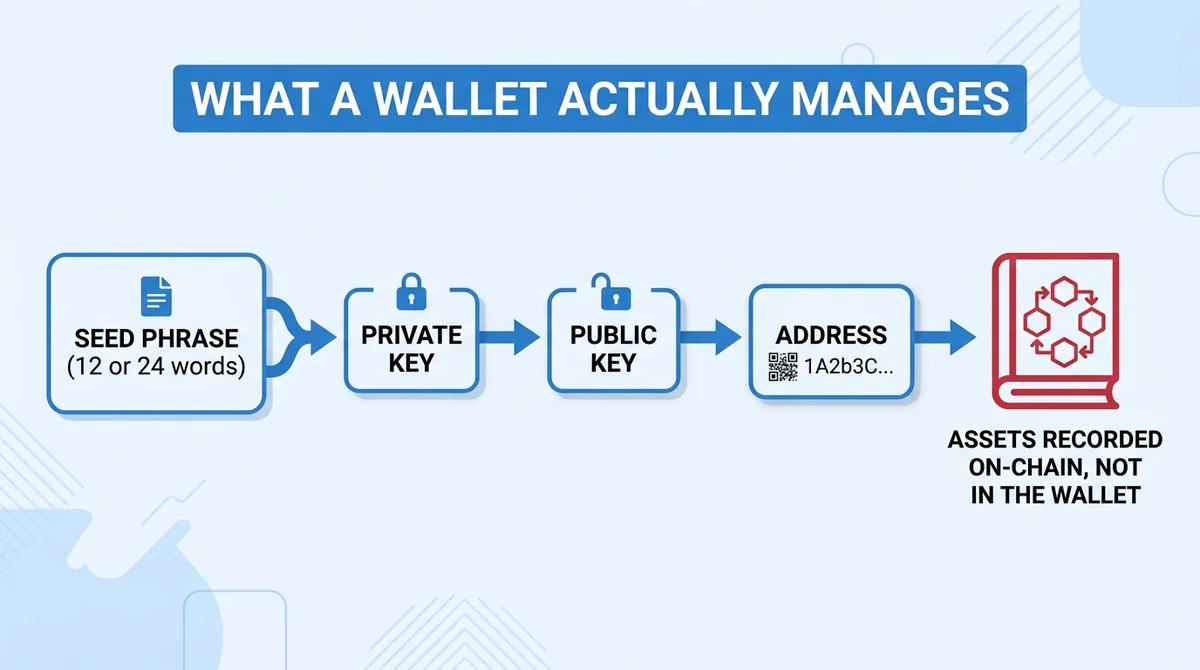
A wallet doesn't store coins; it manages keys. Assets are recorded on the blockchain, and whoever holds the private key or seed phrase controls the assets.
Analogy: A wallet is like a bank card plus its PIN. The card itself holds no money — the money is recorded on the bank's ledger. If you lose the PIN, you can't withdraw the money.
- Private key: A string of characters only you know, used to sign transactions.
- Public key: Derived from the private key and can be shared publicly.
- Address: Derived from the public key, equivalent to an account number for receiving funds.
- Seed phrase: Commonly 12 or 24 words that can restore the corresponding keys according to standard rules.
So the seed phrase matters more than the wallet software itself. Software can be reinstalled, but if the seed phrase is lost, the assets usually cannot be recovered.
#What Is the Difference Between a Custodial Wallet and a Self-Custodial Wallet?
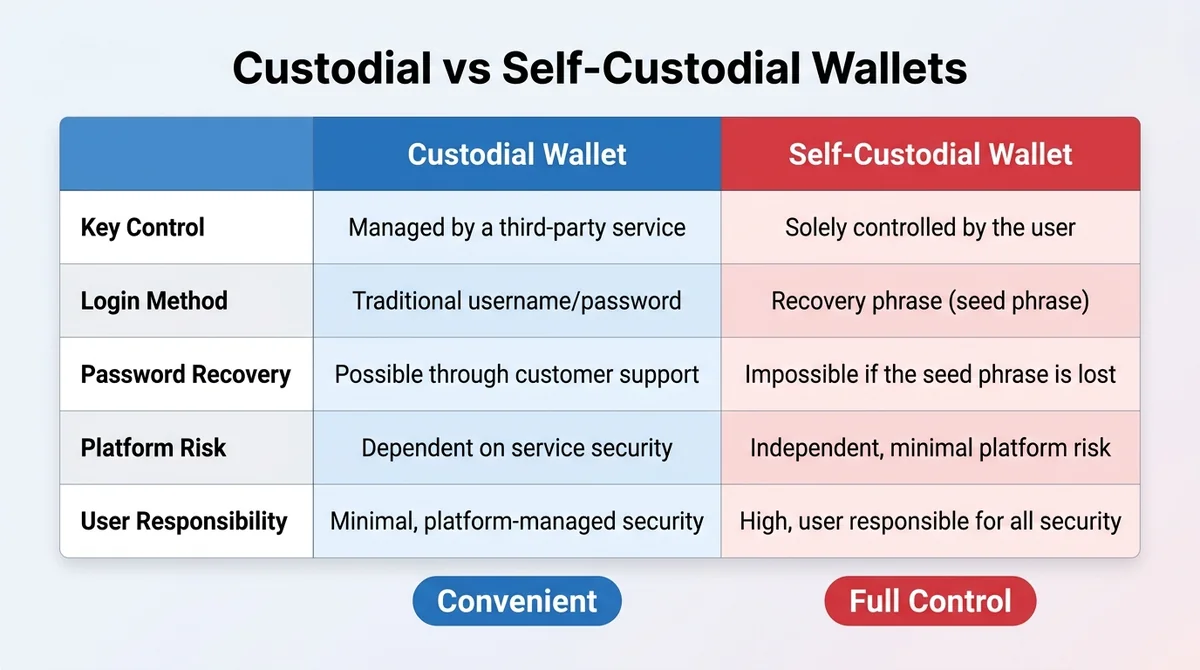
A custodial wallet has the platform manage private keys on your behalf, and you typically log in with an account and password. A self-custodial wallet has you manage the private keys and seed phrase yourself.
Analogy: Custody is like storing valuables in a bank safe deposit box — convenient but dependent on the bank. Self-custody is like keeping them in your own safe — free but you must hide the key yourself.
- Custodial wallet: Quick to get started, and a forgotten login password can usually be recovered through the platform's process, but you're also affected if the platform has problems.
- Self-custodial wallet: Greater control, but backup, anti-phishing, and loss prevention are all your responsibility.
Self-custody means bearing full responsibility — no customer service can help you recover your seed phrase.
#How Do Software Wallets, Hardware Wallets, and Cold Wallets Relate?
A software wallet is an app installed on a phone or computer that is online while running. A hardware wallet is a dedicated small device that stores private keys inside and does not connect to the network when signing. A cold wallet broadly refers to a storage method where private keys stay offline for long periods.
Analogy: A software wallet is like mobile banking — usable anytime. A hardware wallet is like locking the key in a safe and taking it out only when needed.
- Software wallet: Convenient, suitable for small everyday amounts.
- Hardware wallet: Private keys stored offline, suitable for long-term holding.
- Cold wallet: Emphasizes keeping private keys offline; a hardware wallet is a common implementation.
Using a software wallet for small daily amounts is fine — you don't necessarily need a cold wallet.
#What Are HD Wallets and Keystores?
An HD wallet (hierarchical deterministic wallet) uses one seed to derive multiple addresses according to fixed rules, so backing up the seed phrase once can restore those addresses. A keystore is a file that stores encrypted private keys and usually requires a password to use.
Analogy: An HD wallet is like a tree — one seed grows many branch addresses. A keystore is like locking a key in a password-protected box.
- One seed phrase can manage multiple addresses — a common capability of an HD wallet.
- Keystore files must be backed up separately, and the password must be remembered.
- The backup method determines recovery ability; incomplete backups may lead to failed recovery.
#What Dimensions Should You Consider When Choosing a Wallet?
First look at the custody model, which defines the boundary of responsibility; then look at supported networks and assets, which determines whether it works for you; then look at backup and recovery methods, which determines fault tolerance; finally look at whether the code is open source and actively updated, which reflects transparency.
- Do you need self-custody of private keys?
- Which blockchain networks and tokens are supported?
- How are the seed phrase or keystore backed up and recovered?
- Is the code open source, and are updates frequent?
Comparing each of these four dimensions is more reliable than just looking at whether the interface looks good.
#What Security Risks Must You Know When Using a Wallet?
A leaked seed phrase means lost control of assets. Anyone who obtains the seed phrase can transfer the assets, and on-chain transactions cannot be reversed.
Recognize phishing: Download wallets only from official channels, don't click unknown links, and never enter your seed phrase on any website.
Cross-chain operations: A cross-chain bridge is a common risk point; before operating, confirm the target network and contract address.
- Write the seed phrase on paper by hand — don't photograph it or store it in cloud drives.
- Verify the official domain before installing, and beware of fake apps.
- Verify the network and contract address before cross-chain transfers.
⚠️ Digital assets carry risk. This article only explains concepts and does not constitute investment advice.
FAQ
Does a digital asset wallet actually store coins?
No. A wallet is only a key management tool; assets are recorded on the blockchain. Whoever holds the private key or seed phrase controls the assets. If the wallet software is lost, it can be reinstalled, but if the seed phrase is lost, the assets usually cannot be recovered.
How do I choose between a custodial wallet and a self-custodial wallet?
First clarify who controls the private keys. If you want convenience and can accept relying on a platform, choose a custodial wallet. If you want to control your private keys yourself and are willing to take responsibility for backups and anti-phishing, choose a self-custodial wallet.
How do software wallets, hardware wallets, and cold wallets relate?
A software wallet is an online app. A hardware wallet keeps private keys on an offline device and does not connect to the network when signing. A cold wallet broadly refers to a storage method where private keys stay offline for long periods; a hardware wallet is a common implementation. For small daily amounts, a software wallet is sufficient.
What happens if the seed phrase is leaked?
The seed phrase can restore the corresponding keys. Once leaked, anyone who obtains it may transfer the assets, and on-chain transactions cannot be reversed. Write the seed phrase on paper by hand — don't photograph it, don't store it in cloud drives, and never enter it on any website.
Related Terms
Want to see the real data for this concept?
After you sign up, you can view live prices, funding rates, and fees for the related assets.
View live prices and fees →