How to Enable Spot Trading
Enabling spot trading takes three steps: register and verify your identity, set up 2FA and other security, then deposit and buy at the current price.
Answer: Enabling spot trading usually takes three steps — register and complete identity verification, turn on two-factor authentication and other security settings, then deposit funds and buy at the current price. Once the trade fills, the asset is yours immediately. The exact process depends on the rules of the exchange you choose.
#What Is Spot Trading?
Spot trading means using funds to buy digital assets at the current price, with the asset belonging to you immediately after the trade fills. It is the most basic form of digital asset trading.
It works like buying vegetables at a market: you pay, you take the goods, and the goods are yours. After buying, you directly hold the asset — no perpetual futures leverage is involved, and you cannot be forcibly liquidated.
The core difference between spot and futures: with spot, your maximum loss is your principal; futures involve perpetual futures leverage and carry forced liquidation (blow-up) risk.
Put simply, spot solves "buy and hold," while futures solve "betting on price direction." Beginners should understand the former before considering the latter.
Further reading: What Is Spot Trading (/glossary/what-is-spot-trading), Spot vs. Futures Comparison (/compare/spot-vs-futures).
#What Do You Need Before You Start?
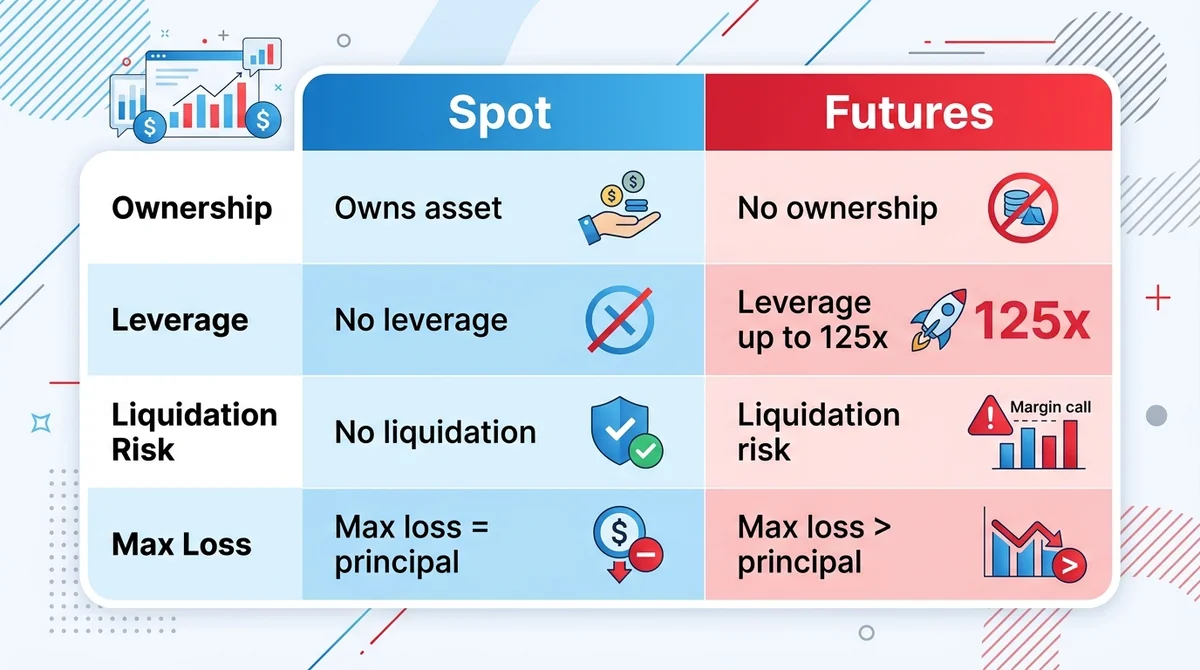
Prepare three things before you start: a working email address or phone number, your own identity document, and a unique strong password. With all three ready, the whole process usually goes through in one sitting.
First, register an account and complete identity verification. This is both a compliance requirement and a prerequisite for account recovery and withdrawals.
Next, enable two-factor authentication (2FA) and set a unique strong password that you do not reuse on other sites.
Finally, spend ten minutes understanding the difference between spot and futures so you do not jump straight into perpetual futures leverage.
One reminder: submit identity verification materials only inside the exchange's official app or website. Never send them through chat tools to anyone, including people claiming to be "customer support."
#How Do You Enable Spot Trading Step by Step?
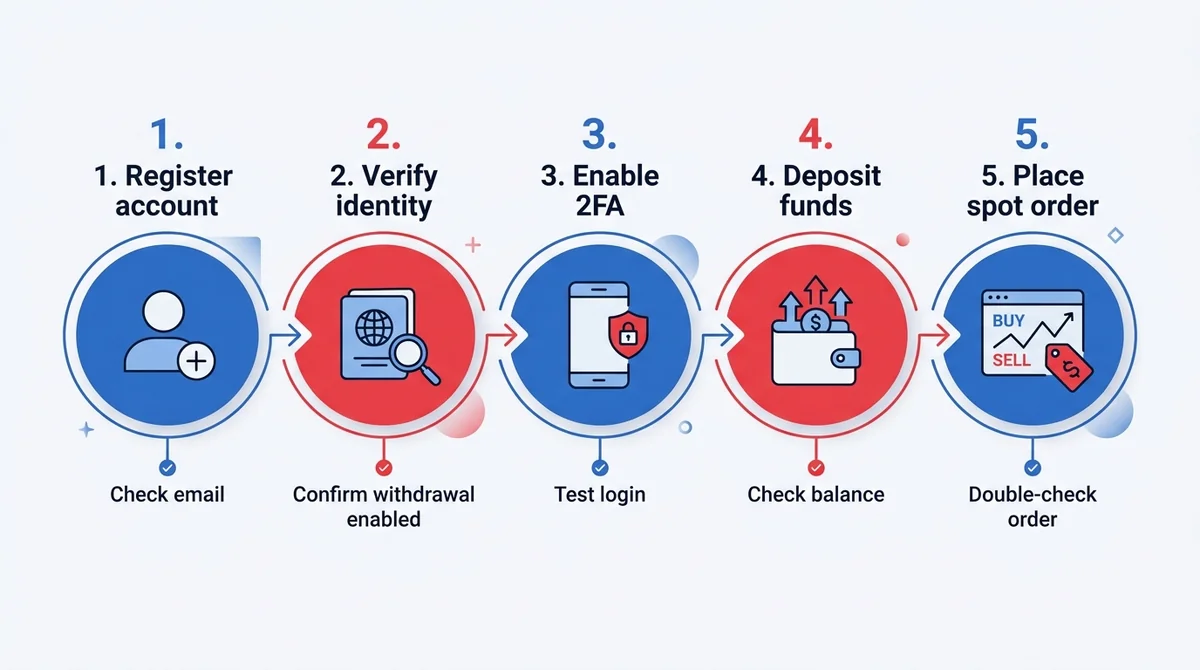
- Choose a compliant exchange and register an account with your email or phone number.
- Submit identity verification materials as the platform requires and wait for approval.
- Enable two-factor authentication and set a unique strong password. ⚠️ Do not take screenshots of verification codes.
- Deposit fiat currency through compliant channels or transfer in digital assets.
- Go to the spot section, select the coin, enter the amount, review, and place the order. ⚠️ Digital asset prices are highly volatile — start with a small test amount.
Each step has a corresponding checkpoint: after registering, confirm your email can receive messages; after verification passes, confirm withdrawal permissions are enabled; after enabling 2FA, log in once yourself to confirm it works; after depositing, check whether the balance has arrived; before placing an order, double-check the coin, amount, and order type.
The point of a small test trade is to verify the entire chain — from deposit to purchase to viewing your holdings — rather than to get the buy right on the first try.
#What Risks Should You Watch After Enabling?
Enabling is only the starting point. Account security and withdrawal security are the two lines you need to hold long term.
The first line of defense is account security: beware of phishing links and log in only through official entry points. Anyone asking for verification codes, seed phrases, or private keys should be refused outright.
Verify the address and network when withdrawing — choosing the wrong network can cause assets to be lost. It is advisable to test with a small amount first and transfer larger amounts only after confirming arrival.
If you move assets to a self-custody wallet, the seed phrase must be stored offline — no photos, no cloud uploads. Note that self-custody means there is no custody fee, but you alone are responsible for security.
In addition, price volatility itself is a risk: spot positions will not be forcibly liquidated, but the value of your assets may fall after purchase, so keep the amount invested within what you can afford to lose.
This article explains concepts only and does not constitute investment advice. For more introductory digital asset concepts, see MSX Learn.
#FAQ
#How many steps does enabling spot trading take?
Usually three: register and complete identity verification, enable two-factor authentication and other security settings, then deposit and buy spot assets. Complete each step before moving to the next, and always double-check the coin and amount before placing an order; the exact steps depend on the rules of the exchange you choose.
#What is the difference between spot trading and futures trading?
Spot trading buys and sells at the current price with immediate settlement, the asset belongs directly to the buyer, no perpetual futures leverage is involved, and the maximum loss is the principal. Futures trading involves perpetual futures leverage and carries forced liquidation risk, with gains and losses amplified.
#Why do you need to complete identity verification before enabling spot trading?
Identity verification is a compliance requirement for exchanges and also affects account recovery and withdrawal permissions. Without completed verification, you usually cannot deposit or withdraw normally, and account security is lower.
#Should beginners start with spot or futures?
It is recommended to start with spot. Spot has no perpetual futures leverage and no forced liquidation mechanism, so beginners can first understand the basic flow of placing orders, filling trades, and holding assets before considering derivatives.
#What should you watch for when withdrawing to a wallet?
Check that the withdrawal address matches the selected network, and test with a small amount before transferring a large one. Store seed phrases and private keys offline — do not screenshot them, send them to others, or keep them in online custody.
#What materials do you need to prepare to enable spot trading?
You need a working email address or phone number, your own identity document, and a unique strong password. Submit materials only inside the official app or website, and never send them to others through chat tools.
#Can you withdraw immediately after enabling?
Usually withdrawal permissions only open after identity verification is complete and two-factor authentication is enabled. The specifics depend on the rules of the exchange you choose; for a first withdrawal, test with a small amount.
FAQ
How many steps does enabling spot trading take?
Usually three: register and complete identity verification, enable two-factor authentication and other security settings, then deposit and buy spot assets. Complete each step before moving to the next, and always double-check the coin and amount before placing an order; the exact steps depend on the rules of the exchange you choose.
What is the difference between spot trading and futures trading?
Spot trading buys and sells at the current price with immediate settlement, the asset belongs directly to the buyer, no perpetual futures leverage is involved, and the maximum loss is the principal. Futures trading involves perpetual futures leverage and carries forced liquidation risk, with gains and losses amplified.
Why do you need to complete identity verification before enabling spot trading?
Identity verification is a compliance requirement for exchanges and also affects account recovery and withdrawal permissions. Without completed verification, you usually cannot deposit or withdraw normally, and account security is lower.
Should beginners start with spot or futures?
It is recommended to start with spot. Spot has no perpetual futures leverage and no forced liquidation mechanism, so beginners can first understand the basic flow of placing orders, filling trades, and holding assets before considering derivatives.
What should you watch for when withdrawing to a wallet?
Check that the withdrawal address matches the selected network, and test with a small amount before transferring a large one. Store seed phrases and private keys offline — do not screenshot them, send them to others, or keep them in online custody.
Related Terms
Want to see the real data for this concept?
After you sign up, you can view live prices, funding rates, and fees for the related assets.
View live prices and fees →