How to Set Risk Limits
Risk limits are the maximum loss you accept before you start trading. Learn a 3-step method: per-trade cap, total cap, and single-asset cap.
Answer: A risk limit is the maximum loss boundary you set for yourself before you start trading — use only spare money that does not affect your daily life, and do not rely on any market judgment. First work out how much you can afford to lose, then work backward to how much you can invest.
#What Is a Risk Limit?
A risk limit is a pre-written rule: "stop when losses reach this point." It does not look at the market; it only enforces rules.
Analogy: It is like setting a spending cap on your wallet before you go out — not predicting what you will buy today, but preventing yourself from overspending.
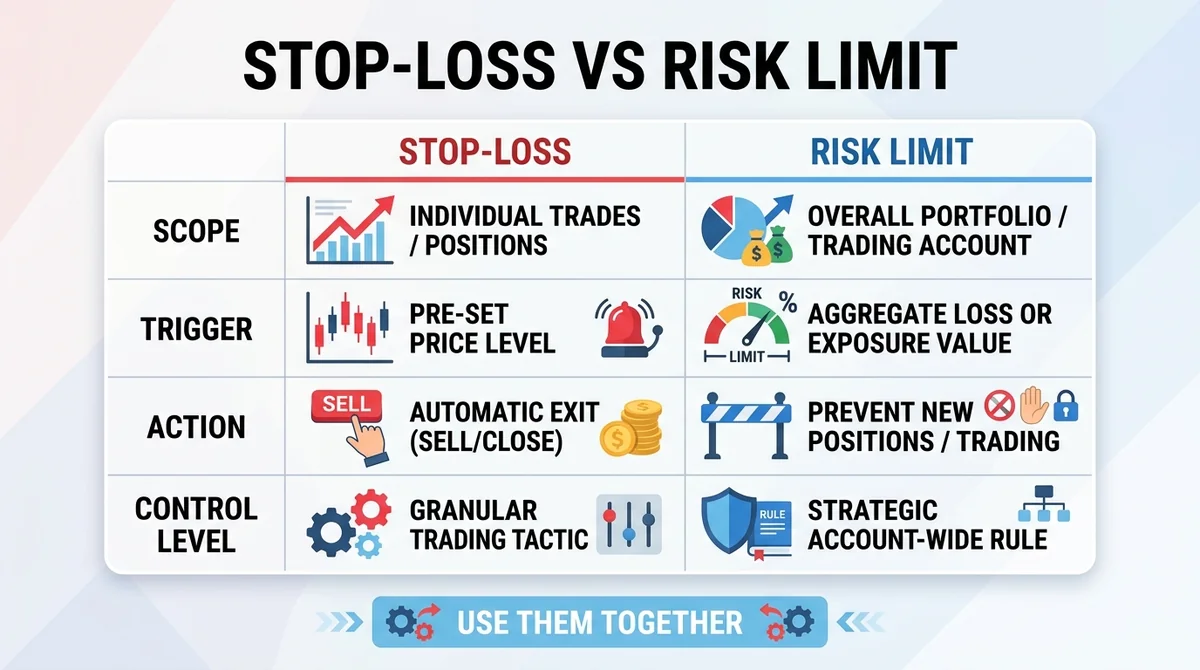
A risk limit is different from a stop-loss, and the difference can be stated in one sentence: a stop-loss is an execution action within a single trade, selling when the price hits a set level; a risk limit is a rule at the overall level, constraining total capital deployed and single-asset allocation. One governs a single trade, the other governs the whole picture, and they need to be used together.
A risk limit generally has three layers:
- Per-trade cap: the maximum you invest in a single trade
- Total capital cap: the maximum across all positions combined
- Single-asset allocation cap: the maximum share of one asset
#What Should You Think Through Before Setting Risk Limits?
The order matters: first assess how much loss you can bear, then work backward to the investment cap. Do not start by thinking about how much you want to earn.
Use only spare money that does not affect your daily life. That way, even if you lose, it will not affect your meals or rent.
Analogy: The total capital cap is like the total weight limit of a suitcase, and the per-trade cap is like the weight of each item. If the case will not close, you cannot stuff in more.
#How Do You Set Risk Limits Step by Step?
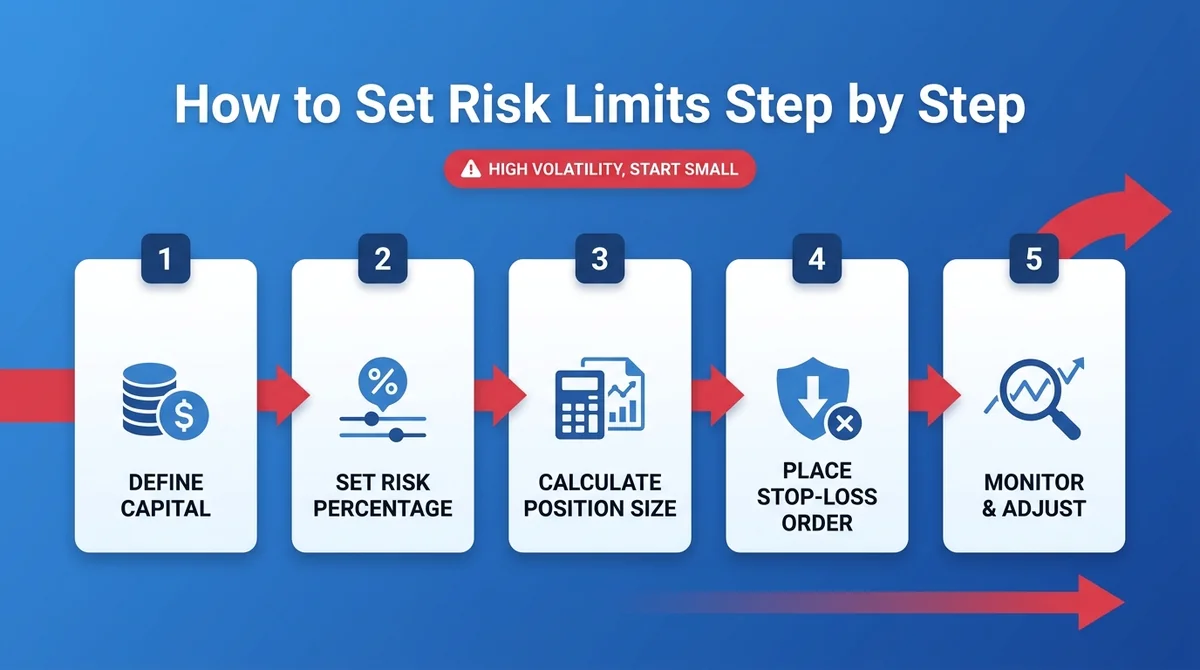
- Determine the total loss you can bear: write down a number that would not affect your life if lost.
- Split it into a per-trade cap: divide the total into several portions; one portion is your per-trade cap.
- Set a single-asset allocation cap: avoid concentrating funds in one asset.
- Write the rules down: put them in a memo, follow them consistently, and do not change them on the fly.
- Review regularly: when your life circumstances change, adjust the limits accordingly.
⚠️ Digital assets are highly volatile; start with small positions. This article explains concepts only and is not investment advice.
#How Do Risk Limits Relate to Wallet Security and Stablecoins?
Wallet security is the first layer of risk limits. If your private key or seed phrase leaks, your principal is lost directly, and any investment cap becomes meaningless. So when setting risk limits, you must factor in wallet security.
HD wallets can use different addresses to separate funds for different purposes. A hardware wallet stores private keys offline, reducing the risk of theft.
Stablecoins are often used for position management, but they carry issuer and depeg risks of their own and are not absolutely safe. When setting risk limits, stablecoin positions should also count toward total exposure, with a buffer reserved for depegging.
#What New Factors Should Risk Limits Consider Once Assets Are On-Chain?
On-chain assets add a layer of smart contract and protocol risk. Tokenized treasury bonds and tokenized commodities also involve issuers, custody fee arrangements, and redemption mechanisms.
How does perpetual futures funding rate work: it is the ongoing cost or income from holding certain contract products, and it changes your actual exposure. When setting risk limits, the funding rate should be counted in your budget as an ongoing cost.
Analogy: The funding rate is like a balancing fee when supply and demand for capital are out of balance — the longer you hold, the more this fee needs to be budgeted for.
So total exposure must include both technical risk and counterparty risk. Once assets are on-chain, setting risk limits is no longer a simple price stop-loss but a comprehensive constraint on contracts, issuers, and custodians.
#What Are the Most Common Mistakes When Setting Risk Limits?
- Loosening the limit after a loss: this is equivalent to canceling the limit.
- Using borrowed money: losses are amplified, and you also face repayment pressure.
- Assuming diversification means no risk: diversification only reduces single-asset risk; systemic risk remains.
- Setting it once and never revisiting it: limits need regular review.
This article explains concepts only and is not investment advice. Before putting anything into practice, confirm your own risk tolerance.
#FAQ
#What is a risk limit?
A risk limit is the maximum loss boundary an investor sets in advance before trading, usually divided into three layers: per-trade cap, total capital cap, and single-asset allocation cap. It is a discipline tool that does not depend on any market judgment.
#What is the difference between a risk limit and a stop-loss?
A stop-loss is an execution action at the single-trade level, selling when the price hits a set level; a risk limit is a rule at the overall level, constraining total capital deployed and single-asset allocation. One governs a single trade, the other governs the whole picture, and they need to be used together.
#Should beginners set the total capital cap or the per-trade cap first?
Set the total capital cap first, then split out the per-trade cap. The order is: assess how much loss you can bear, work backward from your spare money to a total, and only then divide that total into portions as the boundary for each trade.
#Why should risk limits account for funding rates and smart contract risk?
Once assets are on-chain, besides price volatility you also bear smart contract and protocol risk, issuer and custody risk, and the ongoing cost of funding rates. All of these change your actual exposure and should be included in the total limit.
#Can a risk limit be adjusted on the fly once set?
Loosening it after a loss is not recommended — that is equivalent to canceling the limit. You can review it regularly based on changes in your life and finances, but adjustments should be decided in advance when you are calm, not made during emotional swings.
FAQ
What is a risk limit?
A risk limit is the maximum loss boundary an investor sets in advance before trading, usually divided into three layers: per-trade cap, total capital cap, and single-asset allocation cap. It is a discipline tool that does not depend on any market judgment.
What is the difference between a risk limit and a stop-loss?
A stop-loss is an execution action at the single-trade level, selling when the price hits a set level; a risk limit is a rule at the overall level, constraining total capital deployed and single-asset allocation. One governs a single trade, the other governs the whole picture, and they need to be used together.
Should beginners set the total capital cap or the per-trade cap first?
Set the total capital cap first, then split out the per-trade cap. The order is: assess how much loss you can bear, work backward from your spare money to a total, and only then divide that total into portions as the boundary for each trade.
Why should risk limits account for funding rates and smart contract risk?
Once assets are on-chain, besides price volatility you also bear smart contract and protocol risk, issuer and custody risk, and the ongoing cost of funding rates. All of these change your actual exposure and should be included in the total limit.
Can a risk limit be adjusted on the fly once set?
Loosening it after a loss is not recommended — that is equivalent to canceling the limit. You can review it regularly based on changes in your life and finances, but adjustments should be decided in advance when you are calm, not made during emotional swings.
Related Terms
Want to see the real data for this concept?
After you sign up, you can view live prices, funding rates, and fees for the related assets.
View live prices and fees →