How to Read the Discount Rate in an IPO Discount? A Primer on the Gap Between Issue Price and First-Day Opening Price (2026)
The IPO discount rate measures the gap between issue price and first-day opening price, calculated as (first-day open − issue price) ÷ issue price.
IPO discount rate: a metric that measures the size of the price gap between a new stock's issue price and its first-day opening price, describing the distance between primary-market offering pricing and secondary-market first-day prices.
#What does IPO discount rate mean?
Discount rate: here, "discount" refers to the price gap between the issue price and the first-day opening price — not a retail markdown.
It measures how much the issue price set at the time of the offering differs from the price at the opening of the first trading day.
Analogy: similar to the price gap between a pre-sale item and its market quote after launch. A price is set during pre-sale, while the market quote at official launch may be higher or lower — the discount rate is the percentage describing that gap.
Note: the discount rate is an after-the-fact observation metric, not an ex-ante promise.
#How is the IPO discount rate calculated? How do you read the gap between issue price and opening price?
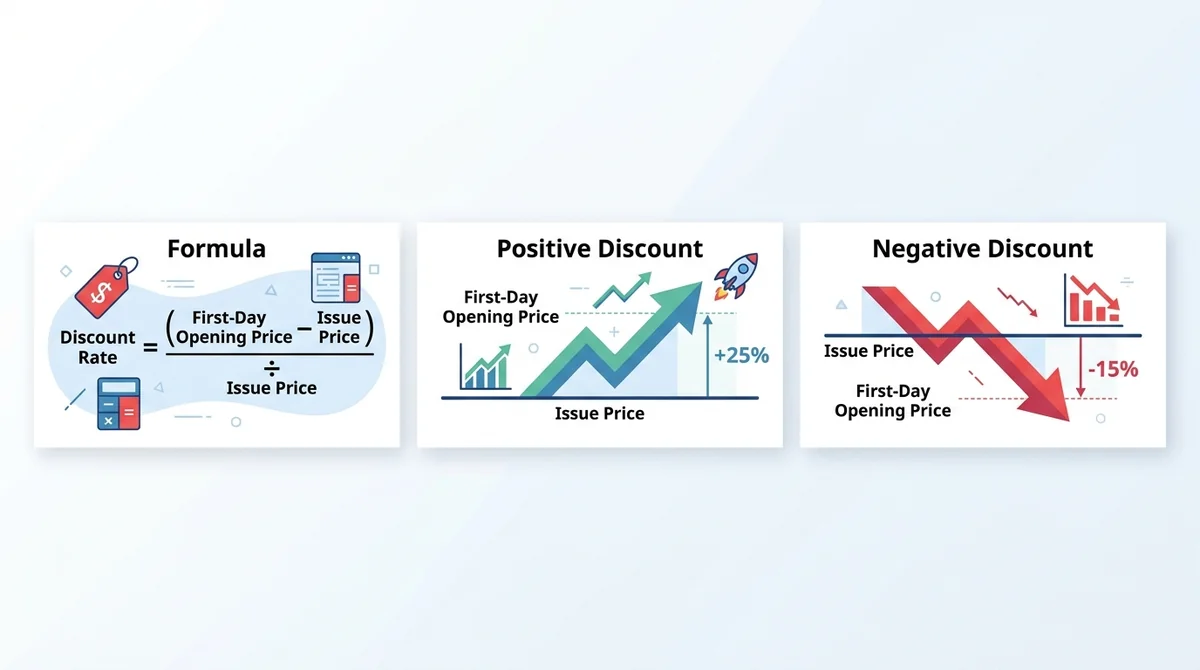
Formula: discount rate = (first-day opening price − issue price) ÷ issue price.
Positive discount: the first-day opening price is above the issue price, meaning secondary-market first-day trading prices were higher than the offering price.
Negative discount: the first-day opening price is below the issue price, meaning the first-day opening price was lower than the offering price.
Why use the issue price as the base: to keep the comparison consistent, all new stocks are referenced against their issue price.
Analogy: like using the same ruler to measure different things — the issue price is the zero mark on that ruler.
#Why does a price gap appear between the issue price and the first-day opening price?
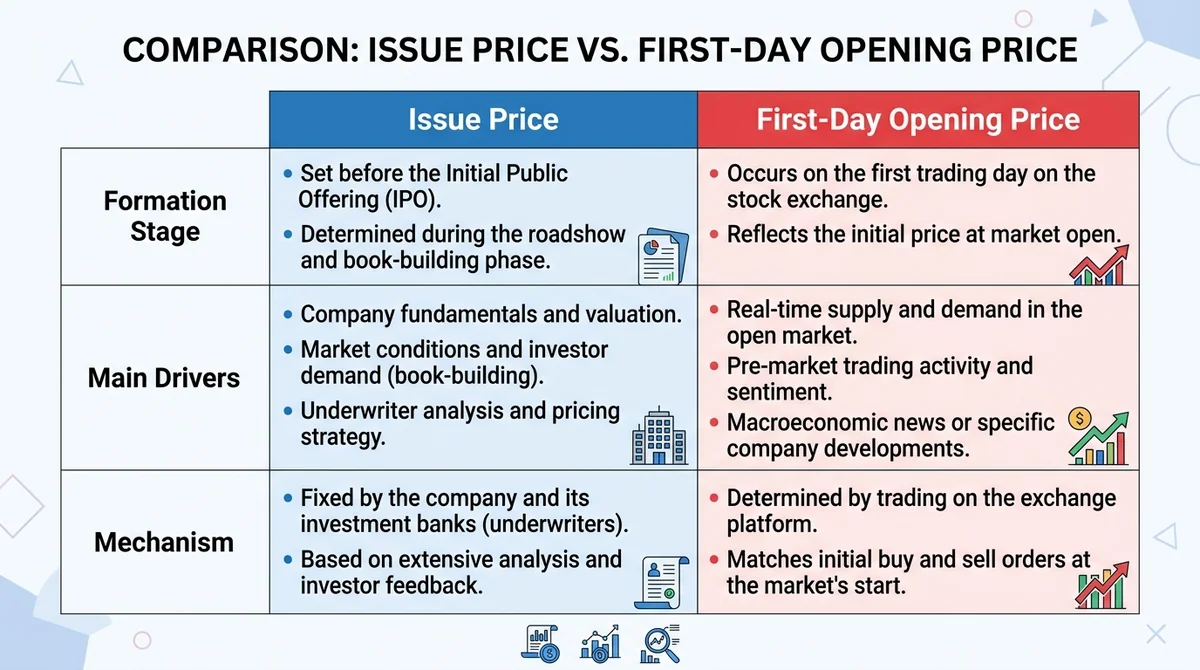
Issue price: determined during the offering and underwriting process, usually referencing company fundamentals, comparable-company valuation, market conditions and other factors.
First-day opening price: formed by secondary-market order matching, influenced by supply and demand, market sentiment and liquidity conditions.
The two are formed through different mechanisms, so a price gap is a common phenomenon.
Does a large gap mean the pricing was flawed: not necessarily. A large gap only shows a divergence between primary-market pricing and secondary-market first-day trading.
#What misunderstandings arise when reading an IPO discount rate?
Misunderstanding 1: a high discount rate means IPO subscription is guaranteed to be profitable. The discount rate is a single-point price gap, not a return promise.
Misunderstanding 2: a negative discount rate means the IPO failed. A negative discount only means the first-day opening price was below the issue price; it does not indicate a problem with company quality.
Misunderstanding 3: the discount rate can predict subsequent price moves. It only reflects a historical price gap and is not used for price forecasting.
#What risks should you watch when using IPO discount rate information?
First-day prices can be volatile, and the discount rate is only a retrospective metric reflecting the price gap at a single point in time.
Beginners should treat it as an introductory concept for understanding primary-market pricing and secondary-market trading mechanisms, not as a basis for decisions.
Any IPO subscription decision carries risk; this article is conceptual education only and does not constitute investment advice.
FAQ
Is a positive or negative IPO discount rate better?
Neither is inherently better. A positive discount means the first-day opening price was above the issue price, while a negative discount means it was below; both merely describe the direction of the price gap and should be understood in the context of the specific market environment.
Can the IPO discount rate be used to predict how a new stock will perform after listing?
No. The discount rate only reflects the single-point price gap between the issue price and the first-day opening price. It is an after-the-fact metric, cannot be used to predict subsequent price moves, and does not constitute investment advice.
Why is the issue price used as the base for the IPO discount rate?
Using the issue price as the base keeps the comparison consistent. All new stocks are referenced against their issue price, so discount rates can be compared across different new listings.
Does a negative discount rate mean the IPO failed?
No. A negative discount only means the first-day opening price was below the issue price, which may be affected by market sentiment, supply and demand and other factors. It does not mean the offering failed or that the company's quality is questionable.
Related Terms
Want to see the real data for this concept?
After you sign up, you can view live prices, funding rates, and fees for the related assets.
View live prices and fees →