IPO Explained: What Is an Initial Public Offering?
Learn Initial Public Offering (IPO) fundamentals, discover the step-by-step issuance process, key risks, and modern tokenized market alternatives in detail.
An Initial Public Offering (IPO) is the process where a private corporation offers its shares to the public for the first time on a stock exchange. This transition enables private businesses to raise institutional and retail equity capital, facilitate liquidity for early founders, and establish transparent market valuation under formal regulatory oversight.
#Key Takeaways
- Corporate Milestone: An IPO marks a private company's transition into a publicly traded corporation.
- Structured Lifecycle: The issuance process includes investment banking underwriting, regulatory filing, a public bidding window, and final share allotment.
- Capital Formation: Going public provides long-term growth financing, enhances brand visibility, and creates an exit pathway for early venture investors.
- Inherent Market Risks: Early secondary market trading often experiences high price volatility, valuation hype, and unfulfilled listing gains.
- Evolving Markets: Modern financial structures now bridge traditional public offerings with pre-IPO allocations and on-chain tokenized securities.
#What Is an IPO (Initial Public Offering)?
An Initial Public Offering represents the primary equity issuance where a privately held enterprise issues shares to general retail and institutional market participants. Before an IPO, a business operates with a restricted cap table consisting of founders, private equity sponsors, angel investors, and venture capitalists.
Private Company (Founders & VCs)
       │
       ▼ [Regulatory Filing & Underwriting]
Public Company (Listed on Stock Exchange for All Investors)
#Simple Definition of an IPO
In simple financial terms, an IPO is the corporate event where ownership equity is split into fractional shares and listed on a regulated securities exchange. Once listed, any investor with a standard brokerage account can buy and sell these shares at dynamic market prices.
#Transition from a Private Company to a Public Company
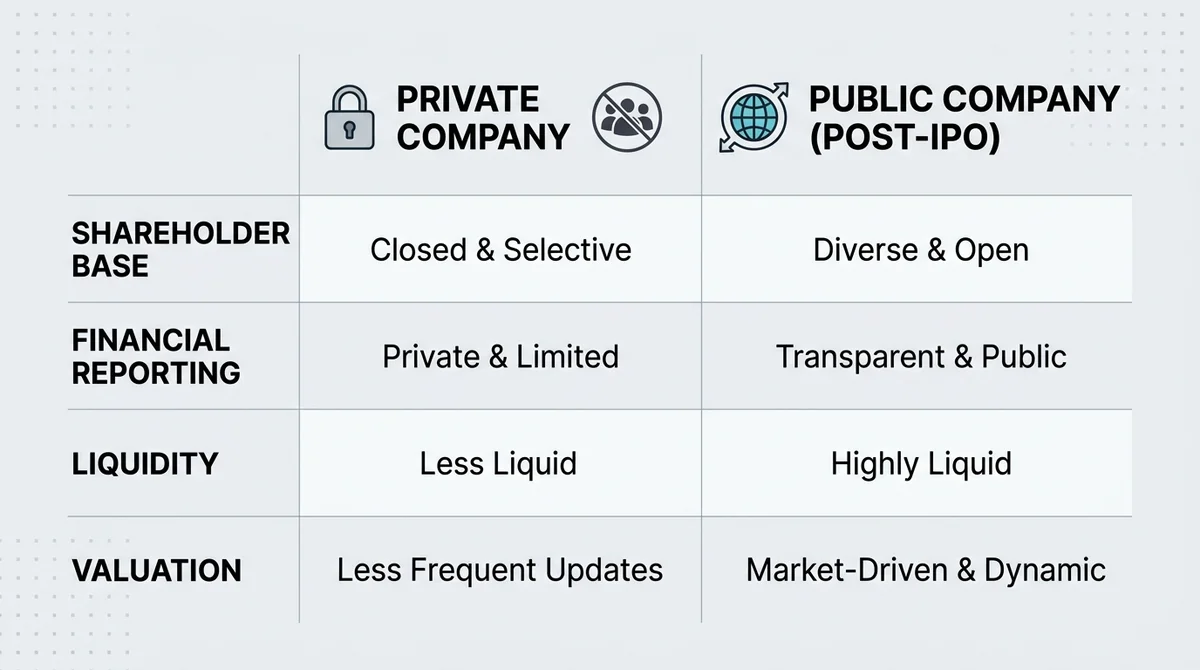
Transitioning from private status to a public listing alters an organization's governance, regulatory obligations, and shareholder rights. Key differences include:
| Feature | Private Company | Public Company (Post-IPO) |
|---|---|---|
| Shareholder Base | Restricted to founders, employees, and venture funds | Open to retail, institutional, and international public |
| Reporting Mandates | Confidential internal financials | Mandatory quarterly and annual public audited disclosures |
| Liquidity Profile | Illiquid; trades require private secondary approvals | Highly liquid on public exchanges with real-time order books |
| Valuation Mechanism | Determined during private venture funding rounds | Continuous market valuation set by public supply and demand |
Citable Definition: An Initial Public Offering (IPO) transitions a private company into a regulated public entity by offering corporate shares to global public markets for the first time. This mechanism establishes a formal market valuation, democratizes investor access across retail and institutional sectors, and mandates rigorous regulatory transparency under securities oversight.
#How Does an IPO Work Step by Step?
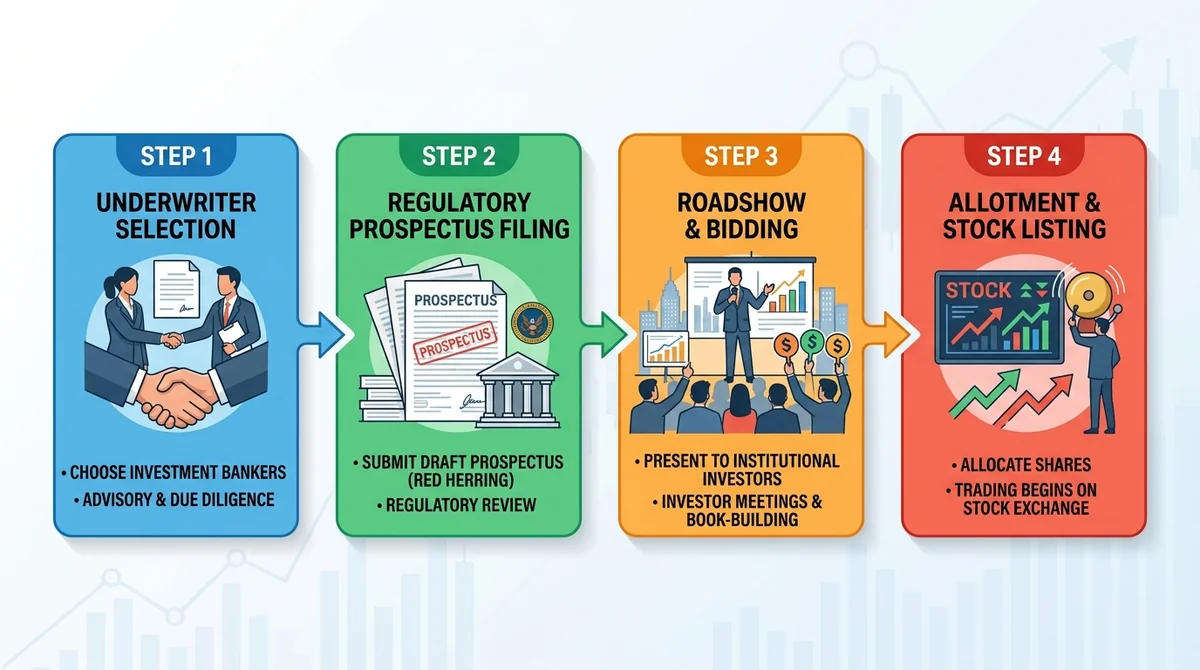
The IPO mechanism follows a structured timeline involving financial intermediaries, legal auditing, and capital allocation.
1. Underwriter Selection ➔ 2. Regulatory Filing (Prospectus) ➔ 3. Roadshow & Bidding ➔ 4. Allotment & Listing
#Hiring Underwriters and Investment Banks
A company begins the IPO journey by hiring institutional merchant banks and underwriters. Underwriters conduct comprehensive financial due diligence, structure the capital distribution, assess market appetite, and establish an initial valuation corridor.
#Filing the Prospectus with Financial Regulators
The underwriter drafts and files a detailed disclosure document—often called a Draft Red Herring Prospectus (DRHP) or Form S-1—with relevant securities regulators. This document details:
- Historical audited balance sheets, revenues, and debt metrics.
- Growth trajectory, business model breakdown, and operational risks.
- The exact intended use of newly raised proceeds.
#Price Band Setting, Bidding, and Share Allotment
Once approved by regulators, the company initiates an investor roadshow and opens a bidding window:
- Price Band Announcement: Management sets a floor and ceiling price per share.
- Subscription Window: Retail and institutional investors submit bids through supported banking gateways or brokerages. Traders tracking speculative secondary interest often examine the IPO Grey Market Premium (GMP) to gauge pre-listing sentiment.
- Share Allotment: If demand exceeds supply (oversubscription), shares are allotted proportionally or via randomized algorithmic mechanisms.
- Listing Day: Shares commence live secondary trading on the target stock exchange.
Citable Passage: During an IPO distribution cycle, underwriting banks establish a structured bidding corridor where institutional and retail bids determine the final clearing price. Upon closing the subscription book, shares are officially credited to investor accounts, transitioning the asset from primary issuance into standard continuous secondary market trading.
#Why Do Companies Launch an IPO?
Organizations choose public listings to scale operational capacity, provide liquidity, and enhance organizational credibility.
#Raising Capital for Expansion and Innovation
An IPO allows firms to secure substantial non-debt capital directly from global equity markets. Unlike corporate bank loans or debt instruments, equity financing does not require regular interest amortization, allowing capital to flow into research, infrastructure, and acquisitions.
#Providing Liquidity and Exit Opportunities for Early Investors
Early backers—such as venture capital funds and founding employees with equity options—require an accessible secondary marketplace to monetize their initial stakes. A public listing unlocks deep liquidity pools that facilitate orderly divestment.
#Enhancing Brand Credibility and Public Visibility
Listed firms generally benefit from higher consumer trust, transparent governance ratings, and broader media coverage. Furthermore, a publicly traded stock currency allows companies to execute mergers and strategic acquisitions using listed equity shares.
#What Are the Key Risks and Common Misconceptions of IPOs?
While public offerings offer access to emerging companies, market participants must separate promotional narratives from foundational financial realities.
Common IPO Risks:
├── Listing Day Price Drops (Underwriter mispricing)
├── Speculative Valuation Hype (Unsustainable multiples)
└── Allotment Uncertainty (High oversubscription rates)
#Listing Day Volatility vs Long-Term Fundamentals
A prevalent misconception is that newly listed stocks always generate immediate "listing gains." In reality, short-term opening prices can diverge sharply from intrinsic value based on intraday speculative imbalances, sometimes resulting in rapid capital drawdowns.
#Overvaluation and Market Sentiment Hype
During bull market cycles, aggressive marketing campaigns may inflate price-to-earnings (P/E) or enterprise-value-to-revenue multiples beyond sustainable levels. Investors entering at the initial price band risk multi-year consolidation if forward earnings fail to meet lofty projections.
#No Guaranteed Allocation or Listing Gains
Submitting a bid does not guarantee share allocation. In heavily oversubscribed offerings, retail investors may receive zero shares or minor fractional allotments, limiting upside exposure while still bearing full research overhead.
#Related Financial Terms and Asset Offerings
Capital formation is evolving rapidly, offering varied avenues for equity participation beyond traditional primary stock markets.
#Pre-IPO Investing vs Public Market Trading
Pre-IPO investments occur while the enterprise is still privately held. These opportunities carry significantly higher minimum investment thresholds, extended lock-up periods, and reduced operational liquidity compared to public secondary market spot trading.
#Tokenized Equities and Modern Capital Markets
The integration of blockchain infrastructure is introducing tokenized real-world assets (RWA) to digital finance. Through emerging RWA tokenization protocols, public equities and private assets can be represented on-chain, enabling continuous settlement, fractional participation, and borderless market infrastructure alongside traditional public exchanges.
FAQ
What is an Initial Public Offering (IPO) in simple terms?
An IPO is the process where a private company sells its equity shares to the public for the first time, allowing retail and institutional investors to purchase its stock on a regulated exchange.
Can any investor participate in an IPO?
Yes, once an IPO opens for subscription, any investor with a verified brokerage or securities trading account can submit a bid within the specified price band during the offering period.
Are IPOs guaranteed to make a profit on listing day?
No, IPOs carry market risk and are not guaranteed to appreciate; share prices on listing day depend on broader market sentiment, initial valuation accuracy, and real secondary market demand.
What is the difference between pre-IPO and an IPO?
Pre-IPO refers to private equity placements conducted before a company goes public, whereas an IPO is the formal event where shares become available to the broader public on an official exchange.
Want to see the real data for this concept?
After you sign up, you can view live prices, funding rates, and fees for the related assets.
View live prices and fees →