Are IPO Lock-Up Period and Selling Restriction the Same? A Beginner's Guide to the Terms (2026)
IPO lock-up period and selling restriction usually mean the same thing: certain shareholders can't sell after listing. Here's how the terms differ.
Answer: In most cases, yes. Both refer to the situation where specific shareholders cannot sell their shares for a set period after a new stock lists; the lock-up period emphasizes time, while the selling restriction emphasizes the act of being barred from selling.
#Are the IPO lock-up period and selling restriction the same thing?
In everyday usage, the two terms are often used interchangeably. They point to the same kind of arrangement: after a new stock lists, some people temporarily cannot sell their shares.
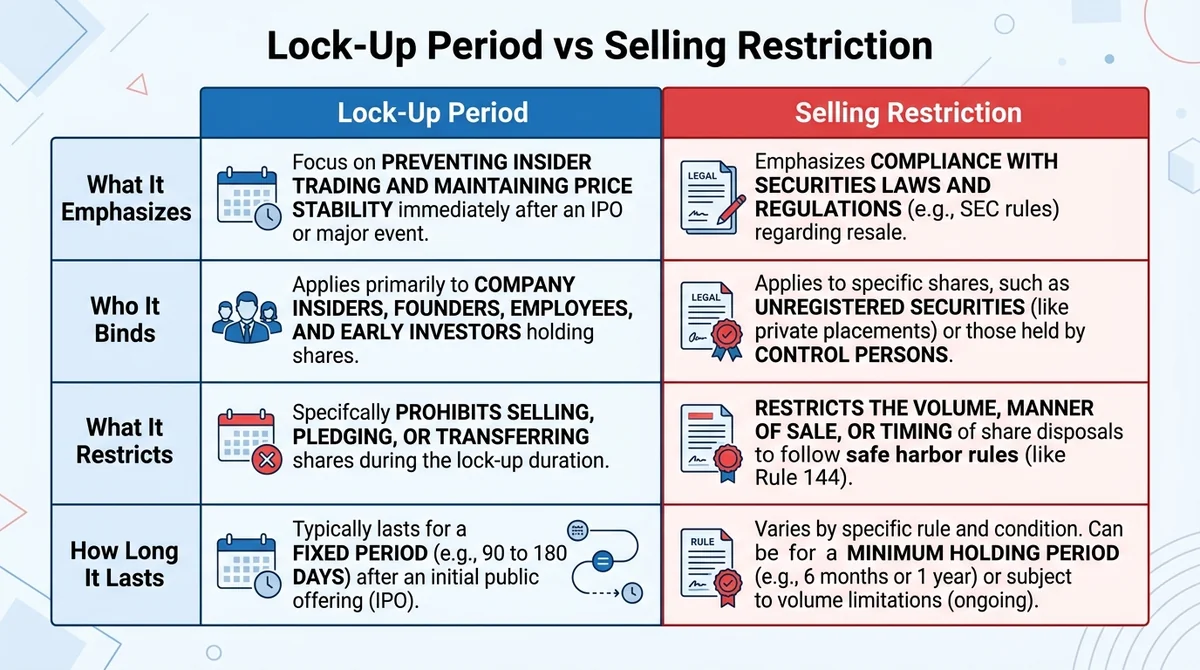
The difference is in emphasis. The lock-up period is about "how long the lock lasts," a time dimension; the selling restriction is about "no selling allowed," a behavioral dimension.
An analogy: a lock-up period is like putting a timed lock on the car door, while a selling restriction is like a sign on the door saying "this door will not open for now." It's the same door — one talks about how long it's locked, the other about not being able to open it.
#What exactly does the English term lock-up mean?
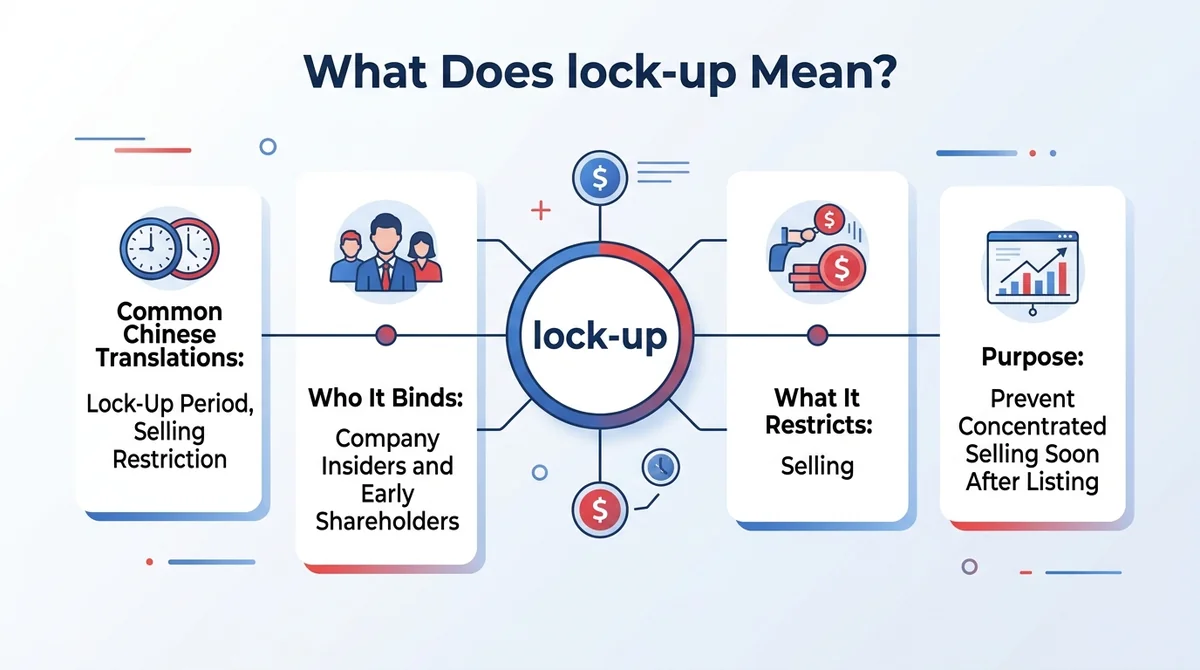
lock-up is the most common English expression. In Chinese materials, it is translated both as lock-up period and as selling restriction.
It does not bind all investors — usually it covers company insiders and early shareholders. These people hold shares at relatively low cost and in large quantities, and one purpose of the restriction is to prevent concentrated selling soon after listing.
- English: lock-up
- Common Chinese translations: lock-up period, selling restriction
- Who it binds: company insiders, early shareholders
- What it restricts: selling
#What exactly does a lock-up period restrict?
It restricts three things — "who, does what, for how long" — and all three matter.
- Who: specific shareholders, not all investors
- What: the act of selling, not holding
- How long: set by the offering arrangement, and it varies
So when you see the words "lock-up period," don't assume it's a universal rule. It only applies to specific groups. The exact term and scope vary by offering arrangement; this article gives no single figure — refer to the disclosures in the relevant offering documents.
#Why does understanding these terms matter for beginners?
Mixing up the terms easily leads to one misunderstanding: assuming the selling restriction is a rule for everyone. In fact, it only binds specific shareholders.
When reading materials, just focus on three points: who is bound, how long the term is, and what behavior is prohibited.
Telling these apart helps you correctly read new-stock selling arrangements and avoid mistaking a specific restriction for a universal rule. This article covers concepts only and is not investment advice.
Further reading: see IPO Lock-Up Period: Definition, Mechanism, and Risks and What Is IPO Due Diligence? A Beginner's Guide.
FAQ
Do the IPO lock-up period and selling restriction mean the same thing?
In most contexts they refer to the same kind of arrangement: after a new stock lists, specific shareholders cannot sell their shares for a set period. The difference is in emphasis: the lock-up period stresses the length of time, while the selling restriction stresses the act of being barred from selling, and the two are often used interchangeably.
How should lock-up be translated into Chinese?
lock-up is the most common English expression, and in Chinese it can be translated as either lock-up period or selling restriction. It typically binds company insiders and early shareholders, not all investors.
Does a lock-up period bind all investors?
No. A lock-up period only binds specific shareholders, such as company insiders and early shareholders, restricting their act of selling shares within the agreed term. The term is set by the offering arrangement and is not a universal restriction on all investors.
What should I look for when reading new-stock materials?
Focus on three points: who is bound, how long the term is, and what behavior is prohibited. Once you distinguish these three, you won't mistake a specific shareholder's selling restriction for a universal rule that applies to everyone. This article covers concepts only and is not investment advice.
Related Terms
Want to see the real data for this concept?
After you sign up, you can view live prices, funding rates, and fees for the related assets.
View live prices and fees →