IPO Lockup Period: Definition, Mechanics, and Risks
Understand IPO lockup periods: why they last 90-180 days, how they affect stock and crypto price stability, and what token unlocks mean for investors.
#IPO Lockup Period: Definition, Mechanics, and Risks
An IPO lockup period is a predetermined timeframe after a public listing during which early investors and company insiders are prohibited from selling their shares or tokens. This restriction is designed to reduce immediate sell pressure and stabilize the market. In traditional IPOs, lockups typically last 90 to 180 days, while crypto projects often use smart contracts to enforce customizable vesting schedules.
Key Takeaways:
- Lockup periods prevent insiders from selling immediately after a public listing, reducing early volatility.
- Traditional IPO lockups usually last 90–180 days; crypto lockups vary and are defined by tokenomics.
- Smart contracts can automate token releases, often using linear or cliff vesting schedules.
- Lockup expiration does not always cause price drops; market conditions and fundamentals matter.
- Retail investors should review unlock schedules and tokenomics before investing.
#What Is an IPO Lockup Period?
An IPO lockup period is a contractual restriction that prevents certain shareholders from selling their shares for a specified time after an IPO. The purpose is to prevent a flood of shares from hitting the market immediately, which could depress the stock price. In crypto, similar lockups apply to tokens distributed to team members, advisors, and early investors. The lockup period typically lasts 90 to 180 days in traditional IPOs, but crypto lockups vary widely and are often defined by tokenomics.
Historically, lockup periods became standard practice to reassure public investors that insiders would not cash out immediately after the listing. This mechanism aligns the interests of insiders with the long-term success of the company or project. For example, a 180-day lockup means that pre-IPO shareholders cannot sell their shares until six months after the IPO date. This period allows the market to absorb the new shares gradually and establishes a more stable trading range.
#How Does an IPO Lockup Period Work?
Lockup agreements are set before the IPO and are disclosed in regulatory filings. In traditional IPOs, the lockup period is legally binding and prevents insiders from selling their shares until the period ends. The underwriting bank often enforces the lockup, and any violation can lead to legal consequences. In crypto, projects may use smart contracts to lock tokens and release them gradually according to a vesting schedule. Smart contracts provide transparency and automation, ensuring that tokens are distributed exactly as programmed without the need for a central authority.
Vesting schedules in crypto can be linear or cliff-based. A linear vesting schedule releases tokens gradually over time, such as monthly or daily. A cliff vesting schedule requires a waiting period before any tokens are released, followed by a lump sum or gradual distribution. For example, a project might lock team tokens for one year (cliff), then release them monthly over two years (linear). This structure incentivizes long-term commitment and reduces the risk of immediate sell-offs.
#Examples of IPO Lockup Periods
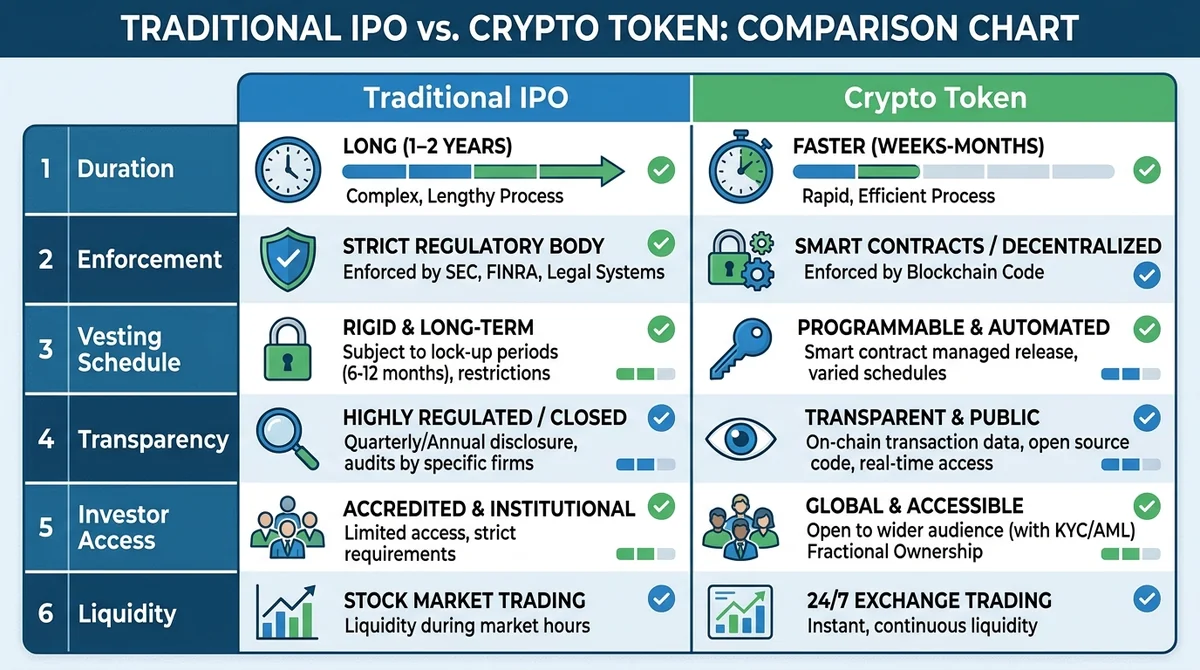
In a traditional IPO, a company might set a 180-day lockup for pre-IPO shareholders. For instance, a technology company going public could require its executives and early investors to hold their shares for six months after the IPO. This period allows the market to establish a fair value without the pressure of insider selling. In crypto, a project might lock team tokens for 1 year, then release them monthly over 2 years. This means that after the first year, 1/24 of the total team allocation is unlocked each month. Different projects have different lockup and vesting terms, so investors should always check the specific tokenomics.
Another example is a decentralized finance (DeFi) protocol that locks its governance tokens for early backers. The lockup could be enforced by a smart contract that automatically releases tokens to the backers' wallets according to a predefined schedule. This ensures that no single entity can dump a large number of tokens at once, protecting the token's price and the community's trust.
#Why Is an IPO Lockup Period Important?
Lockups prevent a flood of shares or tokens from hitting the market immediately, helping to stabilize prices. They align the interests of insiders with long-term project success. For retail investors, understanding lockup expirations can help anticipate volatility. When a lockup expires, a large number of shares or tokens may become available for sale, which can increase supply and put downward pressure on the price. However, the actual impact depends on market conditions, the project's fundamentals, and the overall sentiment.
For example, if a project has strong fundamentals and positive news, a lockup expiration may not lead to a significant price drop because demand absorbs the additional supply. Conversely, if the market is bearish or the project is struggling, a large unlock could exacerbate selling pressure. Therefore, investors should monitor upcoming unlock events and assess the potential impact on the market.
#Risks and Common Misconceptions About Lockup Periods
A common misconception is that lockup expiration always causes a price crash. While it can increase sell pressure, the actual impact depends on market conditions and project fundamentals. In many cases, the market anticipates the unlock and prices it in advance, so the event itself may have a muted effect. However, a large unlock can increase selling pressure and volatility, especially if the market is already fragile.
Investors should review tokenomics and unlock schedules before investing. This includes checking the percentage of total supply that will be unlocked, the vesting schedule, and the distribution to team members, advisors, and early investors. Projects with transparent and well-structured unlock schedules are generally more trustworthy. Additionally, investors should be aware of the risks associated with lockup expirations and consider them as part of their overall risk management strategy.
#How to Evaluate Lockup Schedules as a Retail Investor
As a retail investor, you can take several steps to assess lockup schedules and their potential impact on a project's token price. First, review the project's whitepaper or official documentation to understand the token distribution and vesting terms. Look for details on cliff periods, linear releases, and the total percentage of tokens allocated to insiders. Second, use token tracking platforms to monitor upcoming unlock events and their sizes. These platforms often provide a calendar of unlock events and the expected amount of tokens to be released.
Third, consider the project's fundamentals and market conditions. A project with strong adoption, revenue, and community support is more likely to absorb additional supply without a significant price drop. Fourth, diversify your portfolio and avoid overexposure to tokens with large upcoming unlocks. Finally, remember that lockup expirations are just one factor among many that can affect token prices. Always do your own research and consult with a financial advisor if needed.
FAQ
What is a lockup period in an IPO?
A lockup period is a contractual restriction that prevents certain shareholders from selling their shares for a specified time after an IPO, typically 90 to 180 days.
How do crypto token lockups work?
Crypto projects may use smart contracts to lock tokens and release them gradually according to a vesting schedule, which can vary widely based on tokenomics.
Does a lockup expiration always cause a price drop?
No, not all lockup expirations lead to price drops. The actual impact depends on market conditions and project fundamentals, though a large unlock can increase selling pressure.
How can I check a crypto project's lockup schedule?
You can review a project's tokenomics and unlock schedules, which are often detailed in whitepapers or on token tracking platforms, before investing.
Why are lockup periods important for investors?
Lockup periods help stabilize prices after a listing and align insider incentives with long-term project success, so understanding them can help investors anticipate volatility.
What is the difference between cliff and linear vesting?
Cliff vesting requires a waiting period before any tokens are released, followed by a lump sum or gradual distribution, while linear vesting releases tokens gradually over time, such as monthly or daily.
Related Terms
Want to see the real data for this concept?
After you sign up, you can view live prices, funding rates, and fees for the related assets.
View live prices and fees →