IPO Meaning in Hindi: What Is an Initial Public Offering?
Learn the IPO meaning in Hindi (आरंभिक सार्वजनिक प्रस्ताव), how public offerings work, key risks, and tokenized equity models in this 2026 beginner guide.
An Initial Public Offering (IPO), known in Hindi as प्रारंभिक सार्वजनिक प्रस्ताव (Prarambhik Sarvajanik Prastav), is the formal financial process where a privately held corporation offers its shares to institutional and retail public investors for the first time, enabling capital expansion and listing on a recognized stock exchange.
#Key Takeaways
- Hindi Translation: IPO translates to प्रारंभिक सार्वजनिक प्रस्ताव, representing a company's transition from private ownership to public equity.
- Capital Generation: Companies issue IPOs to raise primary capital for operational scaling, debt repayment, and research.
- Multi-Step Lifecycle: The public issuance journey involves underwriting, regulatory prospectus filing, book-building price discovery, and market listing.
- Modern Evolution: Blockchain technology and Real-World Asset (RWA) tokenization are introducing fractional access to public and pre-IPO equities alongside traditional stock markets.
#What Is the Meaning of IPO (Initial Public Offering)?
An Initial Public Offering (IPO) represents the pivotal milestone where an unlisted, privately owned enterprise opens its share capital to the broader investing public.
#Hindi Definition and Terminology (आरंभिक सार्वजनिक प्रस्ताव)
In Hindi financial terminology, an IPO is termed प्रारंभिक सार्वजनिक प्रस्ताव (Prarambhik Sarvajanik Prastav). The phrase literally breaks down into "Prarambhik" (Initial or First), "Sarvajanik" (Public or Open to all), and "Prastav" (Proposal or Offering). In everyday Hindi financial discussions, market participants also refer to it simply as शेयर बाजार में कंपनी की पहली लिस्टिंग (a company's first listing on the share market).
An Initial Public Offering (IPO), translated into Hindi as प्रारंभिक सार्वजनिक प्रस्ताव (Prarambhik Sarvajanik Prastav), marks the transition of a private corporation into a publicly traded company. Through an IPO, businesses issue new equity shares to institutional and retail investors, raising necessary capital while subjecting their operational, governance, and financial records to strict regulatory oversight on public stock exchanges.
#Core Concept: Transition from Private to Public
Before an IPO, a business is privately owned by its founders, angel investors, and venture capital syndicates. Liquidity is constrained because shares cannot be freely bought or sold by the general public.
When a company undertakes an IPO:
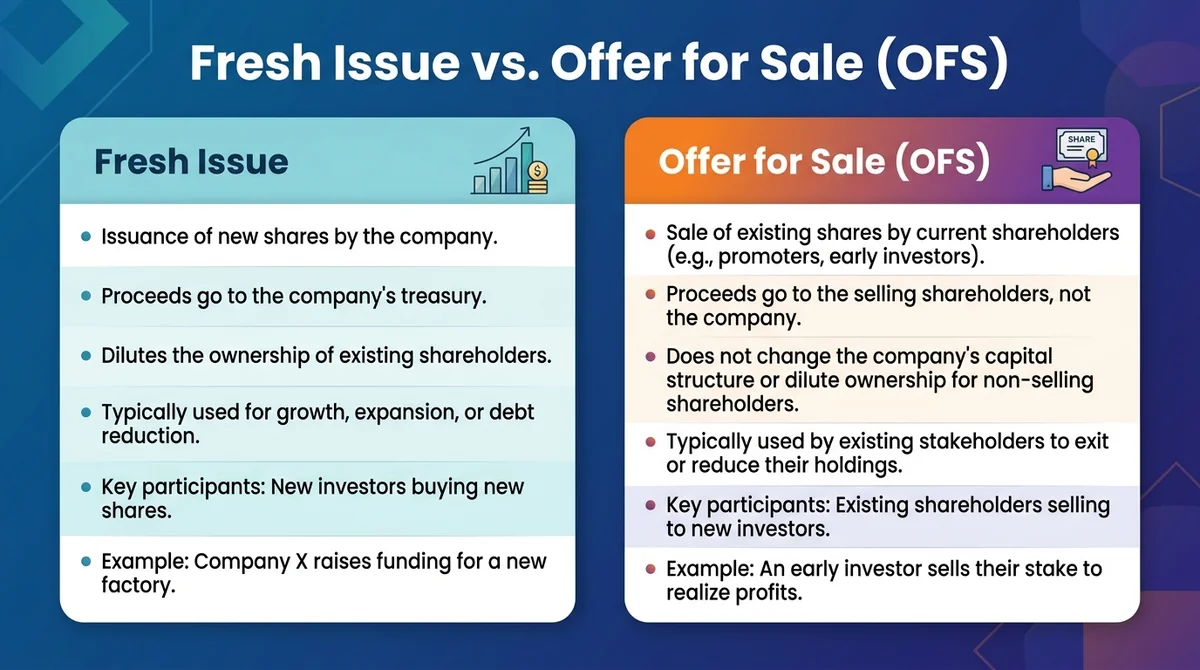
- Fresh Issue: The business creates and sells newly minted shares to inject capital directly onto its balance sheet.
- Offer for Sale (OFS): Existing early-stage investors or promoters sell a portion of their holdings to realize returns without diluting the company's operational treasury.
- Public Trading: Post-offering, the shares trade freely on secondary stock exchanges such as the NSE, BSE, or international equity platforms.
#How Does an IPO Work from Preparation to Listing?
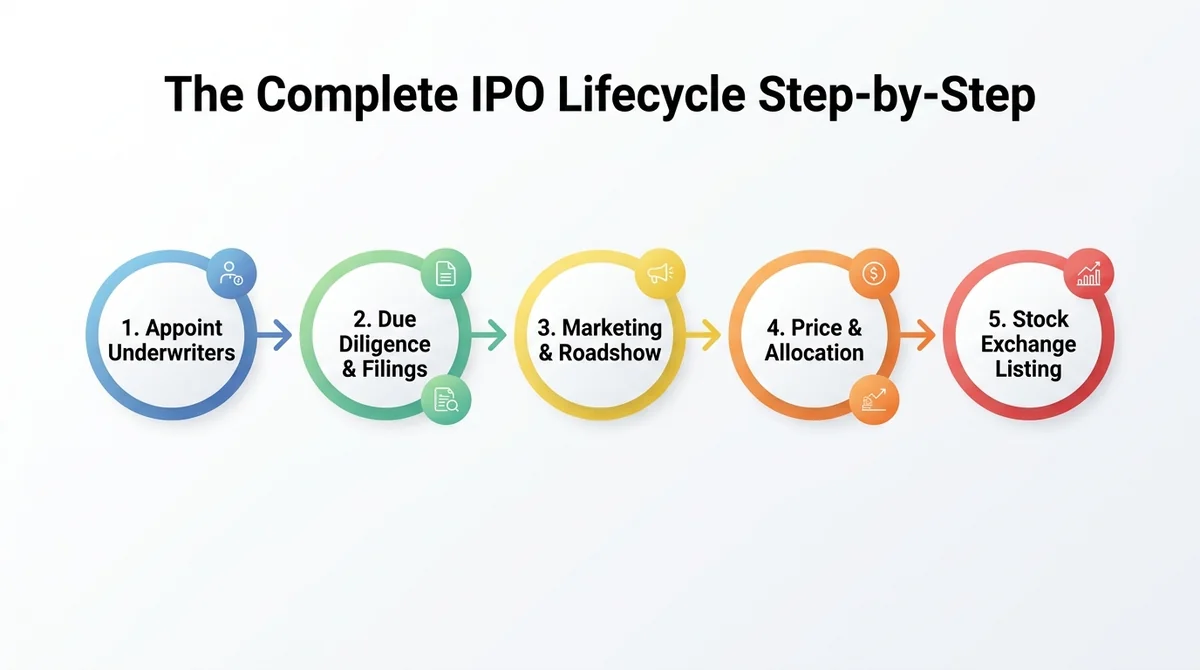
The journey of bringing an IPO to market follows a regulated corporate finance pipeline designed to establish fair valuation and maintain market integrity.
The standard IPO process follows a regulated sequence: the issuing firm hires merchant bankers to underwrite the offering, submits a detailed Draft Red Herring Prospectus (DRHP) to market regulators, establishes a bidding price band, and conducts book-building. Upon closing public subscription, shares are allotted to qualifying bidders before trading begins on secondary market exchanges.
+-----------------------+
| 1. Hire Underwriters  |
+-----------+-----------+
            |
            v
+-----------------------+
| 2. File DRHP / Filing |
+-----------+-----------+
            |
            v
+-----------------------+
| 3. Set Price Band     |
+-----------+-----------+
            |
            v
+-----------------------+
| 4. Public Bidding     |
+-----------+-----------+
            |
            v
+-----------------------+
| 5. Allotment & Listing|
+-----------------------+
#Underwriting and Hiring Investment Banks
The issuing enterprise selects lead managers and merchant banks (underwriters) to structure the transaction. These financial institutions assess the company's valuation, determine the total offering volume, navigate legal compliance, and underwrite the sale to manage liquidity risk.
#Drafting the Prospectus and Regulatory Filing
The company prepares and submits a comprehensive disclosure document—often known as the Draft Red Herring Prospectus (DRHP) in markets like India, or an S-1 registration statement in the United States. This document contains:
- Audited balance sheets, cash flow statements, and income statements.
- Identified business risks, legal proceedings, and industry competition.
- The explicit objective and intended deployment of the proceeds raised.
#Price Band Setting and Public Bidding Process
Issuers typically adopt a book-building mechanism where shares are offered within a specified price floor and ceiling (the price band). During the subscription window (typically 3 to 5 business days), institutional buyers, high-net-worth individuals, and retail investors place bids specifying quantity and target price. Off-market sentiment and anticipated listing margins are often reflected through indicators like IPO GMP (Grey Market Premium) prior to final allotment.
#Why Are IPOs Important for Companies and Retail Investors?
An IPO creates distinct economic advantages for both the issuing corporation and market participants across retail and institutional tiers.
| Stakeholder Group | Primary Advantage | Economic Outcome |
|---|---|---|
| Issuing Company | Growth Capital | Finances business expansion, infrastructure, R&D, or debt reduction. |
| Early Investors | Liquidity & Exit | Allows angel investors and VCs to monetize initial risk capital. |
| Issuing Company | Brand Credibility | Enhances institutional transparency and elevates global public profile. |
| Retail Investors | Direct Equity Access | Enables everyday participants to buy foundational equity at primary issuance rates. |
#Benefits for Issuing Companies: Capital Expansion and Brand Visibility
By accessing broad capital markets, companies avoid high-interest commercial debt while establishing a liquid market value for future mergers and acquisitions (M&A). Listing on a regulated exchange also reinforces customer and supplier trust through mandated financial audits.
#Opportunities for Retail Investors: Early-Stage Public Growth Exposure
For retail investors, participating in an IPO provides an entry point to purchase shares before secondary market price appreciation takes place. Long-term shareholders benefit from corporate growth, potential dividend yields, and voting rights in corporate governance.
#What Are the Major Risks and Common Misconceptions About IPOs?
While public offerings generate significant media attention, they also present substantial financial and valuation risks that retail investors must evaluate.
#Valuation Hype vs. Long-Term Business Fundamentals
A prominent misconception is that every IPO guarantees immediate "listing gains" on debut day. Aggressive merchant banking valuations can price an issue far above intrinsic fundamentals. If market sentiment shifts or broader macroeconomic conditions deteriorate, new listings can trade significantly below their initial offer price upon debut.
#Lock-In Periods and Post-Listing Market Volatility
Key risks to consider before applying for an IPO include:
- Anchor Investor Expirations: Institutional anchor investors often operate under mandatory lock-in schedules (e.g., 30 to 90 days). When these periods expire, large-scale profit-taking can exert downward pressure on share prices.
- Information Asymmetry: Despite regulatory disclosures, private operations have shorter public audit histories than mature blue-chip corporations.
- Subscription Oversubscription: Popular IPOs may allocate only a fraction of requested lots to retail applicants, leading to disproportionate portfolio concentration.
#How Do Traditional IPOs Relate to Tokenized Equities and RWAs?
Financial market infrastructure is evolving beyond legacy paper and centralized depository systems toward on-chain tokenization.
#Pre-IPO Shares and Digital Asset Tokenization
Historically, unlisted pre-IPO private equity was restricted to accredited venture funds due to high capital thresholds. With blockchain-based real-world asset integration, tokenization platforms can wrap verified shares or rights into digital tokens, enabling compliant, fractional ownership of private and pre-IPO enterprises.
#Comparing IPOs with Token Offerings (ICOs/IDOs)
| Feature | Traditional IPO | Token Offering (ICO / IDO) |
|---|---|---|
| Regulatory Framework | Strict oversight (e.g., SEBI, SEC) | Decentralized / Varies by jurisdiction |
| Asset Backing | Legal equity ownership and voting shares | Utility tokens, governance rights, or protocol access |
| Listing Venue | Centralized Stock Exchanges | Decentralized (DEX) or Centralized Crypto Exchanges |
| Settlement Speed | T+1 or T+2 clearing houses | Near-instant on-chain settlement |
FAQ
What is the meaning of IPO in Hindi?
In Hindi, IPO stands for प्रारंभिक सार्वजनिक प्रस्ताव (Prarambhik Sarvajanik Prastav), which means the first time a private company sells its shares to the public to raise funds and list on a stock exchange.
What is the difference between a Fresh Issue and an Offer for Sale (OFS)?
A Fresh Issue creates new shares to raise capital directly for company operations, whereas an Offer for Sale (OFS) involves existing promoters or early investors selling their personal holdings without infusing new capital into the business.
Can an investor lose money in an IPO on listing day?
Yes, investors can experience capital losses on listing day if the issue is overpriced relative to company fundamentals, if market sentiment turns negative, or if institutional demand drops post-allocation.
What is a Draft Red Herring Prospectus (DRHP)?
A DRHP is an initial statutory disclosure document prepared by the issuing company and merchant bankers, detailing financial records, operations, business risks, and the planned use of proceeds for regulatory review.
Want to see the real data for this concept?
After you sign up, you can view live prices, funding rates, and fees for the related assets.
View live prices and fees →