What Is the IPO Process Timeline? A Beginner's Guide to the Stages from Filing to First Day of Trading (2026)
The IPO process timeline maps a company's path from filing its listing application to its first trading day. Here are the four stages: filing, regulatory review, roadshow pricing, and debut.
The IPO process timeline is the sequence of stages a company goes through between "submitting a listing application" and "the first day its stock officially trades." It breaks down into four sequential stages: filing the application → regulatory review and inquiries → roadshow, offering, and pricing → listing on the first day of trading.
Each step has to wait for the previous one to finish, much like an exam: sign up → review → interview → results announced.
#What Is the IPO Process Timeline?
Starting point: The company submits a listing application to regulators — what the news calls "filing."
End point: The first day the stock officially begins trading — the "first day of listing."
The length of time in between varies enormously across companies and markets. This article only covers the general stage framework and makes no promises about review timelines in any specific market.
#What Are the Main Stages of the IPO Process?
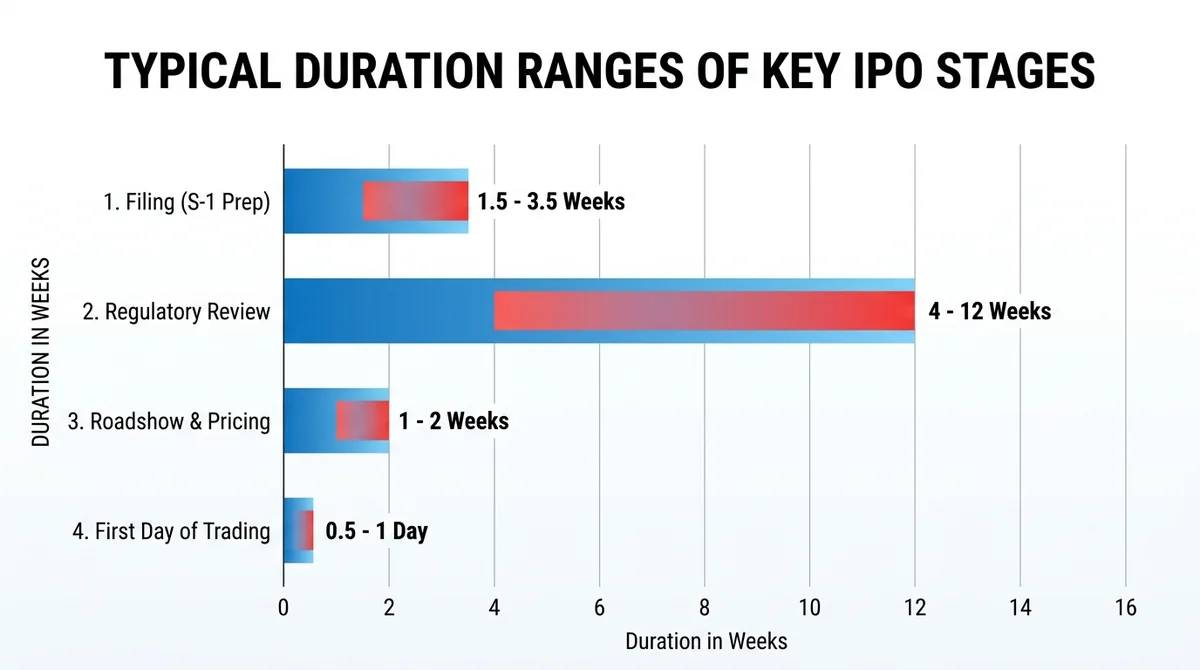
The IPO process timeline is divided into four sequential stages: filing the application, regulatory review and inquiries, roadshow and pricing, and the first day of listing. Only after one stage is completed does the next begin.
- Filing the application: The company prepares its prospectus and other materials and formally submits them to regulators.
- Regulatory review and inquiries: Regulators raise questions, the company responds point by point, and this may go back and forth several rounds.
- Roadshow, offering, and pricing: The company presents to potential investors, collects indications of interest, and finally sets the issue price.
- First day of listing: The stock begins trading on the exchange, and public-market investors can trade it.
#Which Stage Do IPO Terms in the News Refer To?
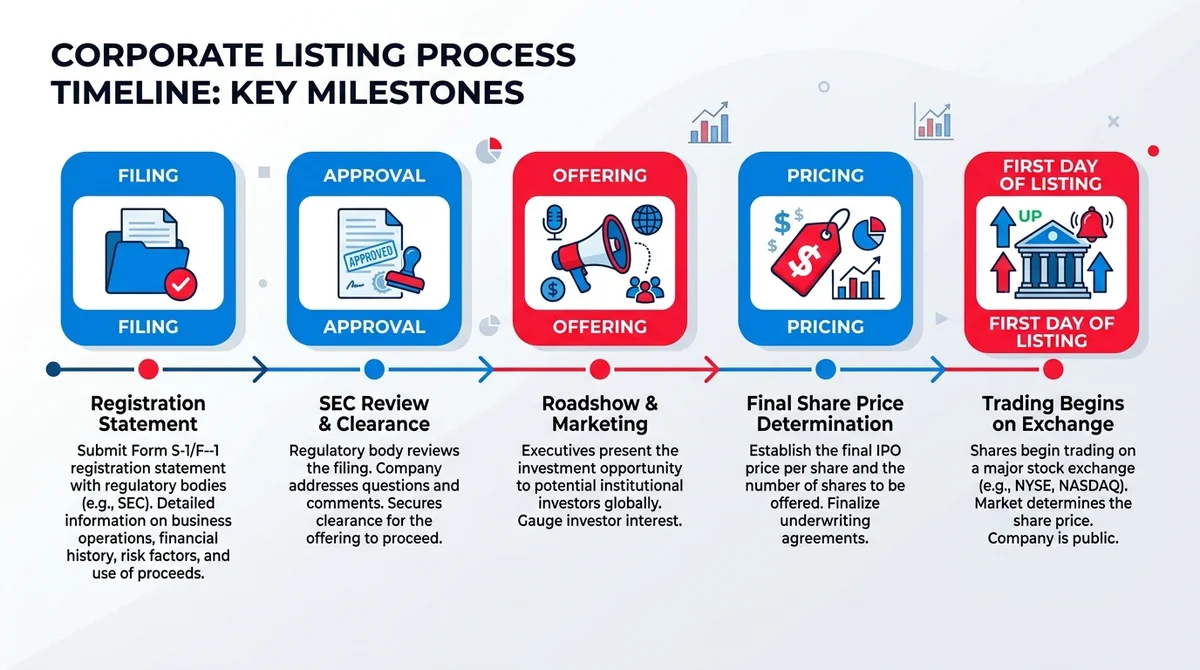
Once you understand these terms, you can roughly place where a piece of news sits on the timeline.
- Filing: corresponds to the application submission stage.
- Approval / passing review: corresponds to the key milestone of passing regulatory review.
- Offering: corresponds to the roadshow and pricing stage, meaning the company has started accepting subscriptions.
- Pricing: the issue price is set, usually in the final stage before listing.
- First day of listing: official trading begins.
#Why Is There No Fixed Duration for the IPO Timeline?
There is no fixed duration because regulatory pace, response speed, market conditions, and issuance arrangements all affect progress.
- Different regulatory pace: Different exchanges and markets review at different speeds.
- Different response speed: How quickly a company answers inquiries directly affects progress.
- Different market conditions: When conditions are poor, a company may voluntarily delay its offering.
- Different issuance arrangements: Deal size and the underwriting team's schedule both affect the pace.
So "how long does an IPO take" has no standard answer — you can only look at specific progress.
#What Should You Keep in Mind About the IPO Timeline?
The timeline is only a process framework. It cannot be used to predict listing outcomes, and it does not constitute any investment advice.
New listings carry uncertainty, and process progress does not equal an investment opportunity.
Beginners should treat it as a tool for "understanding where the news stands" and make independent judgments alongside publicly disclosed information.
To learn more basic concepts, you can refer to our "What Is an IPO" glossary entry and compare the differences between primary and secondary markets.
Risk notice: This article is for conceptual education only and does not constitute investment advice. Trading new stocks, tokenized stocks, or related derivatives (such as perpetual futures leverage or contracts) carries high risk and may result in the loss of your entire principal. Please assess the risks yourself and consult official disclosures.
This article only covers concepts; if you want to see what trading tools look like, you can search for MSX on the main site. For more conceptual guides, see MSX Learn.
#FAQ
What are the starting and ending points of the IPO process timeline? The starting point is when a company submits a listing application to regulators, known as "filing"; the ending point is the first day the stock officially begins trading, known as the "first day of listing."
How many stages does the IPO process generally have? It usually has four stages: filing the application, regulatory review and inquiries, roadshow and pricing, and the first day of listing. Only after one stage is completed does the next begin.
What do "filing," "passing review," and "offering" mean in the news? Filing means submitting a listing application; passing review means the key milestone of clearing regulatory review; offering means entering the roadshow and pricing stage and starting to accept subscriptions.
How long does the IPO process generally take? There is no fixed duration. Regulatory review pace, how quickly a company responds to inquiries, market conditions, and exchange rules all affect the speed, and the specific duration should be based on official disclosures.
Can understanding the IPO timeline help judge investment opportunities? No. The timeline is only a framework describing process stages. It does not predict listing outcomes and does not constitute investment advice. You should make independent judgments alongside publicly disclosed information.
What does "passing review" mean? Passing review means a company has cleared the key milestone of the regulatory review meeting, an important marker on the IPO timeline moving from the review stage to the roadshow and pricing stage.
FAQ
What are the starting and ending points of the IPO process timeline?
The starting point is when a company submits a listing application to regulators, known as "filing"; the ending point is the first day the stock officially begins trading, known as the "first day of listing." The stages in between make up the IPO process timeline.
How many stages does the IPO process generally have?
It usually has four stages: filing the application, regulatory review and inquiries, roadshow and pricing, and the first day of listing. The four stages proceed in order, and only after one stage is completed does the next begin.
What do "filing," "passing review," and "offering" mean in the news?
Filing means submitting a listing application; passing review means the key milestone of clearing regulatory review; offering means entering the roadshow and pricing stage and starting to accept subscriptions. Each of these terms corresponds to a different stage on the IPO timeline.
How long does the IPO process generally take?
There is no fixed duration. Regulatory review pace, how quickly a company responds to inquiries, market conditions, and exchange rules all affect the speed, and it varies greatly across companies. The specific duration should be based on official disclosures.
Can understanding the IPO timeline help judge investment opportunities?
No. The timeline is only a framework describing process stages. It does not predict listing outcomes and does not constitute investment advice. New listings carry uncertainty, so you should make independent judgments alongside publicly disclosed information.
Related Terms
Want to see the real data for this concept?
After you sign up, you can view live prices, funding rates, and fees for the related assets.
View live prices and fees →