What Is an IPO Underwriter?
An IPO underwriter is an investment bank that manages a company's first public share sale. Learn how underwriting works, why it matters, and the risks involved.
#What Is an IPO Underwriter?
An IPO underwriter is a financial intermediary, usually an investment bank, that manages the process of selling a company's shares to the public for the first time. The underwriter helps determine the offering price, buys the shares from the issuer, and resells them to investors, while also providing credibility and market expertise.
Key Takeaways:
- An IPO underwriter is typically an investment bank or a syndicate of banks.
- Underwriters act as intermediaries between the issuing company and the investing public.
- They help determine the offering price, buy the shares, and resell them to investors.
- Underwriting does not guarantee that the stock will rise after listing.
- Crypto token launches may use underwriting-like processes but with less regulatory oversight.
#What Is an IPO Underwriter?
An IPO underwriter is a financial institution, most often an investment bank, that facilitates a company's initial public offering (IPO). The underwriter acts as an intermediary between the company issuing shares and the investing public. Underwriters help determine the offering price, buy the shares from the issuer, and resell them to investors. They also provide due diligence, regulatory filings, and marketing support to ensure a successful public debut.
Who can act as an underwriter? Typically, large investment banks such as Goldman Sachs, Morgan Stanley, and J.P. Morgan serve as underwriters. In some cases, a syndicate of banks may be formed to share the risk and distribution responsibilities. In crypto, token launch platforms or market makers sometimes perform underwriting-like roles, though they are not regulated the same way.
#How Does the IPO Underwriting Process Work?

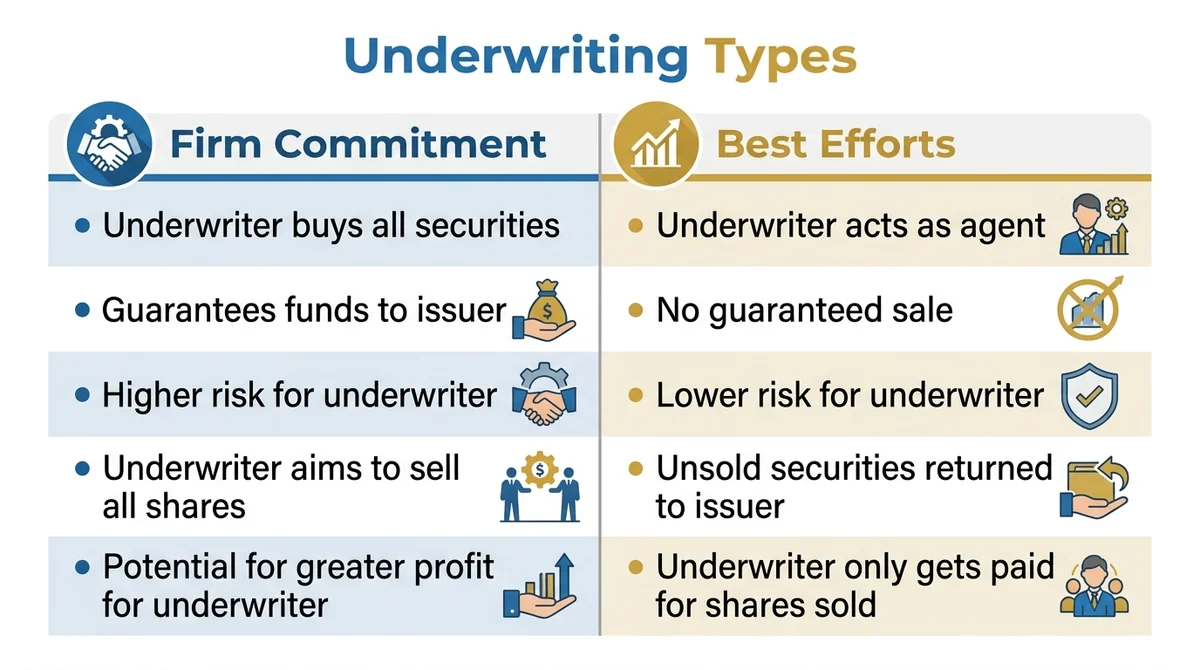
The IPO underwriting process involves several key steps: due diligence, regulatory filings, pricing, allocation, and aftermarket stabilization. The underwriter conducts due diligence on the company's financials, business model, and risks. They help prepare the prospectus and file with regulators. The underwriter and company agree on an offer price based on demand and valuation. Underwriters may buy the shares from the issuer (firm commitment) or act as an agent (best efforts). After listing, underwriters may support the stock price by buying shares in the open market.
#Due Diligence and Regulatory Filings
Before an IPO, the underwriter thoroughly investigates the company's financial statements, operations, and legal standing. This due diligence helps identify material risks and ensures accurate disclosure in the prospectus. The underwriter also assists in preparing and filing the required registration documents with securities regulators.
#Pricing the IPO
Pricing an IPO is a delicate balance. The underwriter assesses investor demand, comparable company valuations, and market conditions to arrive at an offering price. The goal is to set a price that is attractive to investors while raising sufficient capital for the issuer.
#Allocation and Distribution of Shares
Once the price is set, the underwriter allocates shares to institutional and retail investors. In a firm commitment underwriting, the underwriter purchases the entire offering from the issuer and assumes the risk of reselling it. In a best-efforts agreement, the underwriter acts as an agent and does not guarantee the sale of all shares.
#Aftermarket Stabilization
After the stock begins trading, the underwriter may engage in stabilization activities to support the share price. This can involve buying shares in the open market to prevent the price from falling below the offering price during the initial trading period.
#What Is an Example of an IPO Underwriter?
Major investment banks like Goldman Sachs and Morgan Stanley are typical IPO underwriters. A traditional IPO might involve a syndicate of underwriters led by a bookrunner, who coordinates the offering. In crypto, token launch platforms or market makers may perform similar allocation processes but with different regulatory frameworks.
For example, a large technology company going public might hire a syndicate of banks to underwrite its IPO. The lead underwriter, or bookrunner, manages the order book and allocates shares. In the crypto space, a project might use a launchpad platform to distribute tokens to early investors, which resembles an underwriting function but lacks the same regulatory oversight.
#Why Is an IPO Underwriter Important?
IPO underwriters are important because they bring expertise, credibility, and distribution networks that help companies raise capital efficiently and reduce the risk of a failed offering. Underwriters provide expertise in valuation and market conditions. They help build investor confidence through due diligence and marketing. Underwriters assume some of the financial risk by purchasing the shares. They facilitate access to a broad investor base.
#Role in Pricing and Credibility
Underwriters help set a realistic offering price that balances the interests of the issuer and investors. Their involvement signals to the market that the company has been vetted, which can enhance credibility and attract more investors.
#Risk Management for Issuers
By purchasing the shares from the issuer, underwriters assume the risk of reselling them to the public. This transfers some of the financial risk away from the issuing company and provides certainty of capital raised.
#What Are the Risks or Common Misconceptions About IPO Underwriters?
Common misconceptions include the belief that underwriters guarantee stock performance; in reality, they facilitate the offering but do not eliminate investment risk. Underwriters may face conflicts of interest between the issuing company and investors. Underwriting does not guarantee that the stock will rise after listing. Investors should be aware of lock-up periods and potential price volatility. In crypto, underwriting-like activities may lack the same investor protections.
#Underwriter Conflicts of Interest
Underwriters are paid by the issuing company, which can create a conflict of interest. They may be incentivized to set a higher offering price to please the issuer, even if it is not in the best interest of investors.
#Misconception: Underwriters Guarantee Profits
A common misconception is that an underwriter's involvement guarantees that the stock will perform well. In reality, underwriters cannot control market forces, and many IPOs experience price declines after listing.
#Risks for Investors
Investors in IPOs face risks such as lock-up periods that restrict selling, limited historical financial data, and potential price volatility immediately after listing.
#How Does IPO Underwriting Relate to Crypto and Token Launches?
While crypto token launches may use underwriting-like processes for allocation and liquidity, they often operate with less regulatory oversight than traditional IPOs. Crypto projects sometimes use underwriters or launchpads to distribute tokens. Token launches may involve market makers who provide liquidity, similar to stabilization. Regulatory oversight is generally less standardized in crypto compared to traditional IPOs.
#Similarities in Allocation and Distribution
Both traditional IPOs and crypto token launches involve allocating assets to investors. In crypto, launchpads or initial DEX offerings (IDOs) serve a similar function to underwriters by distributing tokens to early backers.
#Key Differences in Regulation and Mechanics
Traditional IPOs are heavily regulated, with strict disclosure requirements and investor protections. Crypto token launches often occur in a less regulated environment, which can expose investors to higher risks such as scams or lack of recourse.
FAQ
What is an IPO underwriter?
An IPO underwriter is an investment bank that manages the process of selling a company's shares to the public for the first time.
How does an IPO underwriter make money?
Underwriters typically earn fees based on a percentage of the total offering value, known as the underwriting spread.
Can an IPO underwriter guarantee the stock price will go up?
No, an underwriter cannot guarantee stock performance. They facilitate the offering but do not eliminate investment risk.
What is the difference between a firm commitment and best efforts underwriting?
In a firm commitment, the underwriter buys the shares and assumes resale risk. In best efforts, the underwriter acts as an agent without guaranteeing the sale.
Do crypto projects use IPO underwriters?
Crypto projects may use launchpads or market makers for token distribution, but these are not regulated like traditional IPO underwriters.
Related Terms
Want to see the real data for this concept?
After you sign up, you can view live prices, funding rates, and fees for the related assets.
View live prices and fees →