What Is IPO Valuation? A Beginner's Guide to Crypto IPO Valuation
Learn what IPO valuation is, how it works in crypto, and why it matters. Discover common valuation methods, risks, and misconceptions in this beginner's guide.
#What Is IPO Valuation?
IPO valuation is the process of assigning a monetary value to a company or crypto project before its shares or tokens are publicly traded. It serves as a baseline for initial pricing and shapes investor expectations. In traditional finance, IPO valuation determines the share price at which a company goes public. In crypto, it often refers to the valuation of a project before its token is listed on exchanges.
Key Takeaways:
- IPO valuation is the estimated market value of a company at the time of its initial public offering.
- In crypto, it can refer to the valuation of a project before its token is listed on exchanges.
- Valuation sets the initial share or token price and influences investor perception.
- A realistic valuation helps projects raise sufficient capital without over-diluting token holders.
#What Is IPO Valuation?
IPO valuation is the estimated market value of a company at the time of its initial public offering. It represents the total worth assigned to a company's equity before it starts trading on a public exchange. In the crypto space, IPO valuation can also refer to the valuation of a project before its token is listed on exchanges. This valuation sets the initial share or token price and influences how investors perceive the offering.
#Simple definition of IPO valuation
At its core, IPO valuation answers the question: "How much is this company or project worth?" It is calculated using various financial models and market comparisons, and it directly affects the price at which shares or tokens are offered to the public. For traditional companies, valuation is often based on revenue, earnings, and comparable companies. For crypto projects, valuation may incorporate tokenomics, network metrics, and market comparables.
#How IPO valuation differs from token valuation
While traditional IPO valuation focuses on a company's financial performance and assets, token valuation in crypto often considers the utility and supply of the token. In a traditional IPO, the valuation is typically derived from discounted cash flow analysis or comparable company analysis. In crypto, valuation may be based on the total supply of tokens multiplied by the expected token price, or on the network's projected usage and demand. This difference reflects the unique nature of crypto assets, which may not have traditional revenue streams.
#How Does IPO Valuation Work?
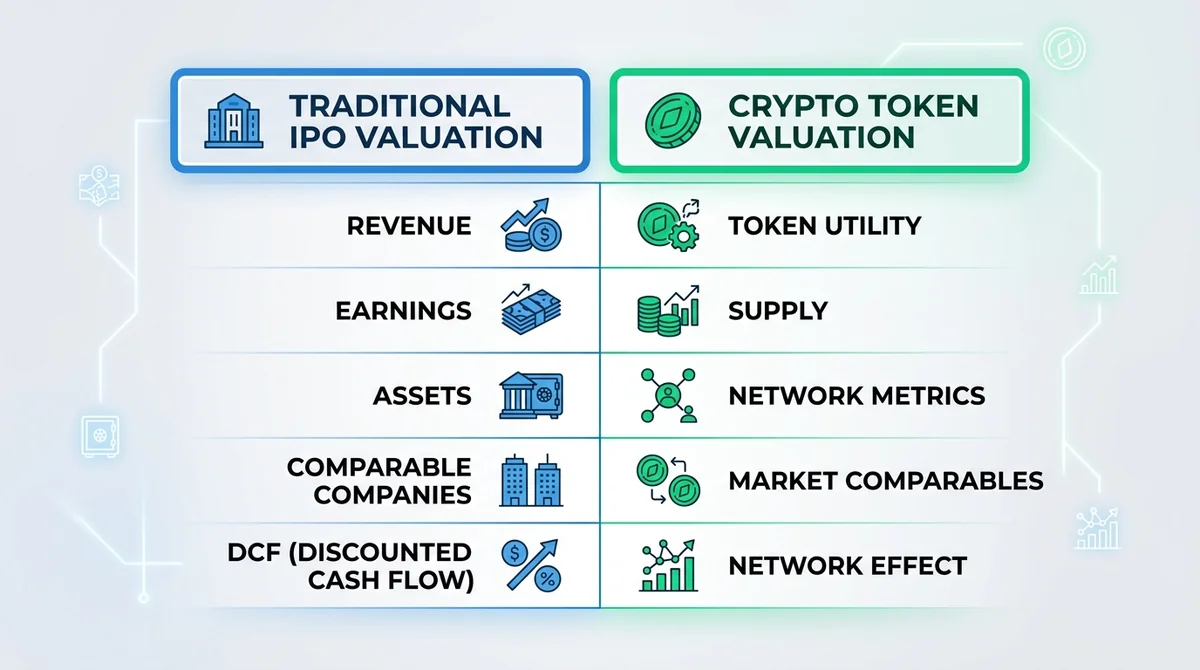
IPO valuation typically uses financial models or market comparisons to estimate a company's worth, with crypto projects adapting these methods to account for token supply and network utility. The process involves several steps, from analyzing financials to determining the final offering price.
#Common valuation methods
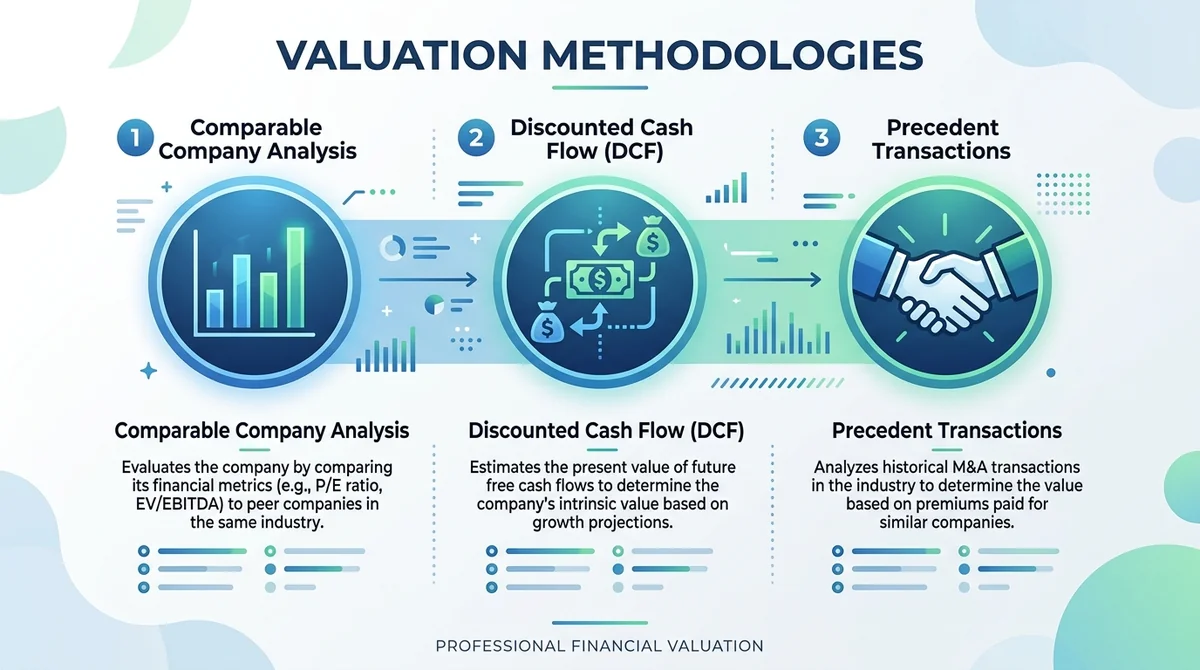
Traditional methods include comparable company analysis, discounted cash flow (DCF), and precedent transactions. Comparable company analysis looks at similar publicly traded companies to derive a valuation multiple. DCF projects future cash flows and discounts them to present value. Precedent transactions examine prices paid in similar acquisitions. In crypto, projects may use tokenomics, network metrics, and market comparables to arrive at a valuation. For example, a project might compare its token metrics to those of similar projects to gauge a fair valuation.
#Steps in a crypto IPO valuation
A typical crypto IPO valuation involves:
- Defining the total token supply and distribution schedule.
- Estimating demand based on the project's utility, community, and market conditions.
- Comparing with similar projects or tokens (market comparables).
- Setting an initial token price that reflects the desired valuation.
- Adjusting for private sale or pre-IPO discounts.
Valuation influences the number of tokens issued and their initial price. A higher valuation may allow the project to raise more capital but could also lead to higher expectations and potential overvaluation.
#IPO Valuation Example in Crypto
In a crypto IPO, a project's valuation is often calculated by multiplying the token price by the total token supply, providing a market capitalization that guides initial listing price. This simple formula illustrates how supply and demand affect initial pricing.
#Hypothetical example of a token launch valuation
Suppose a project has a total supply of 1 billion tokens and aims for a target price of $0.10 per token. The implied valuation would be $100 million (1 billion × $0.10). This valuation serves as a reference for investors and exchanges when the token lists. Pre-IPO token sales or private rounds often set an early valuation before public listing, and the public listing price may be higher or lower depending on market demand.
#Real-world patterns without specific numbers
In practice, many crypto projects experience a significant gap between private round valuations and public listing valuations. Private investors often receive tokens at a discount, while public listing prices may be inflated by hype. This pattern can lead to sharp price corrections after listing if the valuation was not supported by fundamentals. Understanding these patterns helps investors evaluate whether a token's IPO valuation is reasonable.
#Why Is IPO Valuation Important?
IPO valuation is important because it determines the initial price, affects investor confidence, and influences a project's ability to secure funding and achieve sustainable growth. A well-calibrated valuation benefits both the project and its investors.
#Impact on investors
Valuation affects potential returns and risk for early investors. If a token is overvalued at listing, early investors may face losses when the price corrects. Conversely, an undervalued token may offer upside potential. Investors use valuation to assess whether the asking price is justified by the project's fundamentals and growth prospects.
#Impact on project funding
A realistic valuation helps projects raise sufficient capital without over-diluting token holders. If the valuation is too low, the project may not raise enough funds to execute its roadmap. If it is too high, the project may struggle to meet expectations, leading to a loss of investor confidence. Valuation also influences market sentiment and post-listing price stability.
#Risks and Common Misconceptions About IPO Valuation
A key risk in IPO valuation is overvaluation driven by hype, which can result in significant losses for investors when the market corrects; valuation alone is not a reliable indicator of investment quality. Understanding these risks can help investors make more informed decisions.
#Overvaluation risk
Overvaluation can lead to sharp price drops after listing. In the crypto market, hype and speculation often inflate valuations beyond fundamentals. When the initial excitement fades, the token price may fall significantly, causing losses for those who bought at the peak. Projects with little real-world utility or revenue are particularly vulnerable to this risk.
#Misconception: high valuation equals good investment
A high valuation does not guarantee future performance. Many investors mistakenly assume that a high IPO valuation signals a strong project. In reality, valuation is just a number that reflects market expectations at a point in time. A project with a lower valuation may have better growth potential if its fundamentals are solid. Investors should evaluate the underlying technology, team, and market demand rather than relying solely on valuation.
#Related Terms
Understanding IPO valuation in crypto requires familiarity with several related terms. These concepts are essential for evaluating token launches and market dynamics.
#Tokenomics
Tokenomics describes the economic model of a crypto token, including supply and distribution. It covers aspects such as total supply, inflation rate, staking rewards, and token utility. A well-designed tokenomics can support a higher valuation by creating sustainable demand.
#Market capitalization
Market capitalization is the total value of a token or company, calculated as price multiplied by supply. It is a key metric for comparing different crypto projects. A high market cap may indicate a mature project, but it also means more capital is needed to move the price.
#Pre-IPO
Pre-IPO refers to investment rounds before a public listing. In crypto, pre-IPO token sales allow early investors to buy tokens at a discount before they are available to the public. These rounds often set an early valuation that influences the final listing price.
FAQ
What is IPO valuation in simple terms?
IPO valuation is the estimated market value of a company or crypto project at the time of its initial public offering, which determines the initial share or token price.
How is IPO valuation calculated?
Traditional methods include comparable company analysis, discounted cash flow, and precedent transactions. In crypto, valuation often uses token supply multiplied by expected token price, along with network metrics and market comparables.
Why is IPO valuation important for investors?
Valuation affects potential returns and risk. Overvalued tokens may lead to losses after listing, while undervalued tokens may offer upside. It helps investors assess whether the asking price is justified.
What is overvaluation risk in crypto IPOs?
Overvaluation risk is the danger that a token's price is inflated by hype and speculation, leading to sharp price drops after listing when the market corrects.
Does a high IPO valuation mean a good investment?
No. A high valuation does not guarantee future performance. It may simply reflect market hype. Investors should evaluate fundamentals, utility, and team rather than relying solely on valuation.
Want to see the real data for this concept?
After you sign up, you can view live prices, funding rates, and fees for the related assets.
View live prices and fees →