Why Does Margin Trading Magnify Losses? 2026 Margin and Leverage Mechanism Explained
Margin trading magnifies losses because P&L is based on total position, not margin. Adverse moves can drain margin and force liquidation. Learn the risks.
Answer: Margin trading magnifies losses because you trade with borrowed funds, and profits and losses are calculated on the total position. When the price moves against you, margin is quickly depleted and may trigger forced liquidation.
#What Is Margin Trading and How Does It Differ from Regular Trading?
Margin: You only need to put up a portion of the funds to borrow additional capital for trading. Regular trading: If you have 10,000, you buy 10,000 worth of assets; profits and losses are calculated on 10,000. Margin trading: You put up 1,000 as margin, borrow 9,000, and control a total position of 10,000. P&L is calculated on 10,000, but your initial capital is only 1,000.
Analogy: It's like buying a house with only a down payment. The gain or loss on the house is calculated on the total property value, not just the down payment. If you're new, start with What Is Margin? Initial Margin vs. Maintenance Margin vs. Available Margin.
#How Does Leverage Work in Margin Trading?
Leverage multiple: It is the total position divided by margin. If you put up 1,000 to open a 10,000 position, the leverage is 10x. Leverage is the inverse of the margin ratio: 10x leverage corresponds to a 10% margin requirement. The higher the leverage, the lower the margin ratio. Magnifying effect: With 5x leverage, a 1% price increase yields about a 5% return on your margin; with 10x leverage, a 1% price increase yields about a 10% margin return. Leverage acts like a magnifying glass, amplifying the impact of price movements on your account.
For detailed calculations, see How to Calculate Crypto Futures Margin and Leverage? 2026 Isolated vs. Cross Margin Tutorial.
#Why Does Margin Trading Magnify Losses?
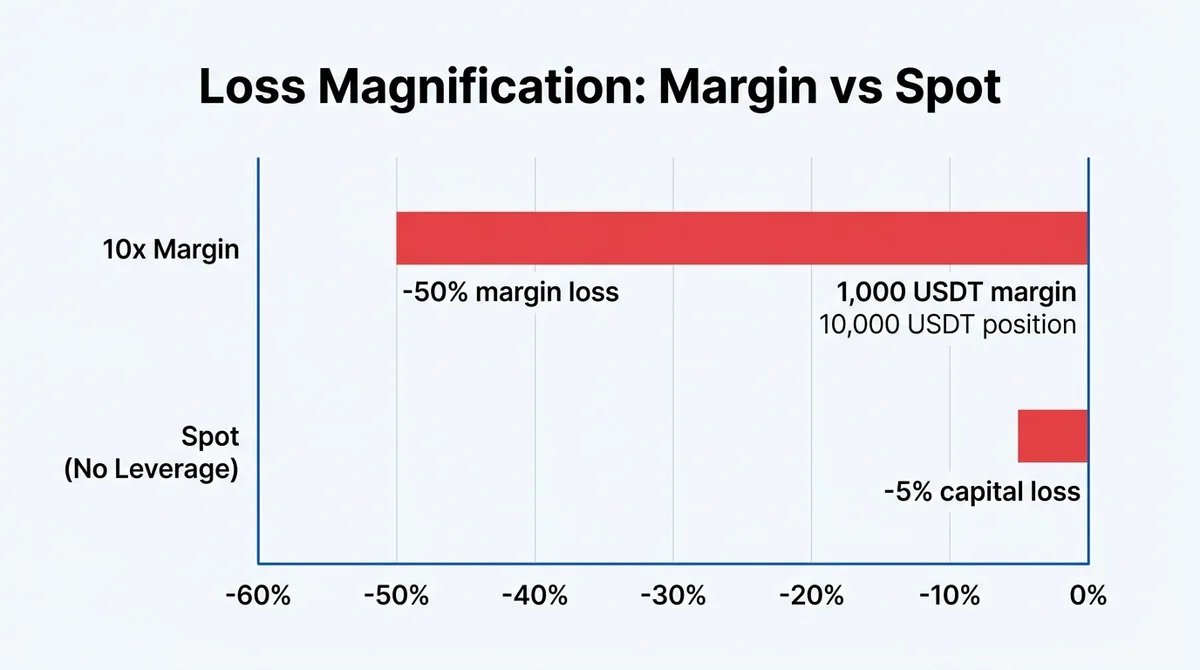
Core reason: P&L is calculated on the total position, not on margin. Example: You open a 10x leveraged position with 1,000 margin, controlling a total position of 10,000. If the price drops 5%, the total position loses 500. This 500 is deducted entirely from your 1,000 margin, leaving only 500 — an actual loss of 50%. Without leverage: If you buy 10,000 worth of spot and it drops 5%, you lose 500, your principal remains 9,500, and your loss is only 5%. Insufficient margin: When losses push your margin below the maintenance margin requirement, the exchange will force-liquidate your position. At that point, you may lose most of your principal. To understand liquidation mechanics, see What Is Maintenance Margin? 2026 Liquidation Triggers and Risk Control.
Analogy: Margin acts like a safety cushion. When the price moves against you, the cushion quickly thins; when it is pierced, the position is forcibly sold.
#What Risks Should You Understand Before Using Margin Trading?
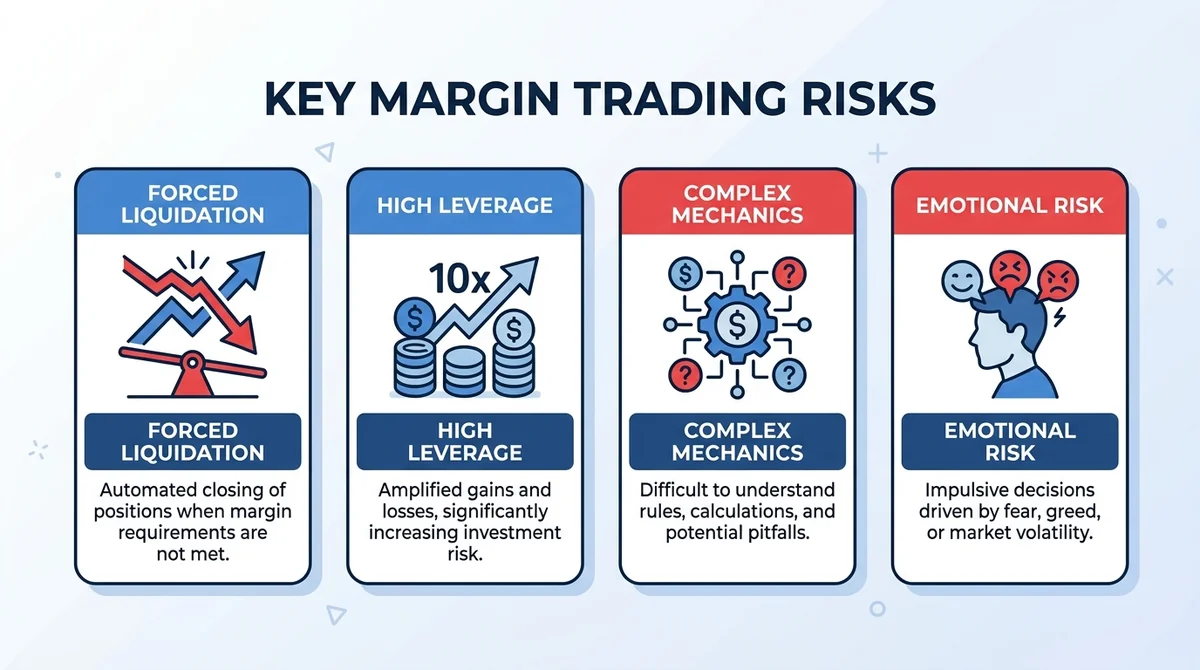
- Forced liquidation risk: A sharp adverse price move can trigger liquidation instantly, causing heavy principal losses.
- High leverage risk: The higher the leverage, the less adverse movement you can withstand, leaving less room for error.
- Complex mechanics: Concepts like margin, maintenance margin, mark price, and funding rate are easy for beginners to miscalculate.
- Emotional risk: Leverage amplifies volatility, making it easy to chase rallies and sell panics.
Start with a small position to learn how liquidation price and margin calls work. See What Is Liquidation Price? 2026 Calculation and Influencing Factors and What Is a Margin Call? 2026 Futures Margin Calls and Liquidation Warnings.
#A Simple Example: How Margin Trading Affects Profits and Losses
Assumption: You use 1,000 USDT as margin to open a 10x long position, with a total position of 10,000 USDT.
- Price rises 10%: The total position gains 1,000, your margin doubles to 2,000, a 100% return.
- Price drops 5%: The total position loses 500, margin drops to 500, a 50% loss.
- Price drops 10%: The total position loses 1,000, margin goes to zero; in actual trading, if the price hits the maintenance margin line, liquidation will be triggered even earlier. Compare with spot: Buying 10,000 USDT in spot and losing 10% means a 1,000 loss, leaving 9,000 principal — a 10% loss.
Risk warning: The above is a simplified ideal calculation that does not include trading fees, funding rates, or slippage; real-world losses may be larger. High leverage magnifies both gains and losses — it is not a "guaranteed profit" tool. Do not use essential living funds for margin trading. This article is for conceptual explanation only and does not constitute investment advice.
To get familiar with the trading process, it is recommended to practice with a demo account or a very small position first.
FAQ
What is margin trading?
Margin trading is a method where you only need to deposit a portion of funds as margin to borrow capital and amplify the size of your trade. P&L is calculated on the total position, not the margin, so both risk and returns are magnified.
What does leverage multiple mean?
Leverage multiple refers to the ratio of total position to margin. For example, 10x leverage means using 1 unit of margin to control 10 times the position. The higher the leverage, the greater the impact of the same price movement on account P&L.
Why does margin trading magnify losses?
Because P&L is calculated on the total position, losses are deducted directly from margin. When the price moves against you, the margin ratio drops quickly; once it falls below the maintenance margin requirement, forced liquidation occurs and you may lose most of your principal.
How can you reduce the risk of margin trading?
Avoid high leverage and full-position trading, set stop-losses, and start with a small position to learn. Understand mechanics like liquidation price, maintenance margin, and funding rate. Do not invest essential living funds. This article does not constitute investment advice.
Related Terms
Want to see the real data for this concept?
After you sign up, you can view live prices, funding rates, and fees for the related assets.
View live prices and fees →