What Are Non Cumulative Preference Shares? Definition, Examples, and Risks
Understand non cumulative preference shares, how they work, and key differences from cumulative shares. Get examples and risk insights for beginners.
Non cumulative preference shares are a type of preferred stock where unpaid dividends do not accumulate. If a company skips a dividend, shareholders have no right to claim it later. This makes them riskier than cumulative preference shares but often higher yielding.
#Key Takeaways
- Non cumulative preference shares pay dividends only when declared; missed dividends are permanently lost.
- They offer higher yields to compensate for the risk of skipped payments.
- Unlike cumulative preference shares, there is no liability for unpaid dividends.
- They rank above common stock for current dividends but below all creditors in liquidation.
#What is the simple definition of non cumulative preference shares?
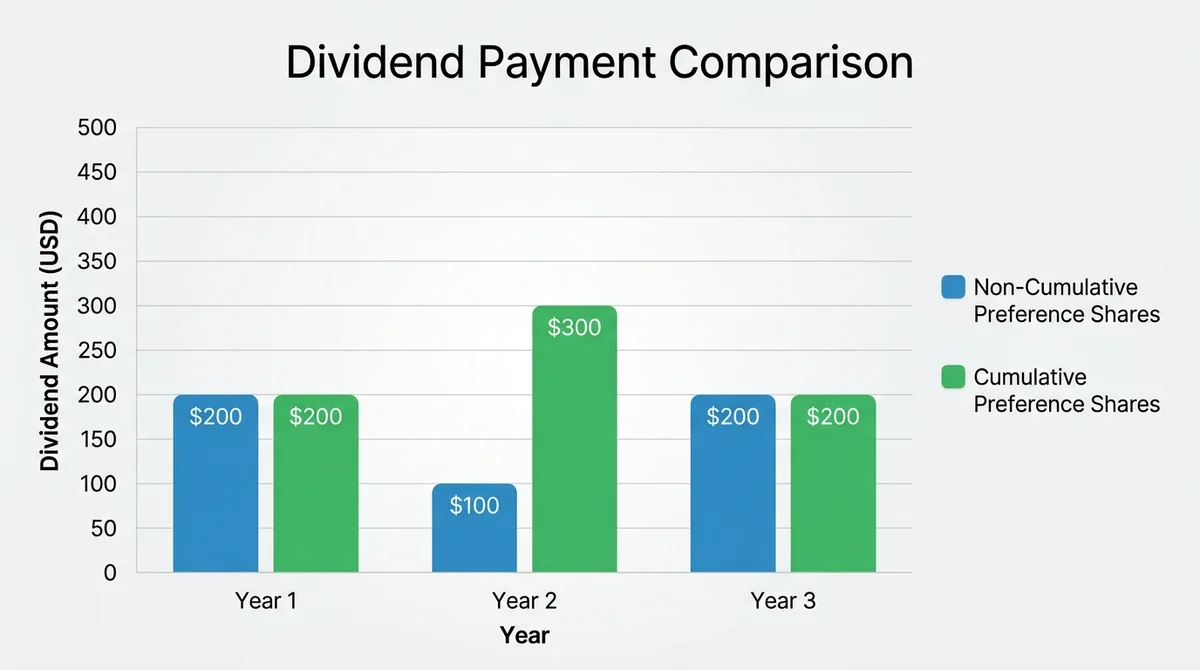
Non cumulative preference shares are a class of preferred stock where any unpaid dividend is permanently forfeited. Shareholders only receive dividends when the company's board declares them. This contrasts with cumulative preference shares, where missed dividends accrue and must be paid before common dividends.
#How do non cumulative preference shares work?
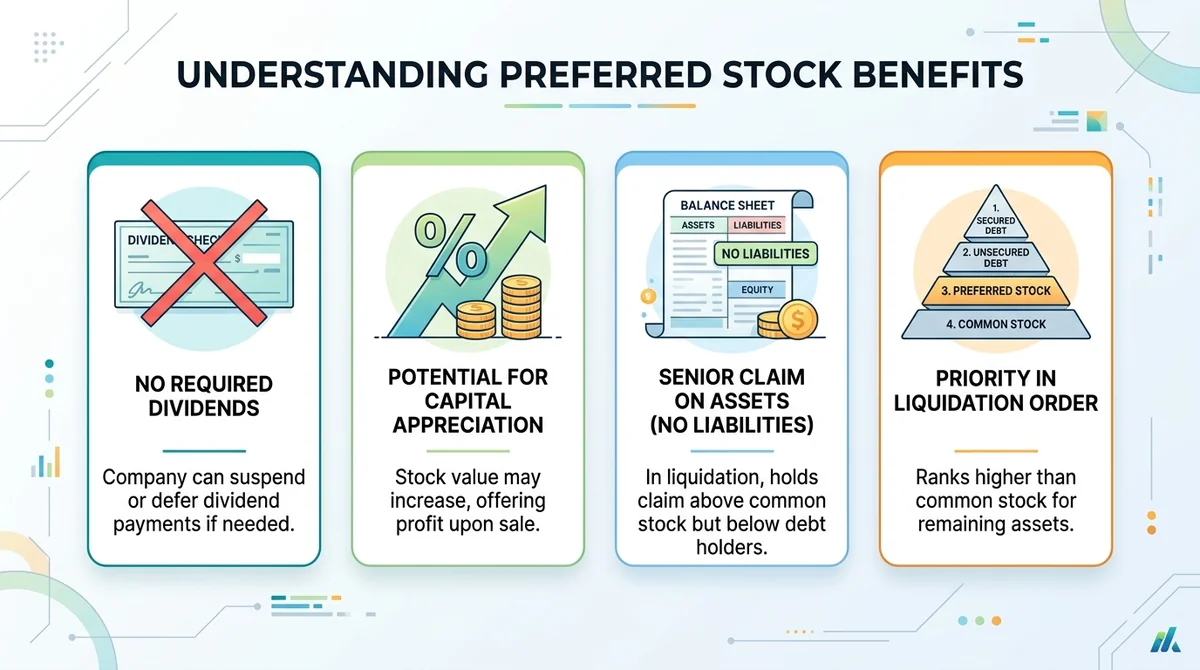
Non cumulative preference shares pay a fixed dividend rate only if the company declares a dividend for that period. If the board skips a dividend, the obligation disappears—shareholders cannot claim it later. These shares have priority over common stock for current dividends, but no claim on past missed dividends. They usually carry no voting rights, similar to other preferred shares.
#What happens if a dividend is skipped?
If a dividend is skipped, shareholders simply receive nothing for that period. The company has no legal obligation to make up the missed payment in the future. This is the core risk of non cumulative preference shares.
#How are dividends calculated and paid?
Dividends are calculated as a fixed percentage of the share's par value. For example, a 6% non cumulative preference share with a $100 par value pays $6 per share annually if declared. Payments are typically made quarterly or annually, but only when the board approves them.
#What is the priority of payment compared to common shares?
Non cumulative preference shareholders receive their current dividends before common shareholders receive any dividends. However, if dividends are skipped, they lose their place in line for those missed payments. In liquidation, they rank below all creditors but above common shareholders.
#What are some examples of non cumulative preference shares?
Consider Company XYZ issuing 6% non cumulative preference shares with a $100 par value. If the company pays dividends in Year 1 but skips Year 2, shareholders get $6 in Year 1 and nothing in Year 2, and no $6 accrual for Year 2. In contrast, cumulative preference shares would accumulate the $6 from Year 2 and pay it later before common dividends.
#Why are non cumulative preference shares important?
Non cumulative preference shares matter because they give companies flexibility to skip dividends without accumulating debt. For investors, they offer potentially higher yields in exchange for the risk of lost income. This makes them a middle ground between debt and common equity for issuers.
#Why do companies issue them?
Companies prefer non cumulative preference shares because skipped dividends do not become liabilities on the balance sheet. This flexibility is valuable during cash flow shortages. Issuers can also attract investors with higher dividend rates without the burden of accumulating arrears.
#Why do investors buy them despite the risk?
Investors buy non cumulative preference shares for the higher income potential. If the company is stable and consistently pays dividends, the yield can be attractive. However, they must accept the risk that dividends may be skipped without recourse.
#What are the risks and common misconceptions about non cumulative preference shares?
The primary risk is permanent loss of dividend income if the company chooses not to declare dividends. A common misconception is that missed dividends accumulate like cumulative shares, but they do not. Another misconception is that these shares are as safe as bonds; they are not debt and rank below all creditors in liquidation.
#Risk of missed dividends
The main risk is that dividends can be skipped indefinitely without any legal obligation to pay later. This can significantly reduce expected income, especially if the company faces financial difficulties.
#Misconception: They are as safe as bonds
Non cumulative preference shares are equity, not debt. They do not guarantee payments and rank below all creditors in liquidation. Higher yield does not guarantee payment; it compensates for the risk of non-payment.
#Misconception: Unpaid dividends are eventually paid
Many investors mistakenly believe that missed dividends will be paid later, as with cumulative shares. In reality, once a dividend is skipped on non cumulative preference shares, it is gone forever.
#Non cumulative vs cumulative preference shares: what's the difference?
The key difference is that cumulative preference shares accumulate unpaid dividends as a liability, while non cumulative preference shares do not. This makes non cumulative shares riskier but often higher yielding. Cumulative shares are generally safer for income-focused investors.
#Dividend accumulation
Cumulative preference shares accrue missed dividends, which must be paid before common dividends. Non cumulative preference shares do not accrue; missed dividends are lost.
#Risk and return profile
Non cumulative preference shares typically offer a higher dividend rate to compensate for the risk of skipped payments. Cumulative shares offer more security but usually lower yields.
#Which is better for investors?
For income-focused investors who prioritize reliability, cumulative preference shares are usually better. For those willing to accept higher risk for potentially higher income, non cumulative preference shares may be suitable.
FAQ
What happens to unpaid dividends on non cumulative preference shares?
Unpaid dividends on non cumulative preference shares are permanently forfeited. Shareholders have no right to claim them later, unlike cumulative preference shares.
Why would a company issue non cumulative preference shares?
Companies issue non cumulative preference shares because skipped dividends do not become liabilities, giving them more financial flexibility during tough times.
Are non cumulative preference shares riskier than cumulative ones?
Yes, non cumulative preference shares are riskier because missed dividends are lost forever. Cumulative shares accumulate unpaid dividends as a liability.
Do non cumulative preference shares have voting rights?
Typically, non cumulative preference shares do not carry voting rights, similar to other types of preferred stock.
Can non cumulative preference shares be converted to common stock?
Some non cumulative preference shares may be convertible, but this depends on the specific terms set by the issuing company. Not all are convertible.
Want to see the real data for this concept?
After you sign up, you can view live prices, funding rates, and fees for the related assets.
View live prices and fees →