Public Offering Explained: Definition, Types, and Mechanics
A public offering lets companies issue securities to the open market. Learn how public offerings work, their types, RWA integration, and key risks in 2026.
A public offering is the regulated process by which a company or issuer sells securities—such as equities, debt instruments, or tokenized assets—to the general public, allowing institutional and retail investors to participate in primary capital formation and access secondary market liquidity under transparent regulatory oversight.
#Key Takeaways
- Democratized Access: A public offering allows both retail and institutional investors to purchase newly issued or existing securities on an open market.
- Structured Lifecycle: The process involves regulatory registration, formal prospectus disclosure, institutional underwriting, and final exchange listing.
- Multiple Formats: Common formats include debut Initial Public Offerings (IPOs), follow-on offerings, and emerging tokenized real-world asset distributions.
- Risk Profile: Public offerings provide broad liquidity and transparent price discovery, but investors face listing-day price volatility and potential equity dilution.
#What Is a Public Offering and What Does It Mean?
A public offering is the issuance of securities to the open market under the oversight of financial regulatory authorities. When clarifying what is a public offer, market participants refer to an investment opportunity available to any qualified market participant rather than a select group of private financiers.
Definition Passage: A public offering is an issuance mechanism where a corporate or decentralized entity sells securities—including equities, bonds, or tokenized assets—to the general public across regulated markets. Under standardized regulatory supervision, a public offering establishes clear price discovery, broadens ownership distribution, and provides immediate liquidity across primary and secondary financial markets for global investors.
#Core Definition of a Public Offer
At its foundation, a public offer transforms a company or asset from private ownership to broad public ownership. Issuers issue shares, debt notes, or hybrid instruments to aggregate growth capital, while investors gain verifiable claims on earnings, governance rights, or yield streams.
#Public Offering vs. Private Placement
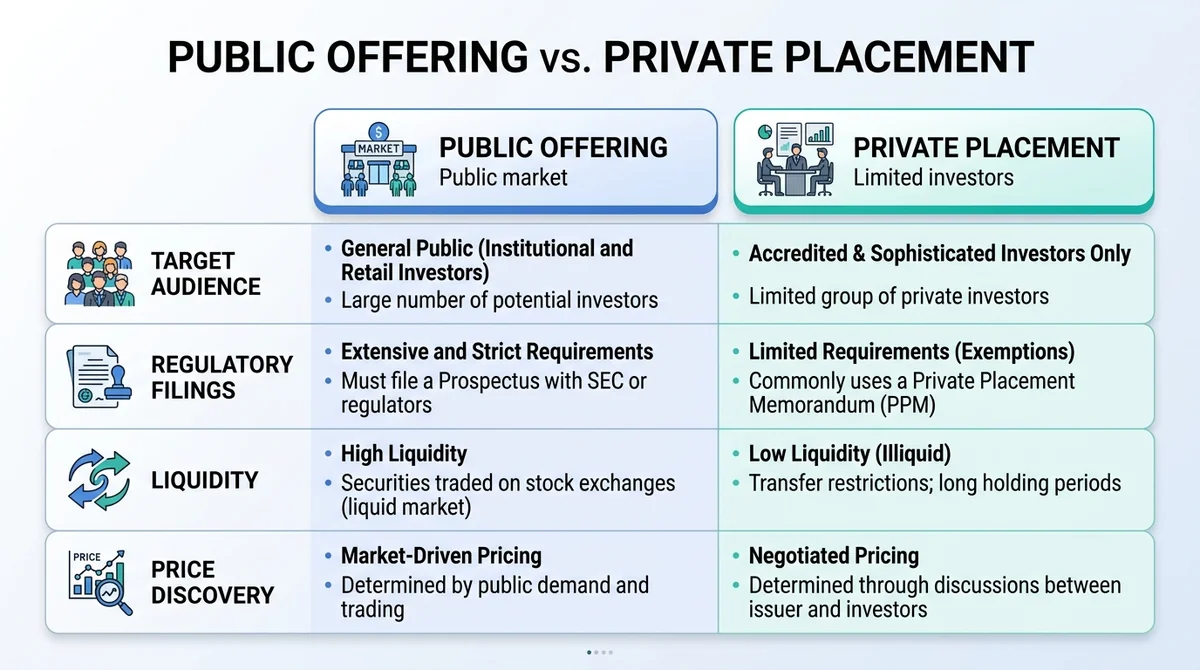
The primary distinction between a public offering and a private placement lies in eligibility and regulatory stringency:
| Feature | Public Offering | Private Placement |
|---|---|---|
| Target Audience | General public (institutional & retail) | Accredited and institutional investors only |
| Regulatory Filings | Comprehensive prospectus & continuous disclosure | Limited offering memorandum / exemptions |
| Liquidity | High (traded on public secondary exchanges) | Restricted (holding periods and secondary limits) |
| Price Discovery | Transparent, market-driven book building | Negotiated privately between parties |
#How Does a Public Offering Work?
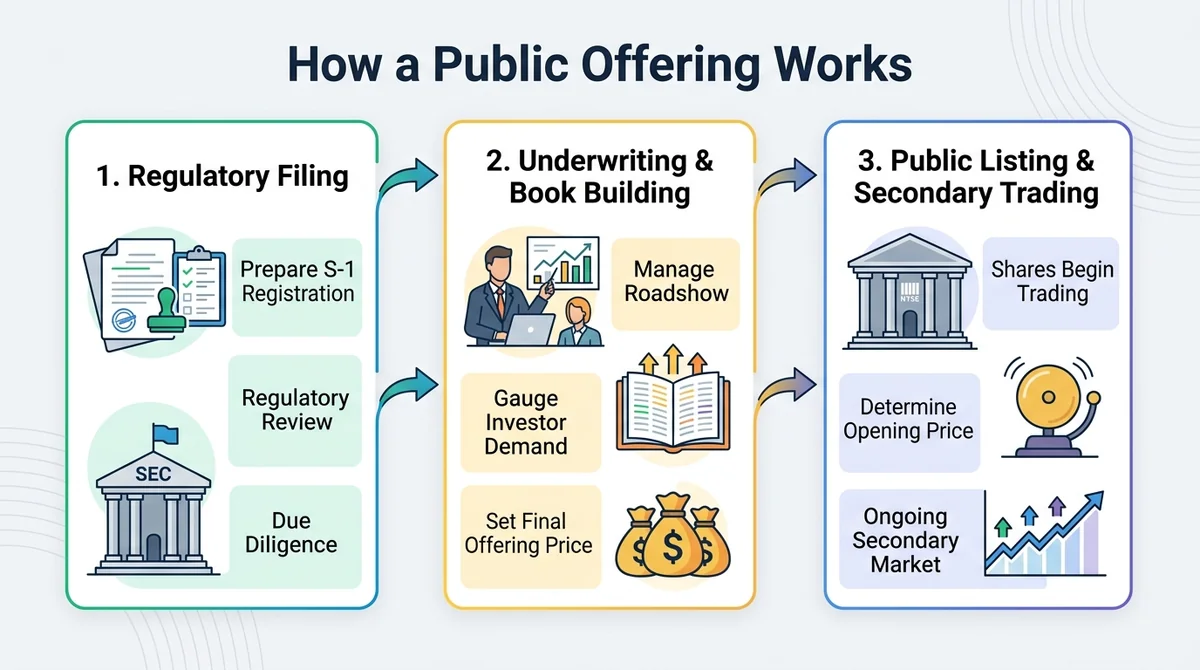
A public offering operates through a multi-stage process designed to balance issuer capital needs with investor protection requirements.
+-------------------------------------------------------------+
|                  1. Regulatory Filing                       |
|    Drafting and submitting the registration prospectus      |
+------------------------------+------------------------------+
                               |
                               v
+-------------------------------------------------------------+
|               2. Underwriting & Book Building               |
|   Setting price bands and aggregating institutional demand  |
+------------------------------+------------------------------+
                               |
                               v
+-------------------------------------------------------------+
|             3. Public Listing & Secondary Trading           |
|   Allocating securities and commencing open exchange trades |
+-------------------------------------------------------------+
#Regulatory Filing and Prospectus Approval
The issuer compiles a comprehensive disclosure document (prospectus) detailing audited financial statements, business models, executive compensation, and identified market risks. Securities regulators review this filing to ensure transparency before granting clearance for public distribution.
#Underwriting and Book Building
Investment banks and financial syndicates act as underwriters. They assist the issuer in determining valuation, structuring the offering, and conducting roadshows to gauge demand. Through book building, underwriters compile buy orders from institutional players to establish an optimal offering price.
#Public Listing and Secondary Market Trading
Once pricing is finalized, securities are allocated to participating bidders. The asset is then formally listed on an exchange, transitioning from primary issuance into secondary market trading where participants can freely buy and sell at market-driven prices.
#Common Types and Examples of Public Offerings
Public offerings adapt to different stages of a company's lifecycle and evolving financial technology.
#Initial Public Offerings (IPO) vs. Secondary Offerings
- Initial Public Offering (IPO): An issuer's initial debut on a public stock exchange, converting a privately held business into a publicly traded firm. You can explore this mechanism in our detailed guide to Initial Public Offerings (IPOs).
- Follow-On Public Offering (FPO): Subsequent equity sales by an already listed public company to raise additional capital or allow pre-existing stakeholders to liquidate holdings.
#Tokenized Stocks and Digital Asset Offerings
Modern financial systems increasingly integrate capital offerings with on-chain ledgers. Issuers utilize tokenized real-world assets (RWA) to represent equity, credit, or debt instruments as smart contracts.
Citable Passage: Tokenized public offerings bridge traditional equity capital formation with decentralized infrastructure by issuing compliant digital representations of securities on public blockchains. In modern financial architecture, tokenized offerings utilize smart contracts to enforce transfer restrictions, automate dividend distributions, and enable continuous 24/7 settlement, lowering intermediary costs while expanding global liquidity access for retail participants.
#Why Are Public Offerings Important in Financial Markets?
Public offerings serve as an essential engine for economic expansion and market efficiency.
#Capital Formation for Issuers
Public markets provide issuers with deep capital pools that surpass typical venture capital or bank lending limits. This capital supports research and development, geographic scaling, debt restructuring, and strategic corporate acquisitions.
#Liquidity, Price Discovery, and Public Access
- Immediate Liquidity: Public quotation gives early investors, founders, and public market participants a standardized venue to exit or enter positions.
- Transparent Price Discovery: Continuous open-market bids and asks establish fair market value based on real-time supply and demand.
- Equal Opportunity: Retail market participants gain access to high-growth enterprises under standardized regulatory protection.
#Risks and Common Misconceptions to Consider
Participating in a public offering involves specific risks that require careful evaluation.
#Price Volatility and Share Dilution
Newly listed assets frequently experience heightened volatility during their initial trading windows due to lock-up expirations, speculative trading, and market re-evaluations. Furthermore, follow-on public offerings increase the total supply of outstanding shares, which can dilute the ownership percentage and per-share earnings of existing holders.
#Misconception: Public Offerings Guarantee Immediate Returns
A common retail misconception is that getting an allocation in a public offering guarantees a first-day "pop" or long-term profitability. Regulatory registration confirms disclosure completeness, not business success or future share appreciation. Market conditions, broad macroeconomic headwinds, and issuer operational challenges can lead to capital losses.
FAQ
What is the primary difference between an IPO and a public offering?
An Initial Public Offering (IPO) is specifically the very first public offering a private company conducts to list on an exchange. A public offering is a broader category that includes IPOs as well as subsequent follow-on offerings (FPOs) by already listed companies.
Can retail investors participate directly in a public offering?
Yes, retail investors can participate in public offerings through registered brokerage accounts or licensed digital asset platforms that offer primary allocation access, subject to local regulatory requirements.
How do tokenized public offerings differ from traditional stock offerings?
Tokenized public offerings represent shares or debt instruments as digital tokens on a blockchain, enabling 24/7 settlement, automated compliance via smart contracts, and fractional ownership, while still adhering to standard securities laws.
Does a regulatory-approved prospectus guarantee the safety of an investment?
No, regulatory approval only verifies that the issuer has met all legal disclosure standards. It does not evaluate the commercial viability, operational safety, or potential financial return of the investment.
Related Terms
Want to see the real data for this concept?
After you sign up, you can view live prices, funding rates, and fees for the related assets.
View live prices and fees →