What Is an SME IPO? Definition, Process, and Key Risks
Learn what an SME IPO is, how small enterprises go public, key listing steps, valuation factors, and mainboard differences in our comprehensive 2026 guide.
#What Is an SME IPO? Definition, Process, and Key Risks
An SME IPO (Small and Medium Enterprise Initial Public Offering) is a specialized fundraising mechanism that enables emerging, small-to-medium businesses to raise equity capital from the public and list on dedicated stock exchange platforms. It features lower post-issue capital thresholds, streamlined regulatory filings, and larger minimum application lot sizes compared to traditional mainboard public listings.
#Key Takeaways
- Targeted Public Listing: SME IPOs allow small and mid-sized enterprises to issue shares publicly on dedicated exchange segments without meeting high mainboard capital requirements.
- Exchange-Centric Regulation: Regulatory scrutiny and approvals are primarily managed directly by the stock exchange rather than an exhaustive multi-agency review.
- Larger Lot Sizes: Trading and subscription occur in predetermined minimum lot sizes to maintain qualified participation and manage market volatility.
- Growth Bridge: Serves as a vital capital-raising bridge between early venture funding and full-scale mainboard stock listings.
#What Is an SME IPO and How Is It Defined?
An SME IPO is an initial equity offering designed specifically for small and medium enterprises seeking growth capital through dedicated stock exchange platforms.
#Definition and Core Purpose
Traditional capital markets impose strict financial thresholds, multi-year profitability records, and high net-worth requirements that exclude many high-growth smaller businesses. An SME IPO creates an accessible pathway for early-to-growth-stage companies to offer shares to institutional and qualified retail investors. By providing an organized public marketplace, dedicated SME platforms bridge the critical financing gap between private venture capital and mature equity markets.
#Target Companies and Typical Eligibility Criteria
Eligibility standards for an IPO SME listing are structured to accommodate smaller operational footprints while maintaining baseline investor protections. Key qualification criteria typically include:
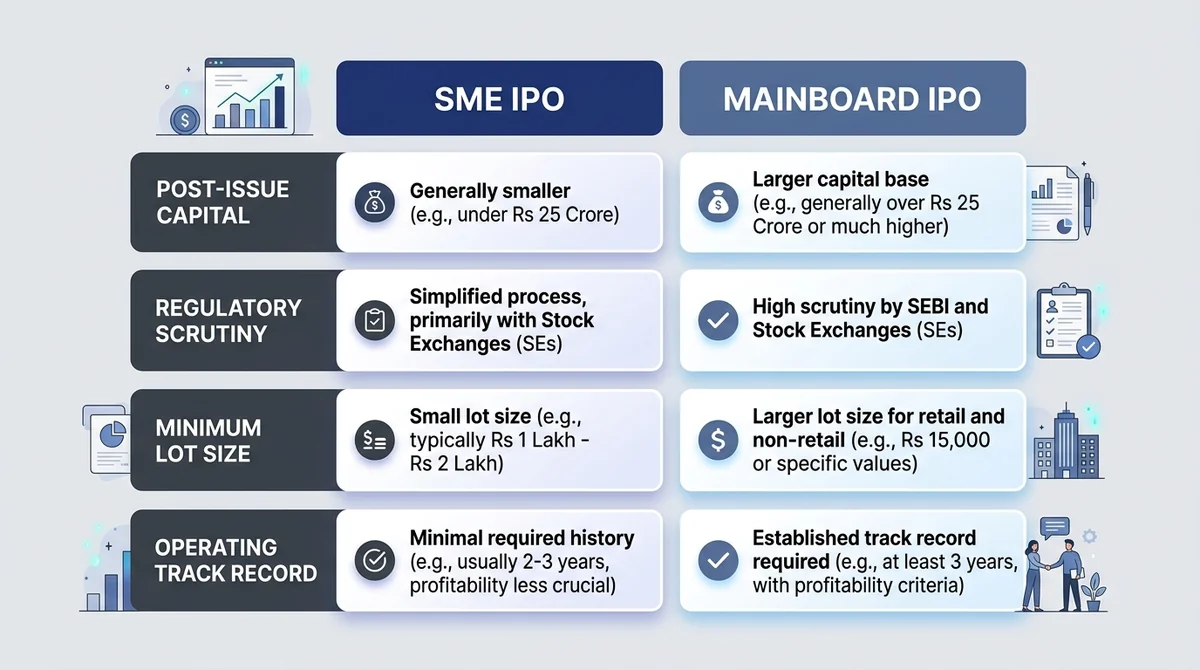
- Post-Issue Paid-Up Capital: Generally capped at modest statutory limits (such as sub-$30 million equivalent), ensuring only small-to-midscale issuers participate.
- Operating Track Record: Issuers usually require at least two to three continuous operating years with tangible operational assets.
- Financial Thresholds: Positive operating cash flow or net operating profit in preceding financial periods, though criteria remain far more relaxed than mainboard mandates.
Citable Definition: An SME IPO is a formal capital-raising process where a small or medium-sized enterprise lists its shares on a dedicated exchange board. By maintaining lower post-issue paid-up capital limits and simplified disclosure obligations compared to primary exchanges, an SME platform provides growing corporations with direct access to public equity markets while preserving streamlined administrative compliance.
#How Does the SME IPO Process Work Step by Step?
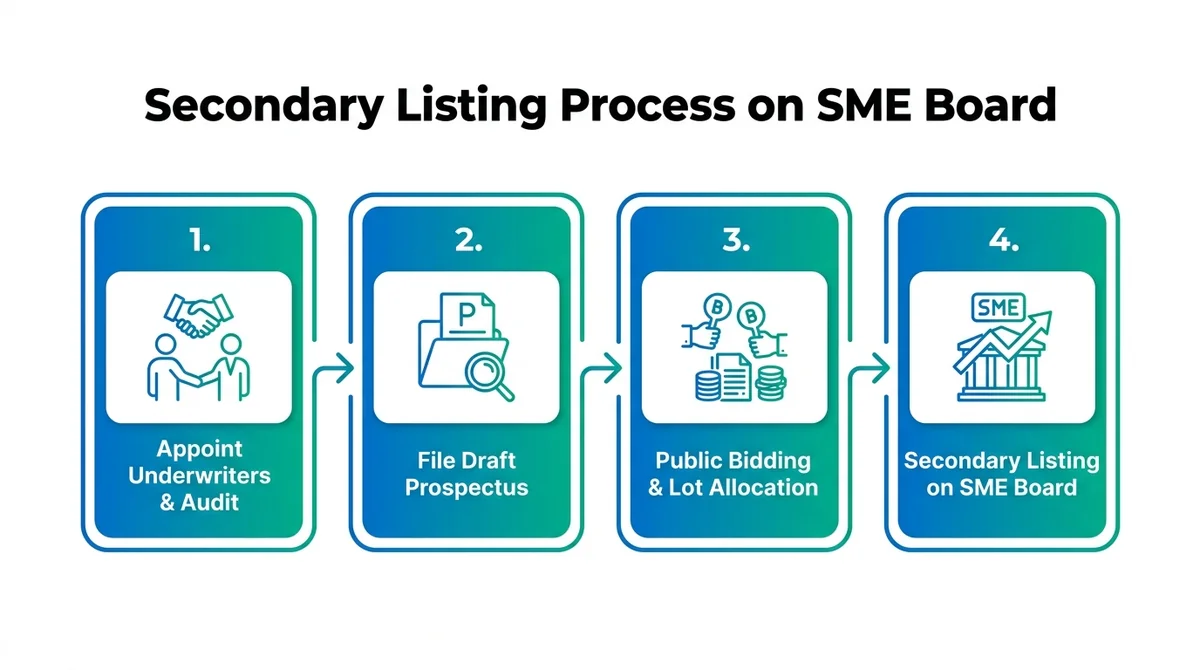
The SME IPO process transitions a private enterprise into a publicly traded corporation through structured underwriting, exchange review, and public allocation stages.
+-----------------------------------+
| 1. Appoint Underwriters & Audit   |
+-----------------+-----------------+
                  |
                  v
+-----------------------------------+
| 2. File Draft Prospectus (Exchange)|
+-----------------+-----------------+
                  |
                  v
+-----------------------------------+
| 3. Public Bidding & Lot Allocation|
+-----------------+-----------------+
                  |
                  v
+-----------------------------------+
| 4. Secondary Listing on SME Board |
+-----------------------------------+
#Appointment of Underwriters and Due Diligence
The issuing company engages registered merchant bankers or underwriters to conduct financial, legal, and operational due diligence. Underwriters assess corporate governance, historical revenue reliability, and capital structure to formulate an appropriate valuation and issue size.
#Drafting the Prospectus and Regulatory Filing
The underwriter prepares a detailed draft red herring prospectus (DRHP) or offer document outlining operational metrics, risk disclosures, and use of proceeds. Unlike mainboard filings that require prolonged national regulatory clearing, SME filings are evaluated and approved directly by the host stock exchange's dedicated listing committee.
#Public Bidding, Allotment, and Exchange Listing
Once approved, the offering opens for public bidding across a specified price band or fixed price. Applications are submitted in mandatory minimum lot sizes. After bidding closes, shares are allotted according to statutory allocation rules, and the equity begins trading on the exchange's SME segment.
Citable Process Rule: In an SME IPO process, the issuing company must obtain direct approval from the exchange review board rather than waiting for extended statutory agency reviews. Furthermore, 100% of the net issue must be underwritten by the appointed merchant bankers, with market makers mandated to supply continuous two-way liquidity quotes for a predetermined initial trading period.
#Why Do Companies Choose an SME IPO Over Traditional Funding?
Companies opt for an SME IPO to access non-debt expansion capital, improve institutional credibility, and establish an organized valuation benchmark.
| Advantage | Impact on SME Issuers |
|---|---|
| Non-Debt Growth Capital | Raises equity funding without recurring interest burdens or physical collateral requirements. |
| Enhanced Public Profile | Public listing boosts vendor confidence, customer trust, and corporate transparency. |
| Employee Incentives | Listed equity allows issuing structured equity incentive plans (ESOPs) to retain core talent. |
| Mainboard Migration | Provides a systematic pathway to transition to the main exchange board once scale milestones are hit. |
#Access to Equity Capital Without High Debt
Debt instruments require recurring interest payments and extensive physical collateral that can strain growing cash flows. An SME IPO delivers permanent equity capital, giving businesses the balance sheet stability needed for research, physical expansion, or working capital.
#Enhanced Credibility and Market Valuation
Operating as a publicly listed entity subjects the firm to periodic reporting and independent auditing. This institutional discipline enhances brand reputation, facilitates favorable credit terms from commercial lenders, and provides an objective market price for the business.
#Transition Pathway to Mainboard Listings
SME boards are deliberately designed as stepping stones. Once a listed SME surpasses market capitalization thresholds, net-worth criteria, and multi-year listing requirements, it can apply for seamless migration to the mainboard without launching a completely separate public offering.
#What Are the Main Risks and Common Misconceptions of SME IPOs?
Investing in or issuing an SME IPO involves distinct market risks stemming from concentrated business operations, larger minimum lot sizes, and potential liquidity bottlenecks.
#Liquidity Constraints and Larger Lot Sizes
To discourage unhedged micro-retail speculation, regulators enforce high minimum application lot sizes (often thousands of dollars per ticket). In secondary trading, shares must trade in full lots, which can lead to wide bid-ask spreads and limited daily trading turnover.
#High Business Concentration and Execution Volatility
Small enterprises typically depend on a limited customer base, specific regional markets, or single-product lines. Any supply disruption, key-person turnover, or industry shock can drastically alter quarterly revenue and cause substantial share price swings.
#Common Misconceptions: Guaranteed Returns vs. Market Reality
- Misconception: Every SME IPO delivers guaranteed listing day gains.
- Reality: Early demand, grey market sentiment, or an inflated IPO GMP does not ensure sustained performance; unproven companies frequently trade below their offer price post-listing.
- Misconception: SME listings carry the same liquidity as mainboard blue-chip stocks.
- Reality: Secondary market participation is limited by mandatory lot trading and smaller overall float sizes.
#How Does an SME IPO Compare to Mainboard IPOs and Related Terms?
Understanding the structural differences between SME IPOs, mainboard offerings, and private financing rounds helps clarify their role in modern capital markets.
| Metric / Dimension | SME IPO | Mainboard IPO | Pre-IPO Financing |
|---|---|---|---|
| Market Stage | Emerging, small-to-mid enterprise | Established, large-scale corporation | Late-stage private company |
| Capital Thresholds | Low post-issue capital cap | High minimum market capitalization | Negotiated private equity round |
| Review Authority | Stock exchange committee | National securities regulator & exchange | Private term sheet / Investors |
| Minimum Application Lot | High (predefined batch sizes) | Low (single or small fraction lots) | Institutional ticket minimums |
| Reporting Cadence | Semi-annual or streamlined quarterly | Comprehensive quarterly disclosures | Private investor updates |
#SME IPO vs. Mainboard IPO
While mainboard IPOs are oriented toward mature enterprises with diversified business units and massive capitalization, SME platforms offer lower entry barriers, flexible reporting, and smaller issue sizes tailored to early expansion stages.
#SME IPO vs. Pre-IPO Financing
Pre-IPO funding represents private investment rounds conducted with venture capital or private equity funds before filing public documents. An SME IPO is a fully public registration event that opens equity participation to institutional and qualified public market participants.
FAQ
What is the primary difference between an SME IPO and a mainboard IPO?
The primary difference lies in capital thresholds and regulatory oversight: SME IPOs have lower post-issue paid-up capital requirements, undergo approval directly from exchange committees rather than multi-agency regulators, and trade in mandatory large lot sizes.
Can retail investors participate in an SME IPO?
Yes, retail investors can participate, but they must bid according to predetermined minimum lot sizes, which require a significantly larger initial capital commitment than traditional mainboard IPOs.
Can an SME-listed company move to the main stock exchange?
Yes, most stock exchanges provide a clear migration pathway that allows an SME-listed company to transition to the mainboard once it satisfies minimum listing tenure, paid-up capital, and shareholder approval requirements.
Why do SME IPOs require mandatory market making?
Regulators require merchant bankers or designated market makers to provide two-way buy and sell quotes for a specified initial period to ensure baseline liquidity for larger lot sizes on the secondary market.
Related Terms
Want to see the real data for this concept?
After you sign up, you can view live prices, funding rates, and fees for the related assets.
View live prices and fees →