what is the difference between spot and perpetual futures
Spot means buying and holding assets; perpetual futures are leveraged bets on price. Learn key differences in ownership, leverage, settlement, and risk.
Answer: Spot trading means you directly buy and hold the asset; perpetual futures mean you don't hold the asset—you only use margin to bet on price movements, with leverage.
#What is the core difference between spot and perpetual futures?
Spot: You spend $1,000 to buy 0.01 Bitcoin, and the Bitcoin goes into your wallet. You truly own it. If the price rises, you sell and profit; if it falls, you hold and wait for recovery.
Perpetual futures: You put up only $100 as margin and open a 10x long position. This is equivalent to betting on Bitcoin's rise with a $1,000 notional position. You don't own any Bitcoin—you've simply entered into a price bet agreement with the exchange.
The most fundamental difference: Spot holds the asset, while perpetual futures only trade the price. Perpetual futures come with built-in leverage, amplifying both gains and losses.
#How do settlement methods differ between spot and perpetual futures?
Spot: Settlement is immediate. You pay, and the asset arrives instantly. There are no ongoing fees and no liquidation.
Perpetual futures: There is no expiry date. You can hold the position indefinitely, but funding fees are settled every 8 hours.
Funding rate: This is the balancing fee between longs and shorts. If too many traders are long, longs pay shorts. This mechanism pushes the contract price toward the spot price.
#Why do perpetual futures need a funding rate?
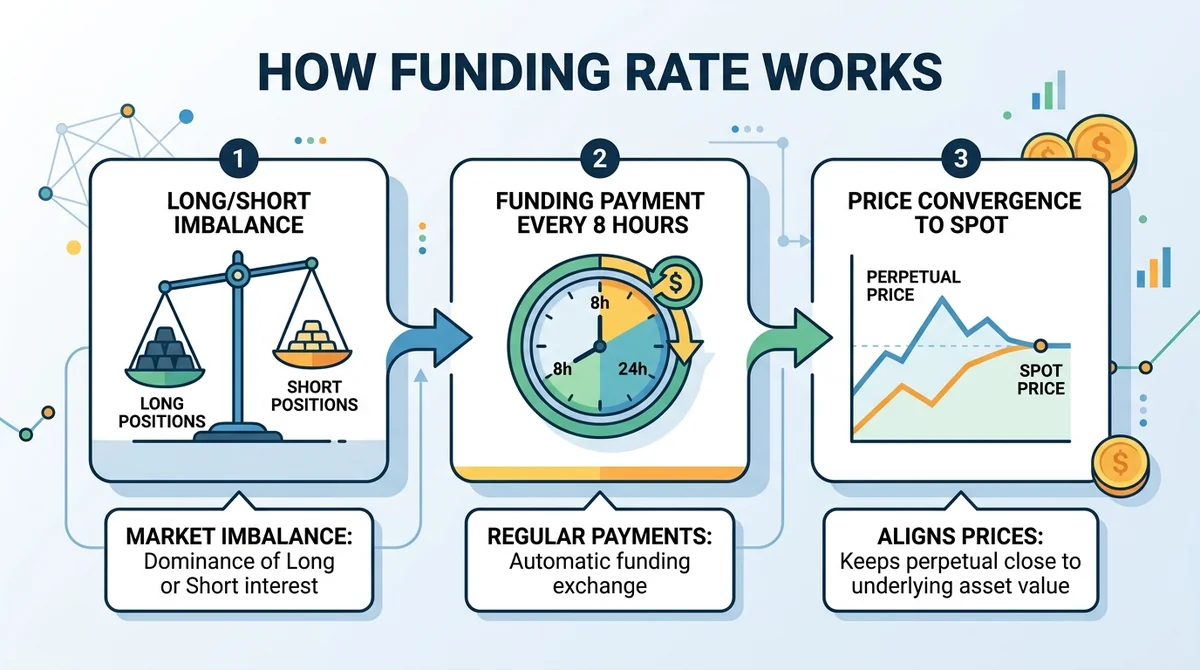
What is the funding rate: It acts like a rebalancing fee when supply and demand are imbalanced. When the market is overheated, longs pay shorts; when it's cold, shorts pay longs.
Impact on positions: If you hold a position long-term, the funding rate will continuously deduct from or add to your account. High rates can slowly eat away your margin.
Settlement frequency: Typically every 8 hours, depending on the exchange.
#What are the risk differences between spot and perpetual futures?
Spot risk: Mainly price decline. The most you can lose is your invested principal.
Additional risks of perpetual futures:
- Leverage amplifies gains and losses: with 10x leverage, a 10% adverse price move liquidates you.
- Liquidation: your margin is wiped out and the position is force-closed.
- Funding rate costs: the longer you hold, the more you may be charged.
Beginner note: Start with small positions and avoid high leverage. Digital assets are extremely volatile; liquidation can happen within minutes.
#A simple example: how does trading Bitcoin differ between spot and perpetual futures?
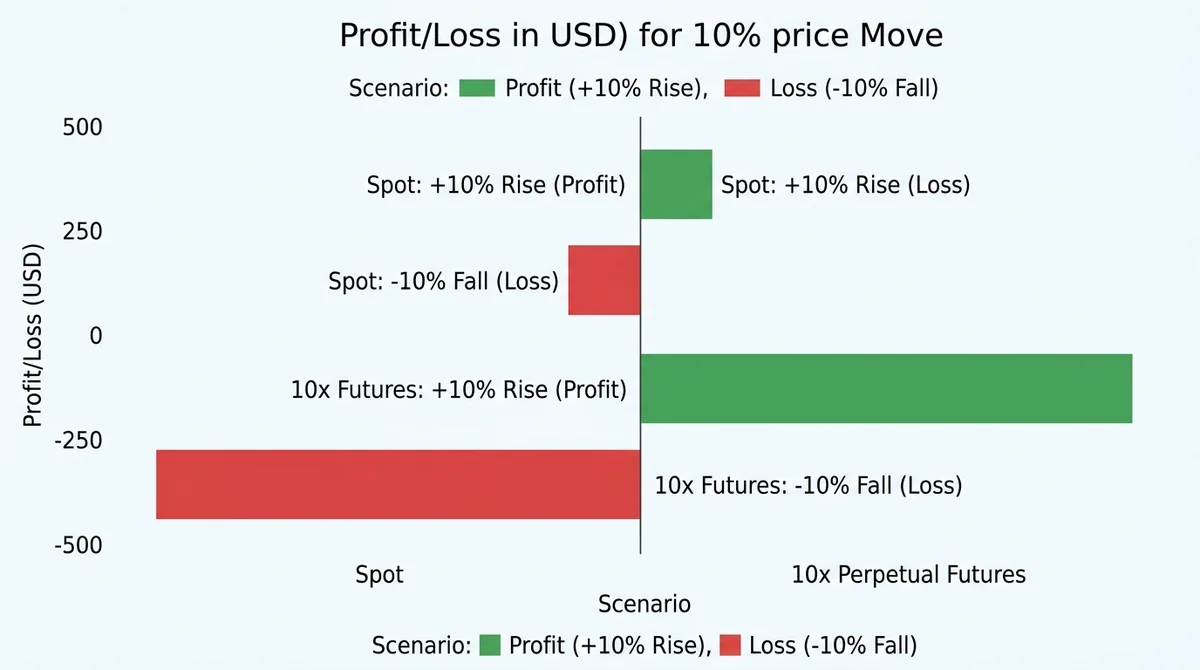
Buying spot: You spend $1,000 to buy 0.01 BTC. If the price rises 10%, you earn $100; if it falls 10%, you lose $100, but you still own the asset.
Opening a perpetual long: You use $100 margin to open a 10x long position, with a notional position of $1,000. If the price rises 10%, you earn $100, a 100% return; if it falls 10%, you lose $100, your entire principal is gone, and you are liquidated.
Comparison: With the same price move, perpetual futures' profit/loss is 10 times that of spot. Leverage is a double-edged sword.
#Spot vs Perpetual Futures FAQ
#Which is better for beginners, spot or perpetual futures?
Spot is better for beginners. Perpetual futures involve leverage and funding rates, which are high risk and can easily lead to liquidation for novices.
#Can perpetual futures be held indefinitely?
Yes, but you must continuously pay or receive funding rates, and leveraged positions carry liquidation risk.
#Is the funding rate a trading fee?
No. The funding rate is a balancing fee between longs and shorts, not a fee charged by the exchange.
#Does spot trading require paying a funding rate?
No. Spot trading has no funding rate.
This article only covers concepts; when you're ready to try, check out the live tools on the main site MSX.
FAQ
Which is better for beginners, spot or perpetual futures?
Spot is better for beginners. Spot involves directly holding assets, and the risk is mainly price fluctuations. Perpetual futures involve leverage and funding rates, which amplify volatility and can easily lead to liquidation for novices.
Can perpetual futures be held indefinitely?
Yes, but you must continuously pay or receive funding rates, and leveraged positions carry liquidation risk. Long-term holding costs can be high.
Is the funding rate a trading fee?
No. The funding rate is a balancing fee between longs and shorts in perpetual futures, used to keep the contract price close to the spot price, not a fee charged by the exchange.
Does spot trading require paying a funding rate?
No. Spot trading has no funding rate, only trading fees when buying or selling.
Related Terms
Want to see the real data for this concept?
After you sign up, you can view live prices, funding rates, and fees for the related assets.
View live prices and fees →