How Are Tokenized Bonds Priced? Interest Rates and Credit Spreads in 2026 Explained
Tokenized bond pricing is about discounted future cash flows. Interest rates and credit spreads are key. Rising rates lower prices, wider spreads add risk. On-chain features change trading, not pricing. Not investment advice.
Answer: The core of tokenized bond pricing is the discounting of future cash flows. Interest rates and credit spreads are the two key pricing variables. On-chain features only change the trading method, not the essence of pricing. Understanding these two will help you grasp most tokenized bond price movements.
#What Are Tokenized Bonds?
Tokenized bonds are traditional bonds whose claims are represented as digital tokens on a blockchain; holding the token means holding a corresponding share of the bond. They still retain coupon payments and maturity dates, with only the recording method changed from paper or centralized ledgers to blockchain. Currently, tokenized bonds on the market include both government bonds (such as tokenized U.S. Treasuries) and corporate bonds, usually using smart contracts to automatically distribute coupons. Each token represents a small fraction of the bond's face value—for example, one token may represent $1 of face value, allowing small capital to participate. For a detailed definition of tokenized bonds, see tokenized bonds.
Analogy: A tokenized bond is like cutting a whole thousand-dollar bond into one thousand one-dollar pieces. Each piece can be bought, sold, and held independently.
#Pricing Logic: How Interest Rates and Credit Spreads Affect Prices
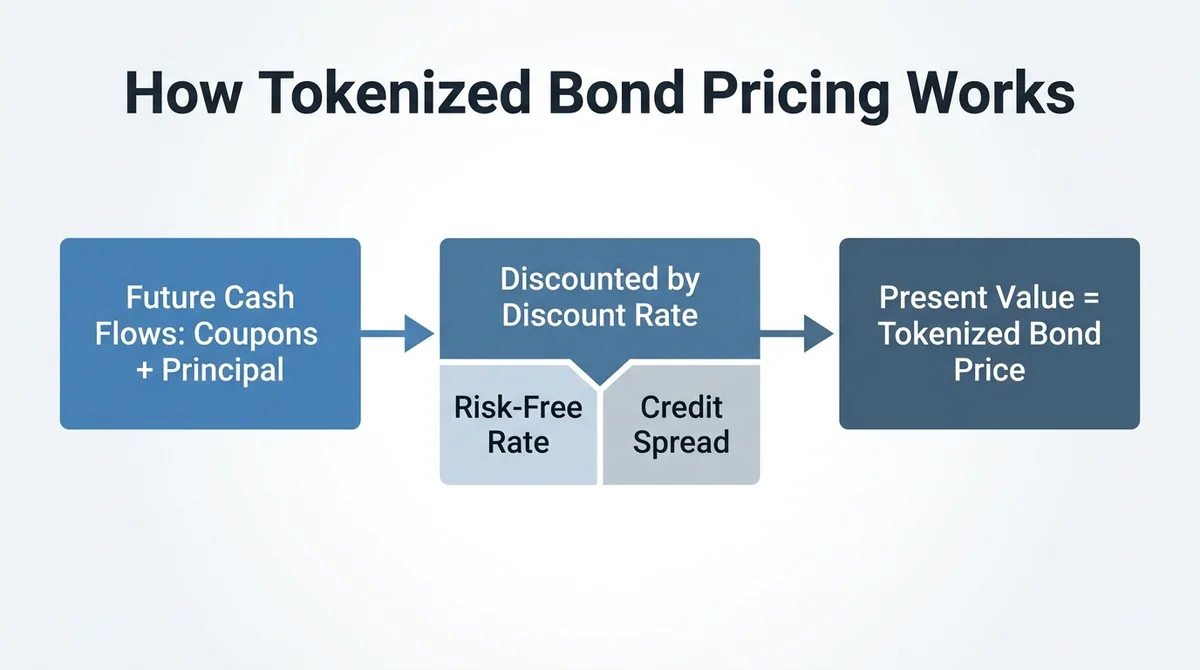
Bond prices are determined by the present value of all future cash flows. Tokenized bonds follow the same rule. The cash flows are mainly periodic coupons and the principal at maturity. The higher the discount rate, the lower the present value. This discount rate can be split into the risk-free rate plus a credit spread.
Interest rates: When interest rates rise, the discount rate rises, and fixed-coupon bond prices fall. The two have an inverse relationship. For example, a bond with a 5% coupon will fall below par when the market rate rises from 5% to 6%, because new bonds offer higher coupons, and old bonds must be priced lower to attract buyers.
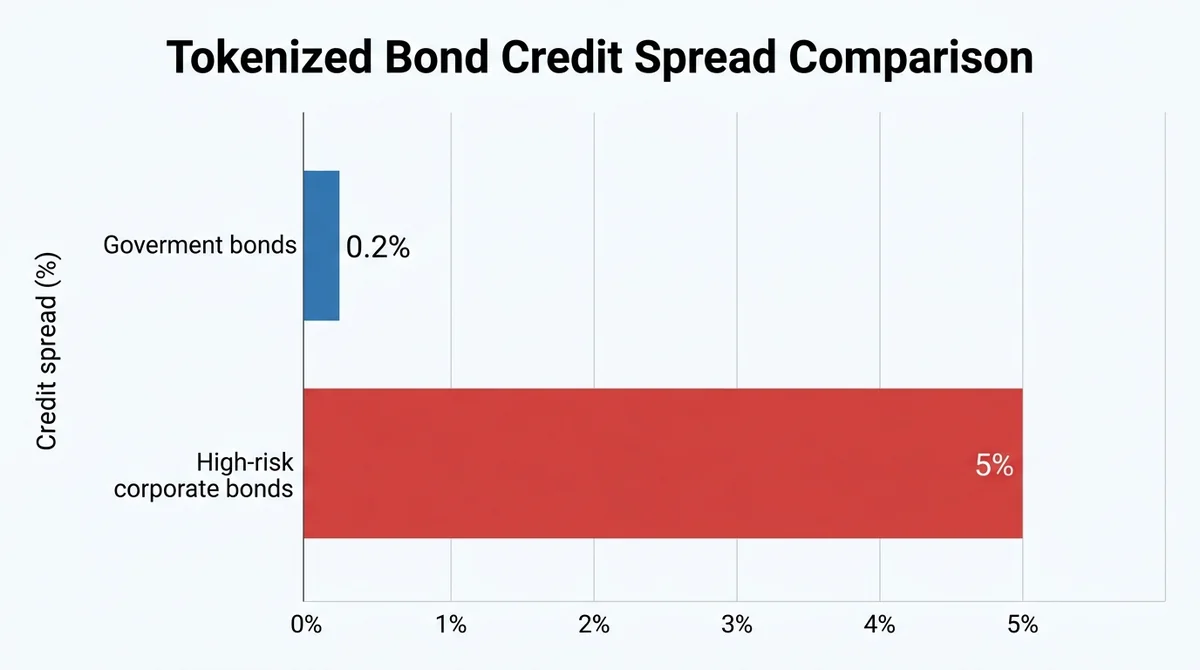
Credit spreads: A credit spread is the market's extra compensation for default risk. The worse the issuer's credit, the wider the spread and the lower the bond price. When the spread narrows, prices recover. For example, for a 3-year bond, the spread on government bonds might be only 0.2%, while for high-risk corporate bonds it could be as high as 5%.
Analogy: Interest rates are like the market's benchmark water level. When the water rises, all boats sink. Credit spreads are like the degree of leakage in each individual boat.
#How Is Tokenized Bond Pricing Different from Traditional Bond Pricing?
The underlying pricing logic is the same, but tokenized bonds have on-chain features.
- 24/7 trading: Prices change at any time, unlike many traditional bonds with primary trading sessions.
- Fractional ownership: Lowers the investment barrier and may bring new liquidity.
- On-chain transparency: Bond terms and transfer records are verifiable, but this does not eliminate risk.
These features may affect liquidity premiums, but they do not change the bond's underlying value anchor. In practice, tokenized bonds may reduce liquidity risk due to round-the-clock trading, but they may also have wider bid-ask spreads due to insufficient market depth.
#How Should Beginners Analyze Tokenized Bonds?
If you are interested in tokenized bonds, you can analyze them by following these steps:
- Confirm the underlying asset: Check whether the token represents government bonds, corporate bonds, or other debt, and understand the issuer's credit status.
- Check the coupon and maturity: Calculate the expected yield and compare it with similar traditional bonds.
- Review the smart contract: Check whether the contract has been audited and whether the custodian is compliant.
- Assess liquidity: See which platforms the token trades on and what the trading volume is.
- Set a risk budget: Only invest money you can afford to lose.
#What Risks Should Beginners Watch For?
Besides interest rate and credit risk, tokenized bonds carry unique risks.
- Smart contract risk: Code vulnerabilities may lead to asset loss.
- Custody and compliance risk: If the underlying asset custodian or issuer is non-compliant, redemption may be affected.
- Underlying bond default risk: If the issuer cannot repay, the token will also be affected.
- Regulatory risk: Different jurisdictions may classify tokenized bonds differently, which could affect trading.
- Market liquidity risk: The tokenized bond market is relatively small, and large trades may cause price slippage.
Digital assets and bond investments carry volatility and loss risks. This article explains concepts only and does not constitute investment advice. For more basic concepts, see MSX Learn.
#FAQ
Q: What is a tokenized bond? A: A tokenized bond is a traditional bond's claim represented by a blockchain token; holding the token equals holding a share of the bond. It retains coupon and maturity, but can be held fractionally, transferred on-chain, and traded more flexibly in terms of time.
Q: Why does a tokenized bond's price fall when interest rates rise? A: Rising interest rates increase the discount rate, lowering the present value of future fixed coupons and principal, so the bond price falls. Tokenized bonds follow the same inverse relationship.
Q: What is a credit spread, and how does it affect pricing? A: A credit spread is the additional yield investors demand for default risk. When the issuer's credit deteriorates, the spread widens and bond prices fall; when credit improves, the spread narrows and prices rise.
Q: What is the main pricing difference between tokenized bonds and traditional bonds? A: The underlying pricing logic is the same, but tokenized bonds can trade 24/7, be held fractionally, and on-chain transparency may affect liquidity premiums, but does not change the value anchor.
Q: What are the risks of investing in tokenized bonds? A: They include interest rate risk, credit risk, smart contract vulnerabilities, custody and compliance risk, and underlying bond default risk. Prices may fall; invest cautiously; this is not investment advice.
Q: How is the yield of a tokenized bond calculated? A: Simple yield = (coupons received during the holding period + difference between selling price and buying price) / buying price. More precise is yield to maturity (YTM), which considers compounding and time to maturity.
FAQ
What is a tokenized bond?
A tokenized bond is a traditional bond's claim represented by a blockchain token; holding the token equals holding a share of the bond. It retains coupon and maturity, but can be held fractionally, transferred on-chain, and traded more flexibly in terms of time.
Why does a tokenized bond's price fall when interest rates rise?
Rising interest rates increase the discount rate, lowering the present value of future fixed coupons and principal, so the bond price falls. Tokenized bonds follow the same inverse relationship.
What is a credit spread, and how does it affect pricing?
A credit spread is the additional yield investors demand for default risk. When the issuer's credit deteriorates, the spread widens and bond prices fall; when credit improves, the spread narrows and prices rise.
What is the main pricing difference between tokenized bonds and traditional bonds?
The underlying pricing logic is the same, but tokenized bonds can trade 24/7, be held fractionally, and on-chain transparency may affect liquidity premiums, but does not change the value anchor.
What are the risks of investing in tokenized bonds?
They include interest rate risk, credit risk, smart contract vulnerabilities, custody and compliance risk, and underlying bond default risk. Prices may fall; invest cautiously; this is not investment advice.
Related Terms
Want to see the real data for this concept?
After you sign up, you can view live prices, funding rates, and fees for the related assets.
View live prices and fees →