What Is a Tokenized Commodity Linear Contract?
Tokenized commodity linear contracts are stablecoin-settled linear contracts on tokenized gold or oil. Learn how they work, examples, and risks.
Answer: A tokenized commodity linear contract is a linear contract with tokenized gold, crude oil, or similar assets as the underlying, quoted and settled in stablecoins, with profit and loss moving in the same direction as the underlying asset's price. Users can participate in price movements without holding the physical asset, but need to be aware of leverage and funding rate risks.
#What Is a Tokenized Commodity Linear Contract?
Tokenized commodities are digital tokens issued on a blockchain that represent ownership of physical commodities (such as gold or crude oil), and their price is usually anchored to the off-chain market price of the physical commodity. A tokenized commodity linear contract is a linear contract (also called a linear contract) with tokenized commodities as the underlying, quoted and settled in stablecoins, and with profit and loss linearly related to changes in the underlying asset's price.
Analogy: It's like betting on the price of gold with U.S. dollars without holding gold.
The difference between it and ordinary linear contracts: ordinary linear contracts usually have cryptocurrencies as the underlying; this one has tokenized commodities as the underlying. Tokenized commodity prices usually track off-chain physical commodities, but can have premiums or discounts.
#How Does a Tokenized Commodity Linear Contract Work?
Users deposit stablecoins as margin and open positions with leverage. The contract price usually fluctuates around the spot price of the tokenized commodity, and the perpetual futures funding rate settlement schedule helps it converge to the spot price.
Funding rate: A fee exchanged periodically between longs and shorts when supply and demand for long and short positions are imbalanced, used to make the contract price converge to the spot price. When demand from longs is higher than from shorts, longs pay shorts; otherwise, shorts pay longs.
Margin: Like a deposit; leverage is like a magnifying glass, amplifying both gains and losses.
#Common Examples and Importance
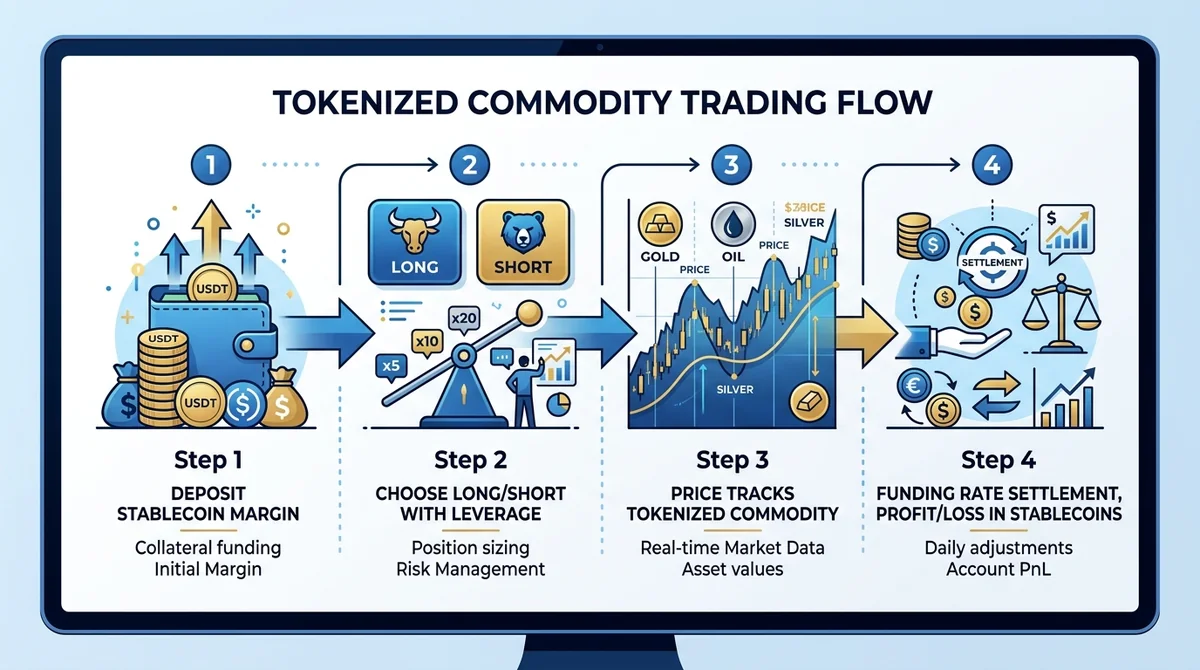
Common underlyings: tokenized gold contracts, tokenized crude oil contracts. Prices usually track spot commodities.
No physical delivery is required, 24/7 trading (depending on the platform), and you can go long or short.
Compared with buying spot commodities directly: Spot requires holding physical assets or physical certificates, while contracts only require margin; contracts usually have leverage, spot usually does not. However, contracts require paying funding rate and trading fees, and face liquidation risk.
#Risks and Relationships
Risks: Leverage can amplify losses, and if margin is insufficient, positions may be forcibly liquidated; funding rates carry a cost, and holding positions long term can erode returns; mistaking contracts for spot and holding them long term can make you ignore liquidation risks. Leveraged trading can lead to the loss of all margin. This article is only a conceptual explanation and does not constitute investment advice.
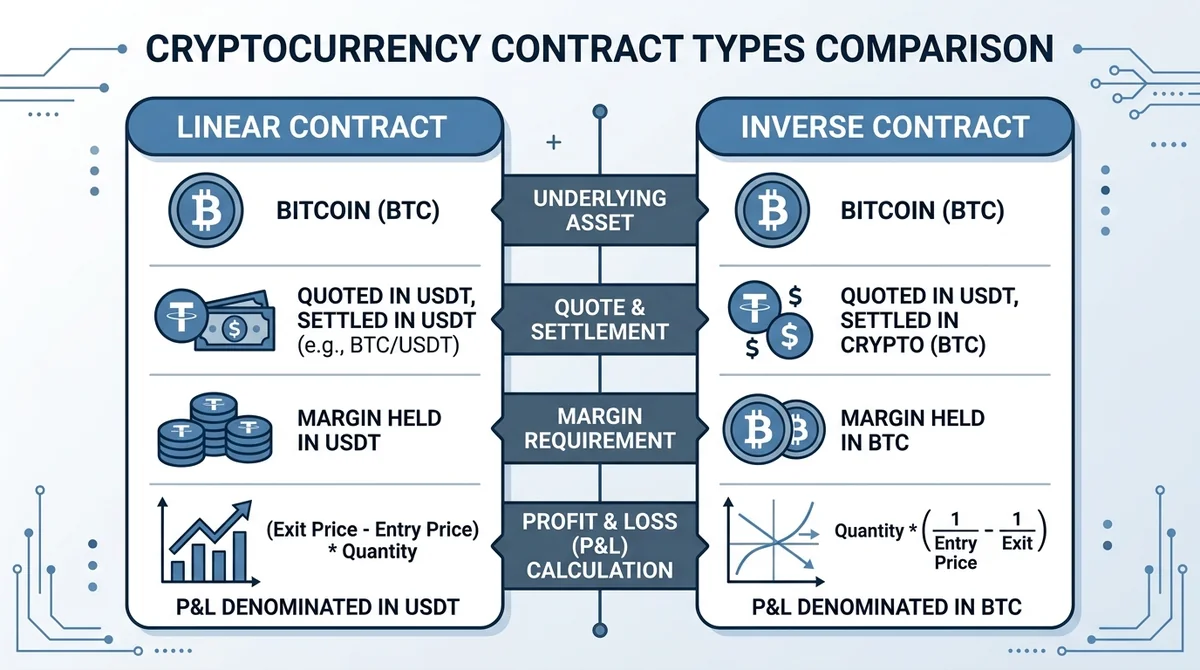
Relationship: Tokenized commodity linear contracts belong to linear contracts, quoted and settled in stablecoins. Inverse contracts use cryptocurrency as margin and profit/loss denomination, and may require conversion at settlement; the two differ in quotation and settlement methods.
Linear contract features:
- Quoted and settled in stablecoins
- Linear profit and loss
- Underlying is a tokenized commodity
Inverse contract features:
- Quoted in cryptocurrency
- Profit and loss reflected in the coin
This article only covers concepts; for actual trading, please fully understand the risks and use compliant platforms.
FAQ
What is a tokenized commodity linear contract?
A tokenized commodity linear contract is a linear contract with tokenized gold, crude oil, or similar assets as the underlying, quoted and settled in stablecoins. Profit and loss move in the same direction as the underlying asset's price, and users can participate in price movements without holding the physical asset, but need to be aware of leverage risk.
What is the difference between a tokenized commodity linear contract and an ordinary linear contract?
Ordinary linear contracts usually have cryptocurrencies as the underlying, while tokenized commodity linear contracts have tokenized commodities (such as tokenized gold or crude oil) as the underlying. Both use stablecoin settlement, but the underlying assets are different.
How does a tokenized commodity linear contract work?
Users deposit stablecoins as margin and open positions with leverage. The contract price usually fluctuates around the spot price of the tokenized commodity, and the funding rate periodically balances between longs and shorts.
What are the risks of a tokenized commodity linear contract?
The main risks are that leverage amplifies losses, and insufficient margin may lead to forced liquidation. Funding rates carry a cost, and long-term holding can erode returns. Beginners often mistake contracts for spot and hold them long term, ignoring liquidation risk. This does not constitute investment advice.
What is the difference between linear contracts and inverse contracts?
Linear contracts are quoted and settled in stablecoins, and profit and loss are directly reflected in stablecoins; inverse contracts use cryptocurrency as margin and denomination, and profit and loss are reflected in that cryptocurrency, possibly requiring conversion at settlement. The two differ in quotation and settlement methods.
Related Terms
Want to see the real data for this concept?
After you sign up, you can view live prices, funding rates, and fees for the related assets.
View live prices and fees →