Underwritten Public Offering: Definition, Process, and Risks
An underwritten public offering lets an underwriter buy the entire issuance and resell it. Learn the process, risks, and crypto applications.
#What Is an Underwritten Public Offering?
An underwritten public offering is a fundraising method where an underwriter (typically an investment bank or syndicate) buys the entire issuance from the issuer at a negotiated price and resells it to public investors, transferring the risk of unsold shares or tokens to the underwriter. This structure guarantees the issuer raises a predetermined amount of capital, while the underwriter assumes the risk of distributing the securities to the market.
#Key Takeaways
- An underwritten public offering involves an underwriter purchasing the entire issue from the issuer at a negotiated price and reselling to investors.
- In crypto, underwriting can apply to security token offerings (STOs), tokenized equity, or certain token sales structured as securities offerings.
- Underwriting differs from a direct listing, where no intermediary buys the assets and the issuer sells directly to the market.
- Key risks include underwriter default, mispricing, high fees, and regulatory uncertainty.
#How Does Underwriting Differ from a Direct Listing?
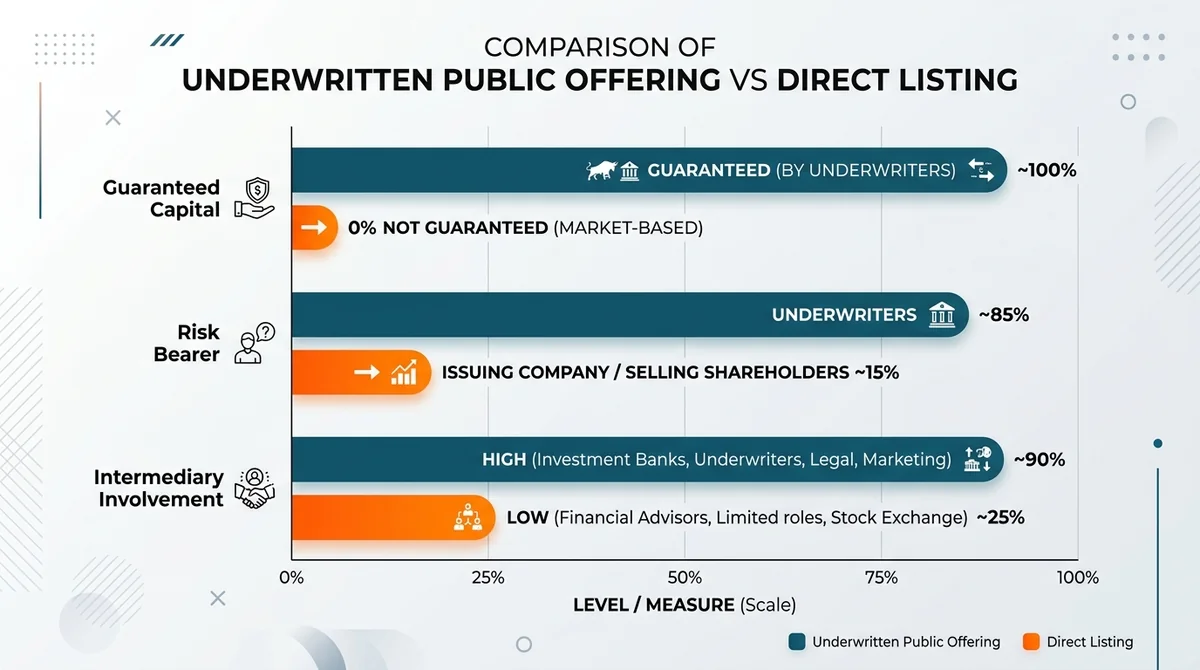
In a direct listing, the issuer sells shares or tokens directly to the public without an intermediary buying the assets. There is no guaranteed capital, and the issuer bears the risk of unsold assets. In an underwritten public offering, the underwriter purchases the entire issuance, guaranteeing the issuer receives a set amount of funds regardless of market demand. This key difference shifts the risk from the issuer to the underwriter.
#What Types of Assets Can Be Underwritten in Crypto?
In crypto, underwriting can apply to security token offerings (STOs), tokenized equity, debt tokens, and certain token sales structured as securities offerings. These assets typically represent ownership, profit-sharing, or debt obligations, making them subject to securities regulations. Utility tokens from initial coin offerings (ICOs) are rarely underwritten due to regulatory ambiguity.
#How Does an Underwritten Public Offering Work in Crypto?
In crypto, an underwritten public offering typically involves an underwriter committing to purchase a set amount of tokens at a fixed price, then reselling them to investors, often using a syndicate to manage risk. The process mirrors traditional IPOs but may use smart contracts for distribution.
#Step-by-Step Process of Underwriting a Token Offering
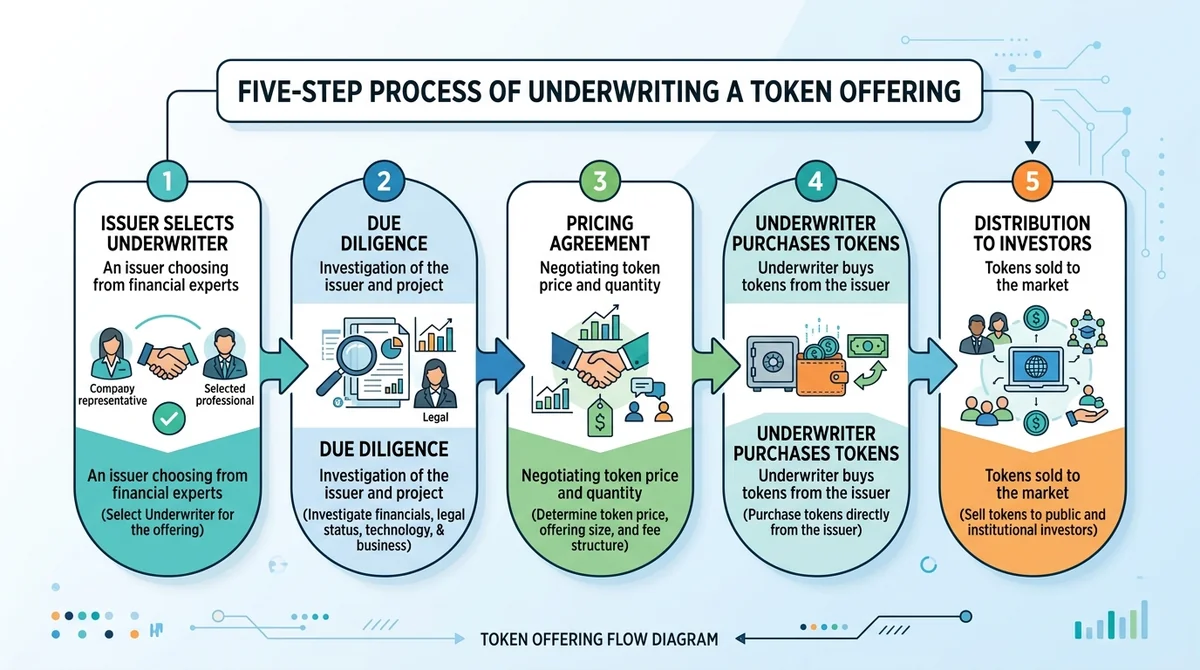
- Issuer selects underwriter(s): The issuer chooses a crypto investment firm, broker-dealer, or specialized token offering platform.
- Due diligence: The underwriter reviews the issuer's business, financials, and token economics.
- Pricing agreement: Both parties negotiate the purchase price and total amount of tokens.
- Underwriter purchases tokens: The underwriter buys the entire issuance at the agreed price, transferring risk from the issuer.
- Distribution to investors: The underwriter resells tokens to its network of investors, possibly using a syndicate to spread risk.
#Who Are the Typical Underwriters in Crypto?
Typical underwriters in crypto include crypto investment firms, broker-dealers, and specialized token offering platforms. These entities may form a syndicate to spread risk, especially for large offerings. Smart contracts may automate parts of distribution, but the underwriting commitment remains a legal and financial obligation.
#What Are Examples of Underwritten Public Offerings in Crypto?
Examples in crypto include security token offerings and tokenized equity offerings where an underwriter commits to purchase the tokens and resell them, similar to traditional IPOs. No specific examples with hard numbers are provided in the input, but the structure mirrors traditional IPOs.
#Security Token Offerings (STOs) with Underwriting
STOs that represent equity or debt often use underwriting to comply with securities regulations and ensure distribution. The underwriter's involvement can enhance credibility and attract institutional investors.
#Tokenized Equity Offerings
Tokenized shares of private companies or real estate funds may be offered through underwriters to accredited and retail investors. This process brings traditional IPO mechanics to blockchain-based assets.
#Why Is an Underwritten Public Offering Important?
Underwritten public offerings are important because they provide issuers with guaranteed funding and professional distribution, while giving investors a vetted investment opportunity with clearer regulatory compliance.
#Benefits for Token Issuers
- Guaranteed capital: The issuer receives a set amount regardless of market demand.
- Professional pricing: Underwriters help determine a fair offering price.
- Access to distribution network: Underwriters have established investor relationships.
- Enhanced credibility: Underwriting signals institutional validation.
#Benefits for Investors
- Underwriter's due diligence may signal quality.
- Potential for more liquidity due to underwriter support.
- Clearer regulatory compliance for security tokens.
#What Are the Risks or Common Misconceptions About Underwritten Public Offerings in Crypto?
Key risks of underwritten public offerings in crypto include underwriter failure, mispricing, high fees, and regulatory uncertainty, while common misconceptions include confusing underwriting with listing or assuming all token sales are underwritten.
#Risks: Underwriter Failure and Mispricing
Risks include underwriter default, mispricing causing losses, high fees, and conflicts of interest if the underwriter also trades the token. Regulatory risk exists if the token is later deemed a security, subjecting the offering to enforcement actions.
#Misconception: All Token Sales Are Underwritten
A common misconception is assuming that underwriting guarantees token price appreciation or that all token sales have underwriters. Underwriting is not the same as a simple listing on an exchange; it involves a purchase commitment.
#Related Terms to Understand
Related terms include IPO, STO, direct listing, underwriter, and syndicate, all of which help contextualize underwritten public offerings in both traditional and crypto markets.
- Initial Public Offering (IPO): Traditional company going public.
- Security Token Offering (STO): Tokenized securities offering.
- Direct Listing: Selling shares/tokens without underwriters.
- Underwriter: The financial intermediary that assumes risk.
- Syndicate: Group of underwriters sharing risk.
FAQ
What is the difference between an underwritten public offering and a direct listing?
In an underwritten public offering, an underwriter buys the entire issuance and resells it, guaranteeing capital for the issuer. In a direct listing, the issuer sells directly to the public without an intermediary, bearing the risk of unsold assets.
Are all token sales underwritten?
No, most token sales, especially utility token ICOs, are not underwritten due to regulatory ambiguity. Underwriting is more common for security token offerings and tokenized equity.
What are the main risks of underwritten public offerings in crypto?
Key risks include underwriter default, mispricing, high fees, conflicts of interest, and regulatory uncertainty if the token is later deemed a security.
Who can act as an underwriter in crypto?
Crypto investment firms, broker-dealers, and specialized token offering platforms can act as underwriters. They may form a syndicate to spread risk for large offerings.
Does underwriting guarantee token price appreciation?
No, underwriting does not guarantee price appreciation. It only guarantees the issuer receives a set amount of capital from the underwriter's purchase.
How do underwriters set the price in an underwritten public offering?
Underwriters negotiate the purchase price with the issuer based on due diligence, market demand, and the issuer's financials. The price is set before the underwriter commits to buying the entire issuance.
Want to see the real data for this concept?
After you sign up, you can view live prices, funding rates, and fees for the related assets.
View live prices and fees →