What Are Tokenized Bonds? On-Chain Mapping and Yield Mechanics of Traditional Bonds
Tokenized bonds are blockchain representations of traditional bonds, a form of RWA. Learn how they work, yield sources, and risks in plain language.
Answer: Tokenized bonds are digital tokens created by mapping the debt claims or income rights of traditional bonds onto a blockchain, and are a type of real-world assets (RWA). Holding the token typically corresponds to a small share of the underlying bond's rights, which may not necessarily make bonds easier to hold and transfer, but can lower the participation threshold and improve settlement efficiency.
#What Are Tokenized Bonds?
Traditional bonds are debt instruments where the issuer (such as governments, corporations, etc.) borrows money from holders and promises to repay principal and interest at maturity. Tokenized bonds convert this debt claim into tokens on a blockchain. When you hold the token, you hold a small fraction of the underlying bond's claim or income rights. It is a form of bringing RWA (real-world assets) on-chain.
Analogy: It's like replacing a paper IOU with a programmable digital certificate; transferring and viewing the certificate may be more convenient, but the underlying debt relationship remains unchanged.
#How Do Tokenized Bonds Work?
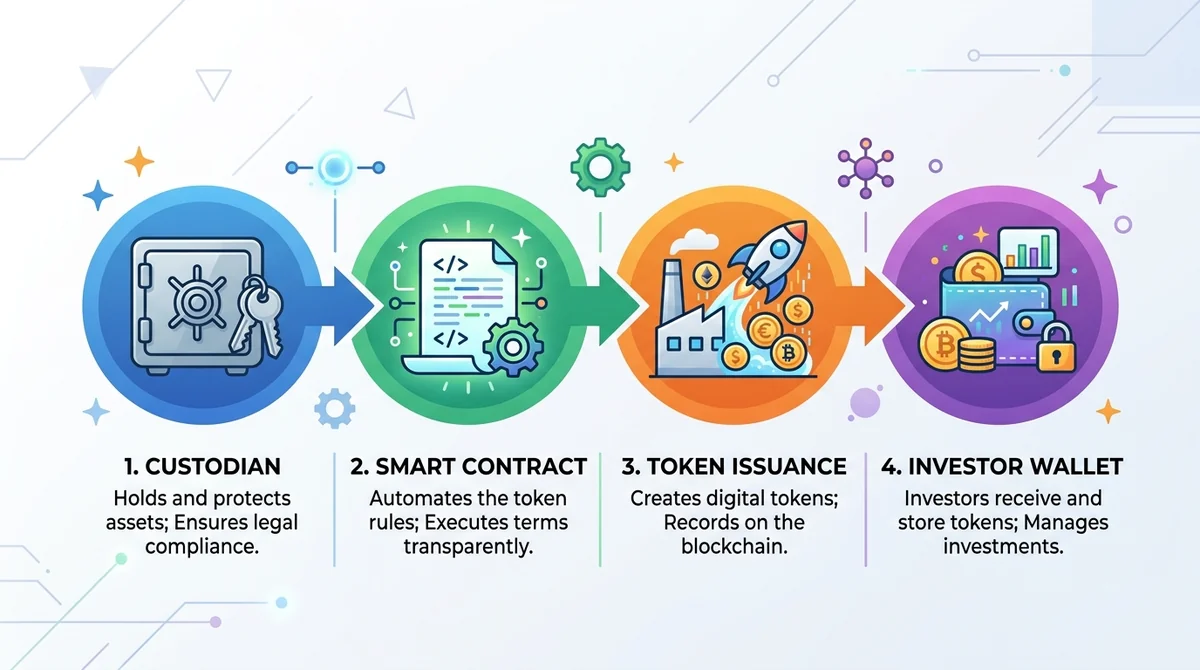
A common process for tokenized bonds is: the issuer or a compliant platform first places the underlying traditional bond in the custody of a licensed institution, then smart contracts issue corresponding tokens on the blockchain. Investors hold these tokens using their own wallets. Smart contracts usually handle operations such as interest distribution and redemption at maturity.
Analogy: The custodian acts like a safe deposit box for the IOU; smart contracts act like an automatic interest payer, paying interest to on-chain addresses according to preset rules. However, the actual operation depends on the custody arrangement and smart contract code.
#Where Does Yield Come From? What Are the Risks?
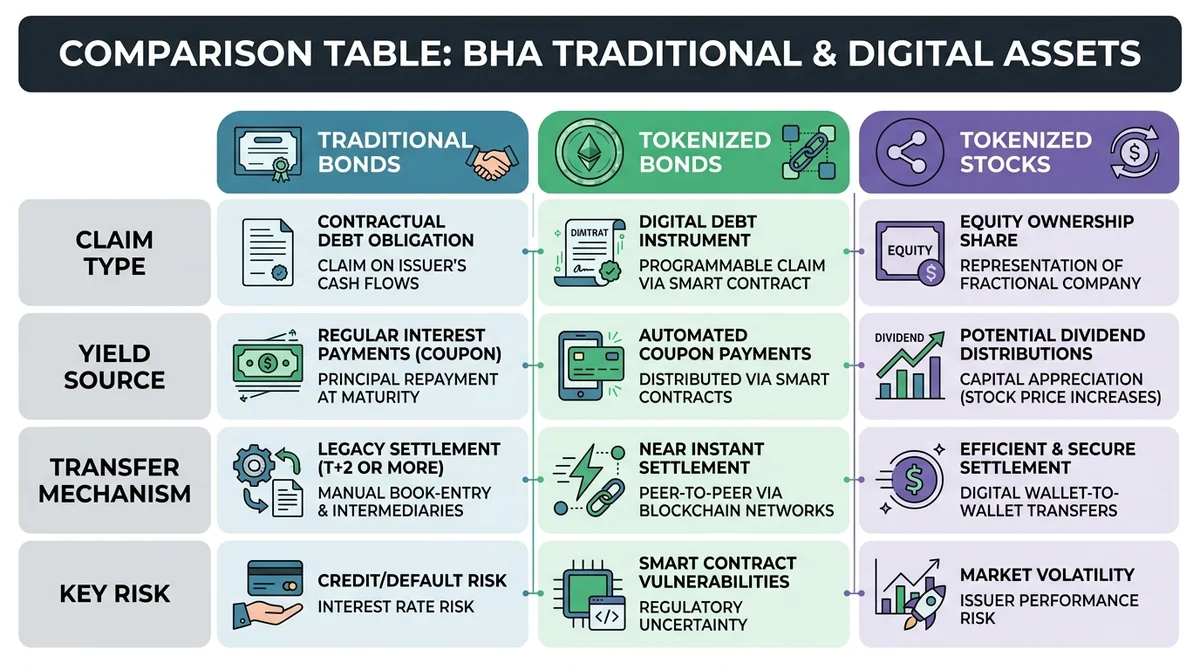
The yield of tokenized bonds mainly comes from the interest of the underlying bond. On-chain holding and settlement may theoretically be faster and more transparent, but the actual experience depends on the specific implementation and custody arrangement. It does not change the credit risk of the underlying bond.
Risk warning: Default of the underlying bond, compliance or technical issues with the platform or custodian, and smart contract vulnerabilities can all cause losses. Tokenized bonds are not principal-protected products, and secondary market prices may also fluctuate. This article is for conceptual education only and does not constitute investment advice.
#What Are Common Terms Related to Tokenized Bonds?
- RWA: Real World Assets, referring to mapping traditional assets such as stocks, bonds, and commodities onto the blockchain.
- Tokenized stocks: represent company equity, and their prices fluctuate with company performance and market sentiment; whereas tokenized bonds represent debt claims and usually have fixed interest and principal repayment at maturity.
- Smart contracts: code that automatically executes on the blockchain, often used in tokenized bonds to distribute interest and handle redemptions.
Note: The above content does not cite specific platform data; all qualitative descriptions are based on public concepts. For fees, custody arrangements, etc., of specific products, please refer to official documents.
FAQ
Are tokenized bonds a type of RWA?
Yes. RWA refers to mapping real assets such as stocks, bonds, and commodities onto the blockchain. Tokenized bonds are exactly the tokenization of bond income rights or debt claims into on-chain tokens.
Where does the yield of tokenized bonds come from?
It mainly comes from the interest of the underlying traditional bond. On-chain holding may make settlement faster and more transparent, but it does not change the bond's interest payment logic; the underlying default risk remains.
Are tokenized bonds principal-protected?
No. They still face underlying bond default risk, platform custody risk, and smart contract risk. Secondary market prices may also fluctuate. There is no principal protection guarantee. Investors need to assess their own risk tolerance.
What is the difference between tokenized stocks and tokenized bonds?
Stocks represent equity, and their prices fluctuate with company performance; bonds represent debt claims and usually have fixed interest and principal repayment at maturity. The on-chain methods are similar, but the rights and obligations are different.
Related Terms
Want to see the real data for this concept?
After you sign up, you can view live prices, funding rates, and fees for the related assets.
View live prices and fees →