Bridge
A cross-chain bridge connects two independent blockchains so assets or data can move between them. Learn how bridges work, common types, key steps, and main risks.
A cross-chain bridge is a tool that connects two independent blockchains and lets assets or data move from one chain to another.
#What Is a Cross-Chain Bridge?
One-sentence definition: A cross-chain bridge is a "channel" between chains, responsible for sending assets or information from chain A to chain B.
Analogy: Two chains are like two islands with no common language; the cross-chain bridge is the ferry between them, and both people and cargo need it to cross the sea.
#What problem does a cross-chain bridge solve?
- Each chain keeps its own ledger, and the ledgers are not connected.
- Your coins on Ethereum are invisible to the Bitcoin network.
- A cross-chain bridge lets assets cross that boundary.
#Why can't different blockchains transfer directly to each other?
Because each chain only recognizes its own ledger and rules. A transfer on one chain can be neither verified nor recorded by another chain. Each chain's nodes maintain only the state of their own chain and cannot read another chain's balances and transaction history, so assets cannot simply be wired across the way a bank transfer works. A bridge is therefore needed to do the "translation + relay", mapping an action on one chain into a result the other chain can recognize and record.
#How does a cross-chain bridge move assets from one chain to another?
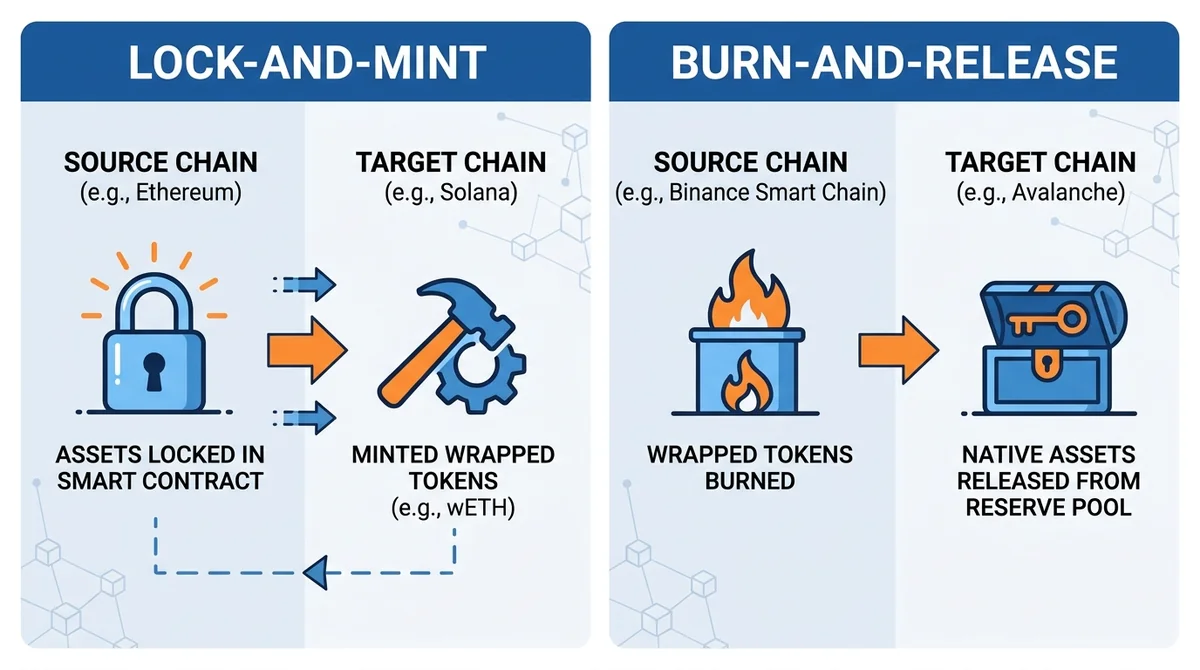
The core idea: assets are "locked up" on the source chain, then an equal amount is "released" on the target chain.
#How does the lock-and-mint model work?
- The source chain locks the original asset into the bridge's contract.
- The target chain mints an equal amount of "wrapped assets".
- What you hold is the wrapped asset on the target chain, not the original coin on the source chain.
#How does the burn-and-release model work?
- Assets are burned on the source chain.
- The target chain releases an equal amount from the bridge's reserve pool.
Analogy: Like withdrawing money in another city — you deposit into the main account first, then withdraw at another branch.
#Where are the assets actually during a cross-chain transfer?
The original assets are usually held by the bridge's contract or a custody fee provider; they are not in your hands and not on the target chain. Users only receive wrapped assets on the target chain representing equal value, and whether they can be redeemed for the original assets depends on the bridge's reserves and operations. This is what determines the risks discussed below: the more assets pooled inside a bridge, the greater the cost of a single point of failure.
#What are the common types of cross-chain bridges?
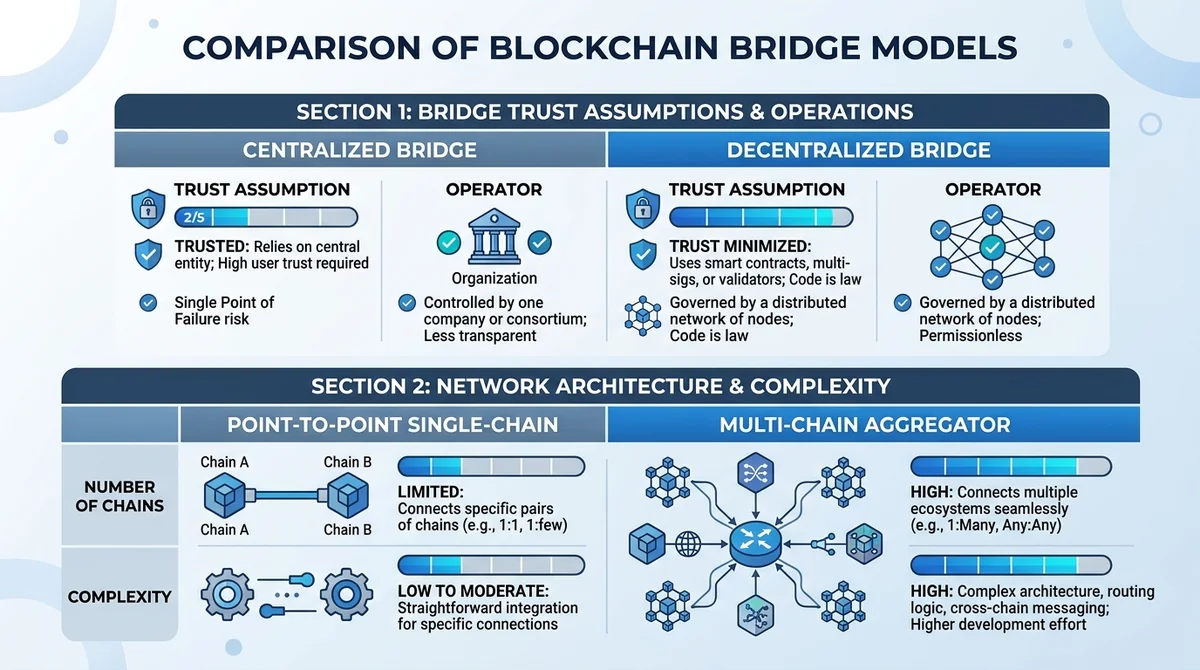
By custody model:
- Centralized bridge: assets are held by an institution, and trust depends on the operator.
- Decentralized bridge: operated by smart contracts and a validator network.
By connection scope:
- Point-to-point single-chain bridge: connects only two chains, with a relatively simple structure.
- Multi-chain aggregator bridge: connects multiple chains at once, more convenient but more complex.
Different types make different trade-offs between trust assumptions and convenience; there is no absolute best. When choosing, consider wallet support — for basic wallet concepts see /glossary/wallet; the underlying logic of bridges relies on contract execution, so you can also read /glossary/smart-contract.
#What are the steps to use a cross-chain bridge?
- Prepare a wallet that supports the target chain.
- Keep enough gas balance on the source chain.
- Open the bridge's official entry point and verify the domain.
- Select the target chain and asset, and verify the contract address.
- Confirm the amount and fees, then submit.
- Use a block explorer to verify arrival on the target chain.
⚠️ Digital assets carry risk. For your first cross-chain transfer, start with a small test amount. This article is not investment advice. For more basic concepts, see the introductory guides on MSX Learn.
#What risks do cross-chain bridges have?
#Why are cross-chain bridges easy targets for attacks?
Bridges hold large amounts of assets in one place, so a single successful breach yields extremely high returns — which is why bridges have long been a prime target for hackers. Compared with ordinary contracts, a bridge connects multiple chains at once and pools cross-chain reserves, giving it a larger attack surface; once there is a gap in validation logic or private key management, losses often affect the entire reserve.
#What risks does centralized custody fee bring?
Assets are controlled by the operator, creating counterparty risk. If the operator runs into trouble, users may be unable to recover their assets. This kind of risk does not come from code bugs but from trusting a single institution, and users often find it hard to detect in advance.
#How can cross-chain risks be reduced?
- Enter only through official channels, and beware of search ads and fake websites — see /security/phishing for how to spot them.
- Test with a small amount first, and scale up only after confirming arrival.
- Do not leave large amounts of assets inside a bridge for long periods.
- Spread usage across different bridges instead of betting on a single channel.
This article covers concepts only and is not investment advice.
#FAQ
#What is a cross-chain bridge?
A cross-chain bridge is a tool that connects two independent blockchains and lets assets or data move from one chain to another. It acts as a channel between the two chains, solving the problem that their ledgers are not connected.
#How does a cross-chain bridge work?
The common approach is to lock or burn assets on the source chain and mint or release an equal amount on the target chain. The original assets are generally held by the bridge's contract or a custody fee provider, and users receive corresponding assets on the target chain.
#What types of cross-chain bridges are there?
By custody model, they fall into centralized and decentralized bridges; by connection scope, into point-to-point single-chain bridges and multi-chain aggregator bridges. Different types make different trade-offs between trust assumptions and convenience.
#Is a cross-chain bridge safe?
Cross-chain bridges carry structural risks: large amounts of assets are concentrated inside the bridge, making it an easy attack target, and centralized custody fee also brings counterparty risk. It is advisable to use only official entry points, test with small amounts, and avoid leaving assets in a bridge for long periods.
#What do I need to prepare to use a cross-chain bridge?
You need a wallet that supports the target chain, a gas balance on the source chain, and verified target-chain and asset contract addresses. After completing the transfer, confirm arrival with a block explorer.
#What is the difference between a cross-chain bridge and a normal transfer?
A normal transfer happens within the same chain and is directly verified and recorded by that chain's nodes; a cross-chain bridge has to cross two ledgers that are not connected, so it must rely on mechanisms such as lock-and-mint or burn-and-release, with the bridge performing the state mapping — which adds a layer of trust dependence on the bridge itself.
#How long does a cross-chain bridge usually take to complete?
Arrival time depends on the bridge's design and congestion on the target chain; there is no uniform figure. Most bridges begin processing after the source-chain transaction is confirmed, then the target chain completes the mint or release, usually requiring block confirmations on both sides. After submitting, track progress with a block explorer and do not submit repeatedly.
FAQ
What is a cross-chain bridge?
A cross-chain bridge is a tool that connects two independent blockchains and lets assets or data move from one chain to another. It acts as a channel between the two chains, solving the problem that their ledgers are not connected.
How does a cross-chain bridge work?
The common approach is to lock or burn assets on the source chain and mint or release an equal amount on the target chain. The original assets are generally held by the bridge's contract or a custody fee provider, and users receive corresponding assets on the target chain.
What types of cross-chain bridges are there?
By custody model, they fall into centralized and decentralized bridges; by connection scope, into point-to-point single-chain bridges and multi-chain aggregator bridges. Different types make different trade-offs between trust assumptions and convenience.
Is a cross-chain bridge safe?
Cross-chain bridges carry structural risks: large amounts of assets are concentrated inside the bridge, making it an easy attack target, and centralized custody fee also brings counterparty risk. It is advisable to use only official entry points, test with small amounts, and avoid leaving assets in a bridge for long periods.
What do I need to prepare to use a cross-chain bridge?
You need a wallet that supports the target chain, a gas balance on the source chain, and verified target-chain and asset contract addresses. After completing the transfer, confirm arrival with a block explorer.
Want to see the real data for this concept?
After you sign up, you can view live prices, funding rates, and fees for the related assets.
View live prices and fees →