What Is a Crypto Address?
A crypto address is a string derived from a public key used to receive or send cryptocurrency on a blockchain, like a public payment account. Learn how addresses are generated from private keys, common formats, transfer risks, and FAQs.
A crypto address is a string of characters generated from a public key, used to receive or send cryptocurrency on a blockchain—essentially a public payment account.
#What Is a Crypto Address?
In simple terms: An address is like your email address: others can send crypto to it, but only the person holding the corresponding private key can control the assets.
Why is it called an 'address'? Because it is a public receiving location on the blockchain, just like your home address for receiving packages.
Is it the same as a bank account? Not exactly. A bank account requires approval from a bank, while an address does not require registration and is automatically generated by your wallet.
#How Are Crypto Addresses Generated and Used?
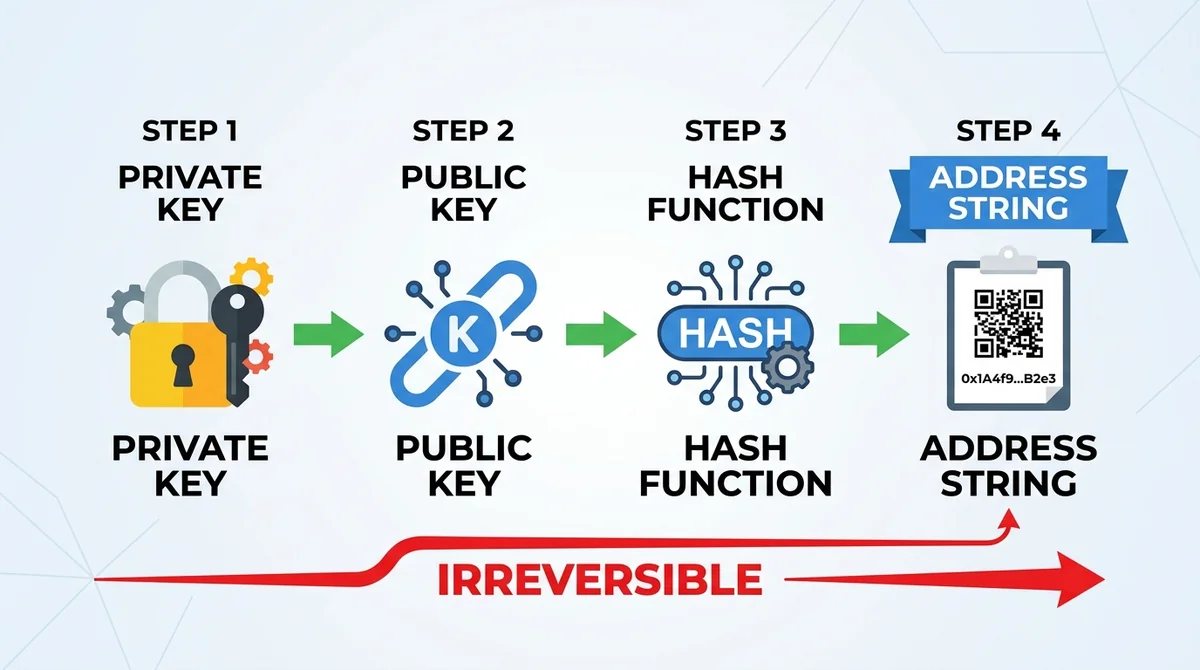
Process: A private key generates a public key, and the public key is then hashed and compressed into an address. Hashing is irreversible, so you cannot derive the private key from the address.
Private keys and public keys: Your private key is your only withdrawal password and must be kept secret; public keys and addresses can be shared openly. A public address only represents a receiving entry point and does not reveal control over the funds.
Why you can share your address publicly: Because only the private key can sign transactions, others who see your address cannot move your coins. For more details, see What is a private key? Private keys, public keys, and addresses in cryptocurrency cryptography.
#What Do Common Crypto Addresses Look Like?
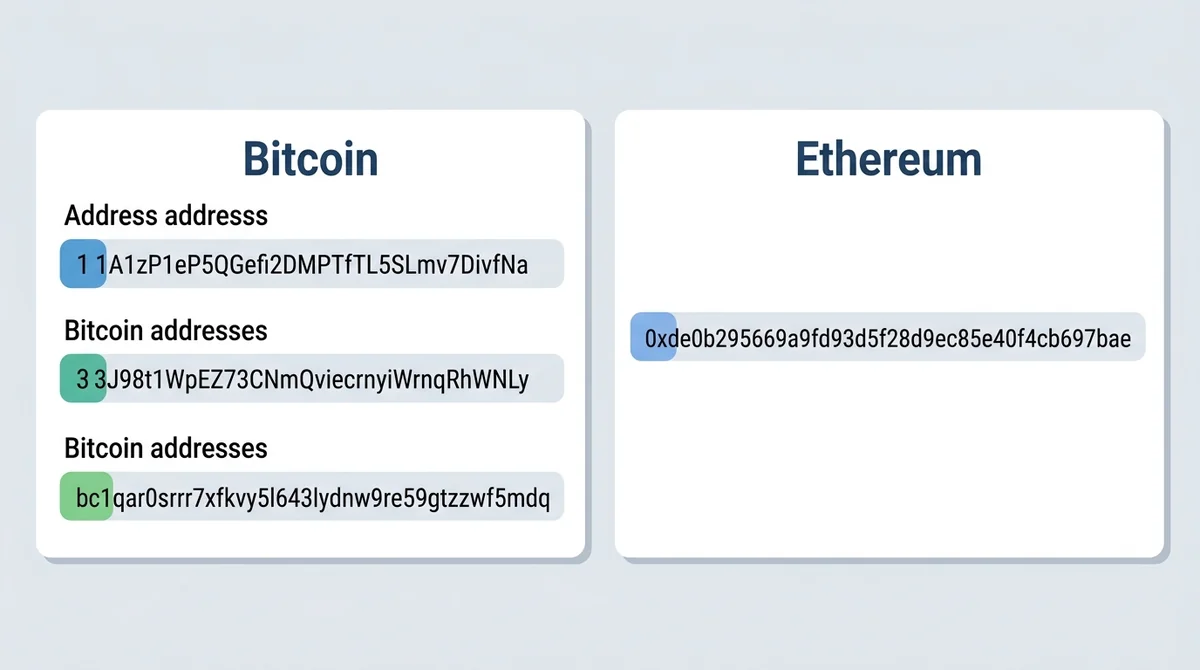
Bitcoin addresses: Commonly start with 1, 3, or bc1. Different prefixes correspond to different address types, but all can receive Bitcoin.
Ethereum addresses: Start with 0x, followed by 40 hexadecimal characters. Address formats differ across blockchains, so do not mix them up.
#Why Is Understanding Crypto Addresses Important?
Transfers are irreversible: There is no 'undo' button on the blockchain. If you enter the wrong address or choose the wrong network, your assets may be permanently lost.
Always check before sending: After copying an address, verify the first and last few characters. It's best to scan the QR code from your wallet to avoid copy-paste tampering.
#What Are Common Risks and Misconceptions When Using Crypto Addresses?
Addresses are not completely anonymous: On-chain transactions are publicly visible, and addresses are 'pseudonymous'. Reusing the same address repeatedly makes it easier to link your identity.
Copy-paste risk: Malware can tamper with the address in your clipboard. Install trusted antivirus software and visually verify the full address before sending.
Avoid reusing the same address over the long term: Although there is no mandatory restriction, for privacy reasons, it is recommended to use a new address for each incoming transaction (wallets usually generate one automatically).
FAQ
Can I share my address with others?
Yes. Public addresses are safe to share; others can only send funds to it and cannot take your assets. However, never reveal your private key. Only the person holding the private key can control the coins in the address.
Can different cryptocurrencies share the same address?
Generally no. Bitcoin addresses, Ethereum addresses, and others have different formats and correspond to different blockchains. Sending coins to an address on the wrong network may result in permanent loss.
Can an address be recovered?
The address itself does not need to be recovered; it is public. However, if you lose your private key, you lose control of the assets in that address. Therefore, backing up your private key or seed phrase is essential.
Are addresses anonymous?
No, they are not completely anonymous, but pseudonymous. On-chain transactions are publicly viewable, and through address linking and on-chain analysis, your real-world identity may be traced. It's recommended to avoid reusing the same address over the long term.
Can a copied address be tampered with?
Yes. Malware can replace the address in your clipboard. Always verify the full address before sending, preferably by scanning the QR code from your wallet, and install trusted security software.
Related Terms
Want to see the real data for this concept?
After you sign up, you can view live prices, funding rates, and fees for the related assets.
View live prices and fees →