Wallet Address
A wallet address is your public on-chain identifier, like a bank account number. Learn how addresses derive from keys, how to verify before sending, and avoid address scams.
A wallet address is your public receiving identifier on the blockchain. Others use it to send you coins, but it does not contain your private key.
#What is a non-custodial wallet address?
A wallet address is an account's public identifier on the blockchain, used to receive assets and check balances. It does not itself contain the private key, and leaking an address will not cause your assets to be transferred away.
It works like a bank account number: you can give it to someone so they can send money in.
What an address looks like: Address formats and lengths differ by chain. Ethereum addresses usually start with 0x, while Bitcoin addresses use other formats.
Different formats on different chains: Bitcoin and Ethereum addresses look different, and assets sent to the wrong chain may be unrecoverable.
- An address can be public; anyone can see it
- An address cannot be used to reverse-derive the private key
- Always confirm the chain type before sending coins
#Is a public key the same as a wallet address?
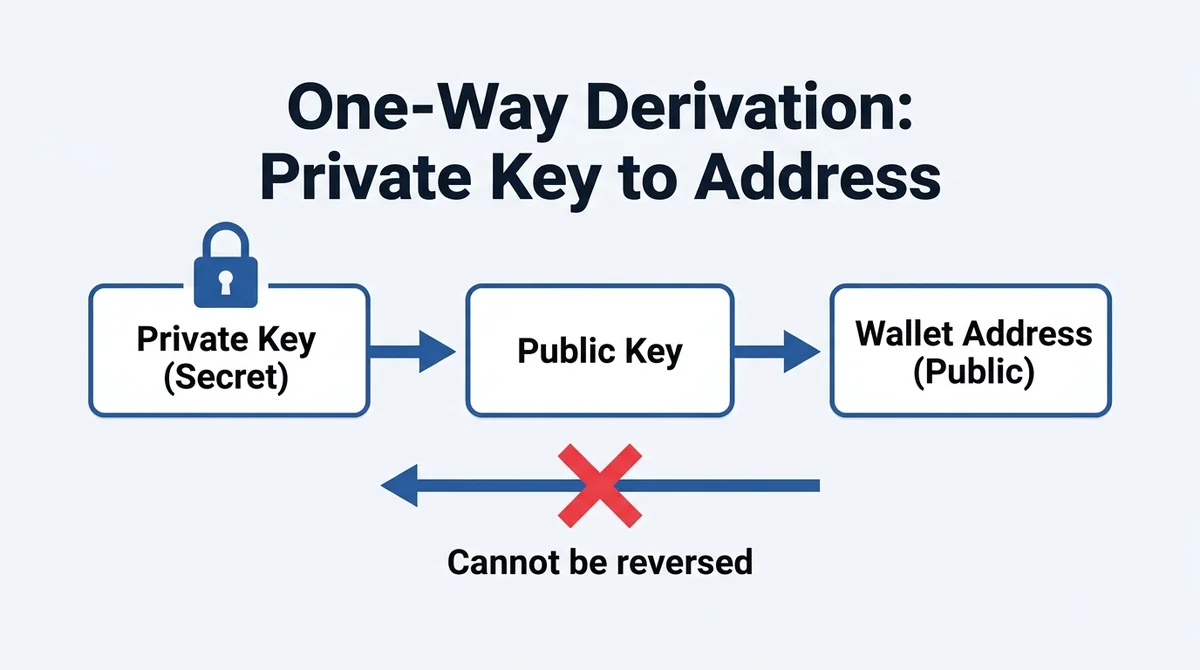
A wallet address is not a public key. It is generated one-way from the public key through hashing and other operations, so knowing the address cannot reveal the public key or private key.
This derivation is one-way: with the private key you can compute the public key and address, but with the address you cannot compute the public key, let alone the private key.
Analogy: The private key is like your house key, and the address is like your house number. Someone who knows the house number still cannot get in.
So an address can be shared publicly, while the private key and seed phrase must always stay secret. For key storage essentials, see the private key and seed phrase guide.
#How do you verify a wallet address before sending assets?
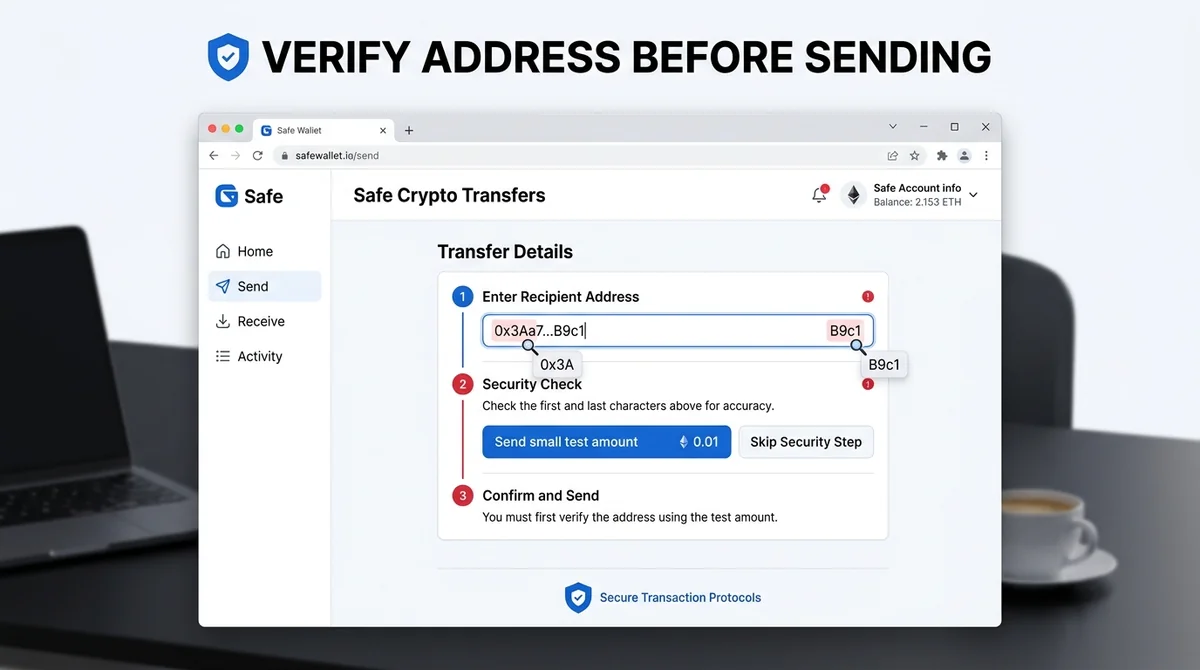
On-chain transfers usually cannot be reversed once sent, so verifying the address is the last line of defense before transferring. Spending an extra minute to check is often more effective than trying to recover funds afterward.
- Check the first and last several characters of the address character by character
- Send a small test amount first, then send the larger amount after confirming receipt
- Do not rely on copy-paste alone; re-read the address after pasting
Why check the beginning and end: Malware often swaps the address in your clipboard for a similar one, usually changing only a few middle characters, so the beginning and end are the easiest places to spot anomalies.
⚠️ Digital asset trading and transfers carry risk. Spending more time verifying before a transfer is more worthwhile than trying to recover funds afterward. This article is for conceptual education only and is not investment advice.
#How do you spot fake wallet addresses and address-replacement scams?
The core trick of fake-address scams is to make you unknowingly send coins to an address controlled by a scammer. There are three common methods.
- Address poisoning: The scammer sends you a small amount so a similar address appears in your transaction history, tricking you into copying the wrong one next time
- Clipboard hijacking: Malware quietly replaces the address you copied
- Lookalike characters: Visually similar characters are used to impersonate the original address
What to do if you receive a small transfer from a stranger: Do not touch it, do not copy its address, and treat it as if you never saw it.
For specific address-poisoning tactics and prevention details, see the address-poisoning scam analysis.
#How does a hardware wallet verify a contract address?
A hardware wallet displays the receiving address or contract address independently on its own screen, without relying on the display of an internet-connected computer.
Before signing a transaction, you should rely on the device screen and check the address and contract information item by item.
If the computer screen and the device screen show different information, stop immediately and inspect your device environment.
#how to choose wallet and manage addresses safely as a beginner
Hot wallets (mobile apps or browser extensions) suit small amounts and frequent use.
Hardware wallets suit large amounts and long-term storage; they show the address on their own screen, and the device screen is authoritative.
A receiving address can be shared publicly; the private key and seed phrase cannot.
Distinguish regular addresses from contract addresses: Sending ordinary tokens to a contract address by mistake can make the assets unrecoverable, so confirm the target address type before acting.
Wallet and asset management involve multiple risks, including private key storage and device security. This article covers concepts only and is not investment advice. MSX Learn's introductory guides can serve as a reference for further understanding of wallet and address basics, and do not constitute any trading guidance.
#FAQ
What is the difference between a wallet address and a private key?
An address is a public receiving identifier, similar to a bank account number, and can be shared with others; a private key is the key that controls assets, similar to a bank card PIN plus signature, and must never be leaked. An address is derived one-way from the private key, and knowing the address cannot reveal the private key.
Is it safe to give someone my wallet address?
Yes. A receiving address is meant to be public; others can only send you coins and cannot take your assets. But make sure the other party is asking for your address, not your private key or seed phrase. Anyone asking for your private key is a scammer.
Can a transfer be reversed if I enter the wrong address?
Usually not. On-chain transfers are generally irreversible once confirmed, and assets may remain at the wrong address permanently. So always send a small test amount first, confirm receipt, then send the larger amount, and check the first and last characters of the address.
Why do addresses on different chains have different formats?
Different blockchains use different cryptographic algorithms and encoding rules, so address lengths and prefixes differ. If you choose the wrong network for a cross-chain transfer, the assets may be unrecoverable, so confirm the chain type before acting.
What should I do if my hardware wallet shows a different address from my computer?
Rely on the address shown on the hardware wallet screen. If the computer screen and device screen differ, your computer may be infected with malware; stop immediately and inspect your device environment.
Can a wallet address be made public?
Yes. A wallet address is a public receiving identifier, and making it public does not give anyone control over your assets. What must always stay secret is the private key and seed phrase.
What if I sent funds to the wrong chain?
Stop any further actions, confirm whether the target address is controlled by you and whether it supports assets on that chain, then assess whether recovery is possible. In most cases, cross-chain mistaken transfers are hard to recover automatically, so confirming the chain type before transferring matters more than fixing it afterward.
FAQ
What is the difference between a wallet address and a private key?
An address is a public receiving identifier, similar to a bank account number, and can be shared with others; a private key is the key that controls assets, similar to a bank card PIN plus signature, and must never be leaked. An address is derived one-way from the private key, and knowing the address cannot reveal the private key.
Is it safe to give someone my wallet address?
Yes. A receiving address is meant to be public; others can only send you coins and cannot take your assets. But make sure the other party is asking for your address, not your private key or seed phrase. Anyone asking for your private key is a scammer.
Can a transfer be reversed if I enter the wrong address?
Usually not. On-chain transfers are generally irreversible once confirmed, and assets may remain at the wrong address permanently. So always send a small test amount first, confirm receipt, then send the larger amount, and check the first and last characters of the address.
Why do addresses on different chains have different formats?
Different blockchains use different cryptographic algorithms and encoding rules, so address lengths and prefixes differ. If you choose the wrong network for a cross-chain transfer, the assets may be unrecoverable, so confirm the chain type before acting.
What should I do if my hardware wallet shows a different address from my computer?
Rely on the address shown on the hardware wallet screen. If the computer screen and device screen differ, your computer may be infected with malware; stop immediately and inspect your device environment.
Related Terms
Want to see the real data for this concept?
After you sign up, you can view live prices, funding rates, and fees for the related assets.
View live prices and fees →