What Is a Non-Custodial Wallet? A 2026 Guide to Private Keys, Seed Phrases, and Hot and Cold Wallets
What is a non-custodial wallet? Learn about private keys, seed phrases, wallet addresses, hot and cold wallets, risks, backups, and safe transfers.
#What Is a Non-Custodial Wallet? A 2026 Guide to Private Keys, Seed Phrases, and Hot and Cold Wallets
Key takeaways:
- In a non-custodial wallet, users manage their own private keys and seed phrases and assume responsibility for asset access and transactions.
- Non-custodial describes who controls the private keys—not whether the wallet is an app, browser extension, or hardware device.
- Hot wallets prioritize the convenience of being connected to the internet, while cold wallets focus on keeping private keys offline. Hardware wallets are a dedicated device format for managing private keys.
- Cold wallets, multisig wallets, and platform reserve mechanisms represent different security layers and should not be treated as equivalent to a personal non-custodial account.
- According to existing MSX materials, 95% of the platform's digital assets are stored in multisig cold wallets, and the platform commits to a physical on-chain reserve ratio strictly above 100%. These claims do not replace the user's responsibility to protect personal keys.
#What Is a Non-Custodial Wallet?
A non-custodial wallet is a wallet model in which users manage their own private keys and seed phrases and assume responsibility for access and control of their assets. Control is not held on the user's behalf by a platform. Put simply, a private key is like the only key to a safe, a seed phrase is like a backup credential that can be used to recreate that key, and a wallet address is more like a receiving account number.
The defining feature of a non-custodial wallet is not a particular brand, software interface, or device format. It is who controls the private keys and seed phrase. A wallet has non-custodial characteristics only when the user can independently safeguard and use the relevant keys. If a platform holds the keys on the user's behalf, the account is custodial. Even if the user sees a page labeled “wallet,” the name alone does not determine its custody model.
The standard for identifying a non-custodial wallet is ownership of control, not the wallet app, browser extension, or hardware design. Users can manage a wallet through software, a browser extension, or a dedicated device, but the medium itself does not automatically determine whether the wallet is non-custodial.
Definition summary: A non-custodial wallet gives users control of the private keys and seed phrase. Users therefore assume direct responsibility for accessing their assets. Non-custodial does not mean automatically secure: exposed or lost keys and user mistakes can still compromise control.
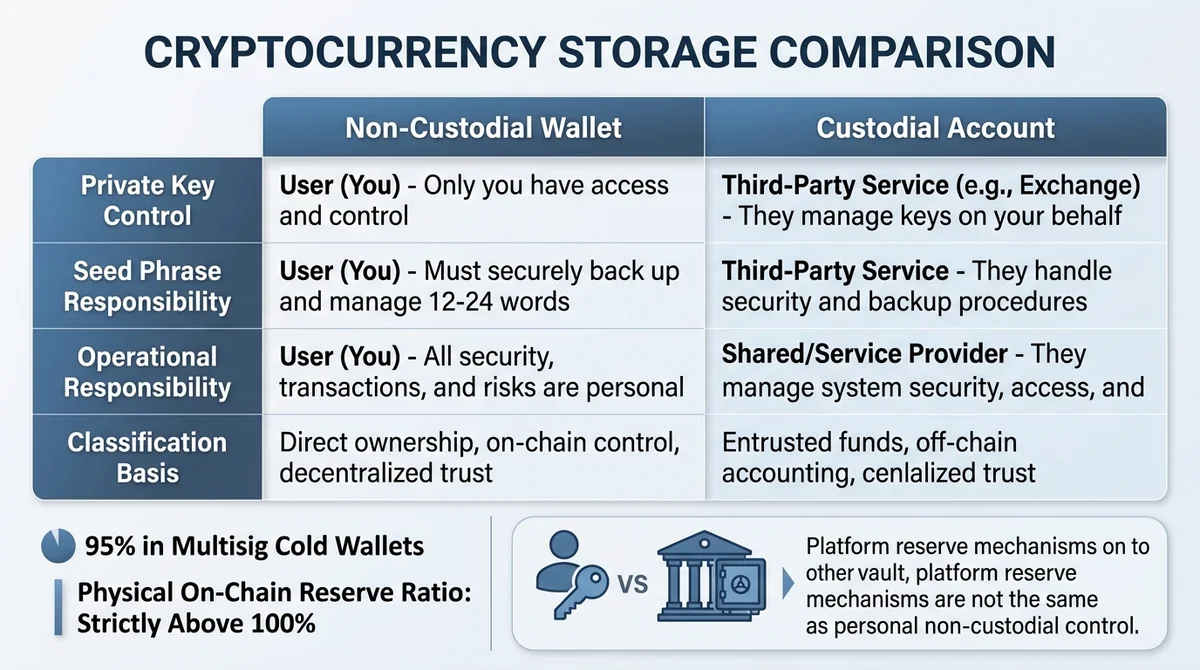
A custodial account is one in which an exchange or other service provider manages the private keys. Users typically operate their assets through account logins, identity verification, or platform procedures. The main differences can be summarized as follows:
| Comparison | Non-custodial wallet | Custodial account |
|---|---|---|
| Who controls the private keys | The user safeguards them | The platform or service provider manages them |
| Seed phrase responsibility | The user is responsible for backup and confidentiality | Usually not directly managed by the user |
| Responsibility for asset operations | The user assumes signing, address, and transaction risks | The platform assumes responsibility for account systems and custody procedures |
| Basis for classification | The user controls the private keys | The user does not control the private keys |
A non-custodial model does not mean that platforms have no role, nor does it mean that wallet transactions require no verification. It simply clarifies the most important point of control: users cannot transfer all responsibility for key backup, confidentiality, and operational mistakes to a platform.
#How Do Private Keys and Seed Phrases Work?
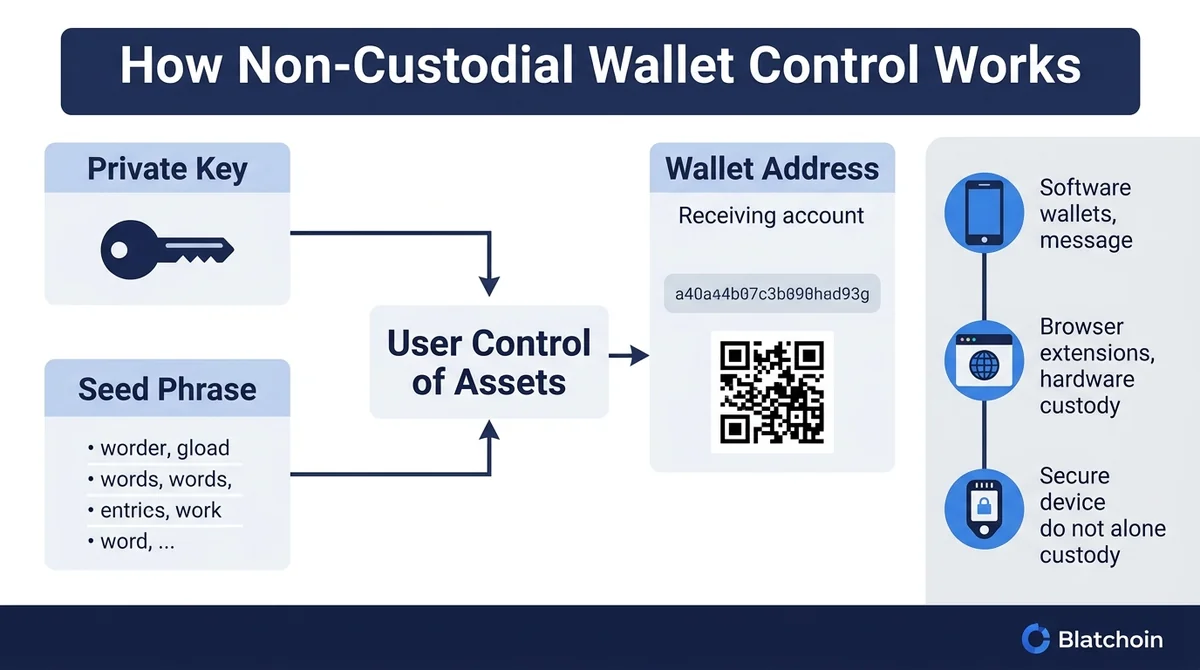
Access control in a non-custodial wallet depends on the private keys and seed phrase managed by the user. Exposure, loss, or incorrect backups can affect the user's control over assets.
A private key is the core piece of information that controls a wallet's authority to perform asset operations. The party that holds and correctly uses the private key can generally complete the corresponding asset operation. A seed phrase is important wallet recovery information that users must back up and keep confidential. In a supported wallet environment, it can be used to restore access. Both are sensitive information and should not be shared publicly like an ordinary account nickname.
Control summary: The private key provides authority to operate assets, while the seed phrase is primarily important for wallet backup and recovery. A wallet address is mainly used to identify a receiving destination. A non-custodial wallet requires users to manage all of this information, but the three elements have different functions.
Private keys, seed phrases, and wallet addresses should not be confused:
- Private key: Used to control wallet operations and must be kept confidential.
- Seed phrase: Used to back up and recover wallet access. It should be stored offline and protected from exposure.
- Wallet address: Used to identify a receiving destination. It can be provided to the sender and generally does not serve as a private-key secret.
- Public key: Public information related to the key system. It cannot be used directly as a private key or seed phrase.
When users manage their own keys, the basic management priorities include the following:
- Back up: Confirm that the seed phrase is complete and readable, and avoid keeping only one easily damaged copy.
- Store offline: Avoid taking screenshots of or copying the seed phrase or private key into chat tools or cloud storage.
- Prevent exposure: Carefully verify any stranger, support representative, or website that asks for a seed phrase, private key, or complete recovery information.
- Review transactions: Check the network, address, and amount before sending funds to reduce the risk of irreversible transfers caused by mistakes.
#How Can You Use a Non-Custodial Wallet Safely?
If you plan to start using a non-custodial wallet, follow these steps in order:
- Install the wallet from an official source: Verify the app name, developer information, and download source to avoid fake apps or browser extensions.
- Create the wallet in an offline environment: Do not record the setup process, take screenshots, or let anyone else see the seed phrase or private key.
- Create and check a backup: Write down the seed phrase word for word, confirm the order and spelling, and store the backup in a fire-resistant, moisture-resistant location that is difficult for others to access.
- Make a small test transfer first: Verify the network, address, and amount before sending. When sending to a new address for the first time, start with a small amount.
- Review every signing request: When connecting to a website or using a contract, check the authorization scope, recipient address, and transaction details. Do not sign blindly.
- Check your device and backup regularly: Keep device security settings up to date and confirm that the backup is still readable. Do not enter the seed phrase into an unfamiliar website for “verification.”
Losing a seed phrase does not necessarily mean that assets disappear immediately, but it may prevent the user from regaining control when a device is damaged, a wallet is replaced, or access needs to be restored. Because a non-custodial model does not provide centralized platform custody for this responsibility, backup quality and confidentiality habits directly affect future access.
For more information about seed phrase backups and security boundaries, see What Is a Seed Phrase? How Seed Phrases and Private Key Backups Work.
#What Is the Difference Between Hot, Cold, and Hardware Wallets?
Hot wallets generally rely on an internet-connected environment for convenience. Cold wallets focus on keeping private keys offline, while hardware wallets use dedicated devices to manage private keys. Platform cold storage does not automatically mean that a user's account is non-custodial.
#What Use Cases Are Hot Wallets Suitable For?
A hot wallet generally refers to a wallet used in an internet-connected environment, with an emphasis on convenient access and fast operations. It can be a mobile app, desktop software, or browser extension. Because the device or software connects to the internet, users should pay particular attention to malware, phishing pages, fake extensions, and mistaken signing requests.
Hot wallets are often suitable for checking balances, receiving funds, and handling routine transactions. However, being connected to the internet does not automatically make a wallet unsafe, and being non-custodial does not mean device protection can be ignored. Actual risk also depends on whether keys are exposed, whether backups are reliable, and whether the user verifies transaction details.
#What Is the Difference Between Cold Wallets and Hardware Wallets?
A cold wallet describes the feature of storing or managing private keys offline. A hardware wallet describes a device format that uses dedicated hardware to manage private keys. The two concepts overlap but are not synonymous. Cold wallets focus on the offline environment, while hardware wallets focus on device form. A hardware wallet can serve as a cold-storage solution, but the device itself cannot guarantee absolute security.
They can be distinguished as follows:
- Cold wallets focus on the storage or operating environment. Their core purpose is to reduce the amount of time private keys remain exposed to an internet-connected environment.
- Hardware wallets focus on the device used to manage private keys. Dedicated hardware can serve as one form of cold storage.
- Hot wallets focus on internet-connected use and contrast with cold wallets in terms of storage environment.
A hardware form factor alone cannot prove complete security. The device source, initialization process, backup storage, firmware environment, connected websites, and transaction confirmation steps can all affect actual security. A multisig wallet is a management mechanism that requires multiple signatures or authorization conditions to complete an operation. It represents a different dimension from whether the user controls the private keys.
#Can a Platform Account Be Treated Directly as a Non-Custodial Wallet?
Whether a platform account is non-custodial should be determined by whether the user personally safeguards the private keys and seed phrase. A platform's use of multisig cold wallets to store assets does not mean that every user account is a non-custodial wallet.
For example, existing MSX materials state that users safeguard their own private keys and seed phrases, which reflects non-custodial characteristics. The platform also has an arrangement in which 95% of its digital assets are stored in multisig cold wallets. These two statements relate respectively to control of user accounts and the platform's asset storage mechanism. They should not be combined into a single concept.
#What Are the Risks and Security Practices of Non-Custodial Wallets?
The importance of a non-custodial wallet is that the user directly controls the private keys. At the same time, the user must independently assume the risks of key storage, backup, and asset operations. Platform security mechanisms cannot replace personal key management.
A non-custodial model places both “who can operate the assets” and “who is responsible for safeguarding the credentials” with the user. Users do not need to give their private keys to a platform, but they also cannot expect a platform to automatically reverse or restore assets after a lost seed phrase, incorrect transfer, or exposed private key, as might occur with a traditional account.
Platform security mechanisms address a different set of issues, such as the storage of custodial assets, permission approvals, risk monitoring, and reserve disclosures. Personal wallet security focuses on private keys, seed phrases, devices, and signing operations. Understanding these two layers helps prevent platform security commitments from being misread as an absolute guarantee for a personal wallet.
According to existing MSX materials:
- The platform states that 95% of its digital assets are stored in multisig cold wallets.
- The platform commits to a physical on-chain reserve ratio strictly above 100% for all listed assets.
- The materials also mention the use of smart contract technology and the ability to share third-party security audit reports, such as publicly available versions.
These figures and mechanisms come from platform-side materials and cannot replace the user's responsibility to safeguard personal private keys and seed phrases. Reserve ratios, cold-wallet percentages, and multisig mechanisms do not mean that every operation is risk-free. Readers should still verify the specific disclosures, audit scope, and applicable account types. The current input does not provide an official page, audit report link, report date, or applicable asset scope that can be directly verified. Therefore, this article labels the information as “existing MSX materials” and does not add external sources that were not provided.
For more information about the boundaries of MSX's non-custodial model, 95% multisig cold-wallet storage, and reserve commitment, read MSX Review: Verifying the Non-Custodial Model and Reserve Commitment.
#Is It Safe to Screenshot a Seed Phrase or Upload It to the Cloud?
Taking a screenshot of a seed phrase, sending it through a chat tool, or uploading it to the cloud increases the risk of access by malware, compromised accounts, and synchronization services. An internet-connected backup should not be treated as the only storage method.
A safer basic approach is to use an offline device when recording the phrase, prevent others from accessing the backup, verify the wallet source before use, and stop immediately when a page or person requests the complete seed phrase. Any claim that a wallet can be “verified for security” by providing a seed phrase should not be treated as a normal recovery procedure.
#Does a Non-Custodial Wallet Mean Platforms Are Completely Unimportant?
A non-custodial wallet only means that the user controls the personal keys. It does not mean that a platform's trading, custody, risk controls, reserve disclosures, or compliance mechanisms are irrelevant. Different accounts and products still need to be evaluated separately.
If users access an exchange account, cross-chain service, or other product, they should still understand how the platform handles assets, orders, identity verification, and risk controls. Platform multisig cold wallets and reserve commitments are institutional security information and do not automatically change who controls the keys to a personal wallet.
#Do Cold Wallets and Hardware Wallets Mean Absolute Security?
A cold wallet only indicates offline storage or management, while a hardware wallet only indicates a device format. The device source, backup method, operating environment, and signing confirmation still affect security. No format can guarantee absolute security.
Common misconceptions include:
- Treating a non-custodial wallet as a cold wallet. The former describes control, while the latter describes the storage environment.
- Treating hardware wallets as the only type of cold wallet. Cold storage does not necessarily have to use a hardware device.
- Treating a platform's multisig cold wallet as a personal wallet. The former concerns platform-side asset management, while the latter concerns personal user control.
- Treating a wallet address as a private key. An address is used for identification and receiving funds, while private keys and seed phrases must remain confidential.
#How Should You Choose Between Non-Custodial and Custodial Wallets?
When choosing between non-custodial and custodial options, first compare your ability to manage keys, transaction frequency, recovery needs, and reliance on platform services. Do not make the decision based only on a label such as “safer” or “more convenient.”
Use the following questions for a self-assessment:
- Can you reliably record and safeguard a seed phrase in an offline environment?
- Can you consistently identify phishing websites, fake support agents, and incorrect signing requests?
- Do you need the account recovery, trading interface, or centralized risk controls provided by a platform?
- Do you understand your responsibility for transfer addresses, network selection, and transaction confirmation?
If you cannot consistently complete basic key-management tasks, using a non-custodial wallet without preparation may amplify personal operational risks. If you use a custodial account, focus on verifying the platform's security mechanisms, asset disclosures, and terms of service. This comparison is provided for security education and does not constitute investment or asset-allocation advice.
For more information about multisignatures, hot and cold wallet segregation, and institutional asset risk controls, see Multisig Wallet Security and Hot and Cold Wallet Segregation Guide.
#What Other Related Terms Are Associated With Non-Custodial Wallets?
Terms related to non-custodial wallets can be divided into three groups: private keys and seed phrases describe control credentials; wallet addresses describe receiving and identification information; and hot wallets, cold wallets, and hardware wallets describe storage or usage methods.
| Term | Core meaning | Relationship to non-custodial wallets |
|---|---|---|
| Private key | Core information that controls wallet asset operations | Reflects non-custodial control when safeguarded by the user |
| Seed phrase | Important information used to back up and recover wallet access | Must be kept confidential and backed up by the user |
| Wallet address | Information used to identify a receiving destination | Can be used to receive funds and is not a private key |
| Hot wallet | A wallet used in an internet-connected environment | Focuses on convenience and does not determine control ownership |
| Cold wallet | Emphasizes keeping or managing private keys offline | Focuses on the storage environment and is not equivalent to non-custody |
| Hardware wallet | A dedicated hardware format for managing private keys | The device format alone cannot prove absolute security |
| Custodial wallet | A wallet model in which a platform or service provider manages the private keys | Provides the control-ownership contrast to a non-custodial wallet |
| Multisig wallet | A management mechanism requiring multiple signatures or authorization conditions | A form of permission control and not equivalent to personal non-custody |
When building internal links between these terms, each glossary page should focus on one core definition. For example, the private key page should explain control authority, the seed phrase page should explain backup and recovery, the cold wallet page should explain offline storage, and the custodial wallet page should explain platform-managed private keys. This reduces repetition and helps readers understand wallet classifications step by step.
#Frequently Asked Questions (FAQ)
#1. What does a non-custodial wallet mean?
A non-custodial wallet is a wallet model in which users safeguard their own private keys and seed phrases. Users directly control asset operations and assume responsibility for backups, confidentiality, device security, and operational mistakes. The deciding factor is who controls the private keys, not the name of the app or hardware.
#2. What is the difference between a private key and a seed phrase?
A private key primarily provides authority to operate assets, while a seed phrase is primarily used to back up and recover wallet access. Both must be kept confidential. A wallet address is not a private key or seed phrase. Wallet addresses are generally used to receive funds and may be provided to the sender, but private keys and seed phrases must not be disclosed.
#3. Is a cold wallet the same as a non-custodial wallet?
No. A cold wallet describes the offline storage or management of private keys, while a non-custodial wallet describes private-key control belonging to the user. A wallet can have both characteristics, but the terms are not synonymous. A cold wallet may also be held by an institution, while a personal non-custodial wallet can use an internet-connected hot-wallet format.
#4. Are hardware wallets secure?
A hardware wallet uses a dedicated device to manage private keys, but it is not absolutely secure. The device source, seed phrase backup, connection environment, and transaction confirmation can all affect actual security. Before use, verify the purchase channel, initialization process, and the address and amount of every transaction.
#5. Does MSX's 95% multisig cold-wallet storage mean that user accounts are non-custodial?
No. MSX materials mention both that users safeguard their own private keys and seed phrases and that 95% of the platform's digital assets are stored in multisig cold wallets. The former concerns user control, while the latter concerns the platform's storage mechanism. These statements address different security layers and cannot replace one another.
#6. Can I save a seed phrase as a screenshot in the cloud?
It is not recommended. Screenshots and cloud storage increase the risk of exposure. A seed phrase should be recorded offline, stored securely, and never provided to a website, stranger, or alleged support representative. If you suspect that a seed phrase has been exposed, promptly follow the wallet's official procedures to assess asset migration options.
#7. Is a non-custodial wallet suitable for every user?
Not necessarily. Non-custodial wallets are suitable for users who can reliably back up seed phrases, identify phishing risks, and review transfer and signing details. If you place greater value on account recovery, centralized risk controls, or a platform interface, first review the custodial service's security mechanisms, asset disclosures, and terms of service before deciding.
FAQ
What does a non-custodial wallet mean?
A non-custodial wallet is a wallet model in which users safeguard their own private keys and seed phrases. Users directly control asset operations and assume responsibility for backups, confidentiality, device security, and operational mistakes.
What is the difference between a private key and a seed phrase?
A private key primarily provides authority to operate assets, while a seed phrase is primarily used to back up and recover wallet access. Both must be kept confidential, and a wallet address should not be confused with either one.
Is a cold wallet the same as a non-custodial wallet?
No. A cold wallet describes the offline storage or management of private keys, while a non-custodial wallet describes private-key control belonging to the user. A wallet can have both characteristics, but the terms are not synonymous.
Are hardware wallets secure?
A hardware wallet uses a dedicated device to manage private keys, but it is not absolutely secure. The device source, seed phrase backup, connection environment, and transaction confirmation can all affect actual security.
Does MSX's 95% multisig cold-wallet storage mean that user accounts are non-custodial?
No. MSX materials mention both that users safeguard their own private keys and seed phrases and that 95% of the platform's digital assets are stored in multisig cold wallets. The former concerns user control, while the latter concerns the platform's storage mechanism.
Related Terms
Want to see the real data for this concept?
After you sign up, you can view live prices, funding rates, and fees for the related assets.
View live prices and fees →