What Is Auto-Deleveraging (ADL)? 2026 Exchange Loss-Sharing Mechanisms and User Protection
Auto-deleveraging (ADL) shares liquidation losses with profitable traders when positions can't close at bankruptcy price. Triggers, fund, ranking, risks.
#What Is Auto-Deleveraging (ADL)? 2026 Exchange Loss-Sharing Mechanisms and User Protection
Auto-deleveraging (ADL) is a systemic mechanism used by crypto derivatives exchanges to allocate shortfall losses to some profitable counterparties when a liquidated position cannot be closed at its bankruptcy price. It is not the forced liquidation of an individual position, but loss allocation at the system level.
In simple terms, after a liquidation fails, the system 'trims' part of profitable positions according to rules to fill the loss hole. That is the essence of ADL.
#What Is Auto-Deleveraging (ADL)?
Auto-deleveraging is not the forced liquidation of a single position; it is the system allocating shortfall losses.
It occurs after a liquidated position cannot be closed at the bankruptcy price, and the loss is borne by some profitable counterparty positions.
It can be understood as an orderly loss-sharing process, not the exchange randomly taking user profits.
#How Does ADL Work?
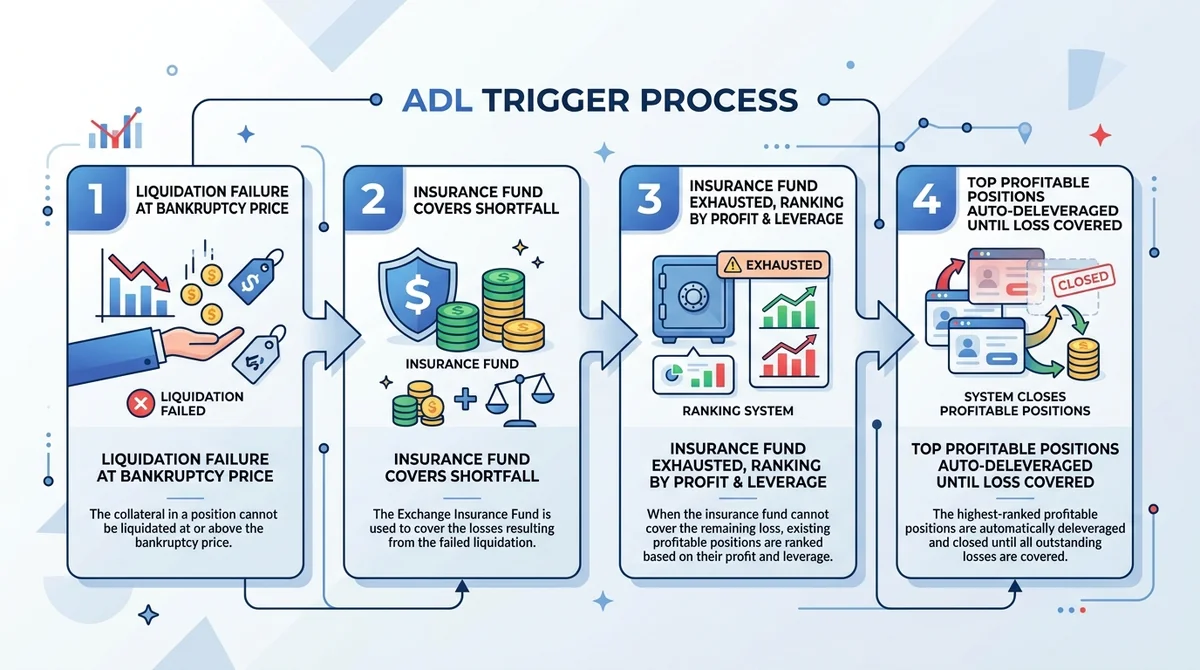
When a liquidated position cannot be filled at the bankruptcy price, a shortfall loss occurs. At this point, the exchange usually first uses the insurance fund to cover it; if the insurance fund is insufficient, ADL is triggered.
The system ranks counterparties by profit and leverage from high to low, then automatically deleverages them in sequence until the shortfall loss is covered. The insurance fund is the first-layer buffer pool before ADL.
The ADL trigger process is as follows:
- A user position triggers forced liquidation, but market depth is insufficient, so it cannot be filled at the bankruptcy price.
- A shortfall loss occurs, and the exchange first covers it with the insurance fund.
- After the insurance fund is exhausted, the system ranks counterparties by profit and leverage.
- Top-ranked profitable positions are automatically deleveraged until the loss is fully covered.
ADL is like voluntary rebooking during flight overbooking, selecting passengers in order. When a flight is overbooked, the airline selects passengers according to rules; ADL also selects counterparties by ranking profit and leverage, rather than deducting randomly.
#Why Do Exchanges Need ADL and Shortfall Allocation?
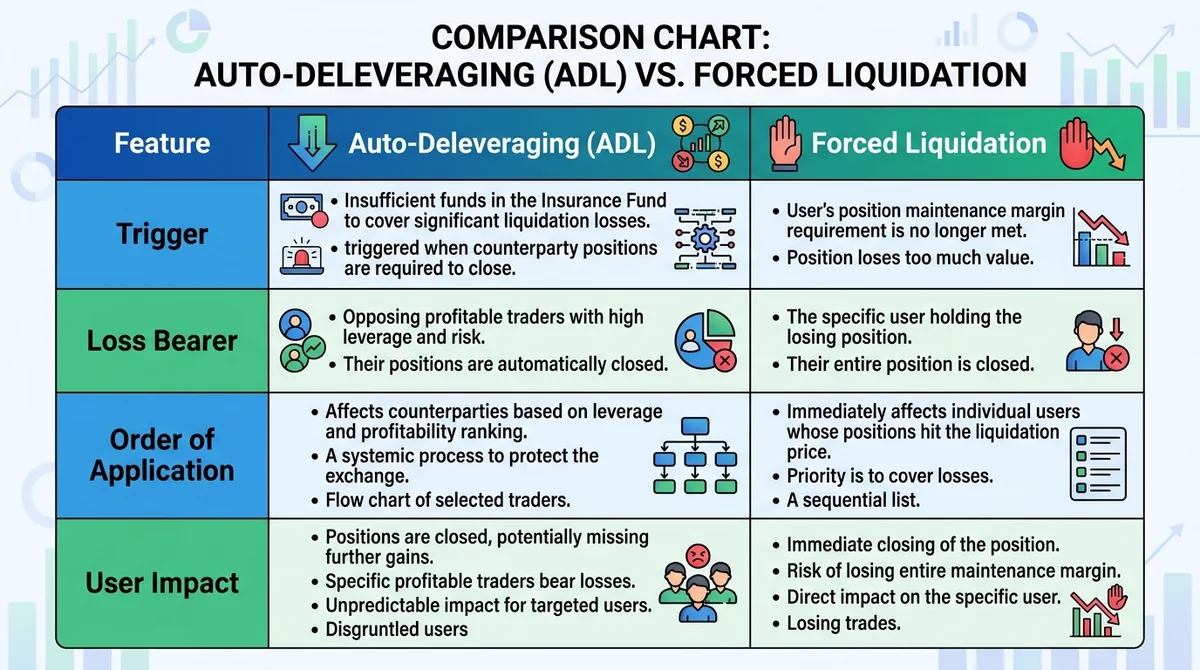
Without ADL, shortfall losses might be borne by the exchange itself or all users, and could even affect platform solvency. ADL can maintain the platform's capital balance in extreme market conditions and prevent a single shortfall loss from spreading too widely.
The insurance fund is usually used first, and ADL is activated only after it is exhausted. Insurance fund sources typically include remaining funds from liquidations and partial fee injections, though specific rules vary slightly by platform.
#What Risks and Common Misconceptions Does ADL Pose to Users?
Positions with high profit and high leverage are more likely to be selected for ADL. ADL is not the exchange arbitrarily deducting profits; it allocates shortfall losses according to rules. Users can check ADL ranking indicators provided by some platforms, but they cannot completely avoid being auto-deleveraged.
Common misconceptions include:
- Mistaking ADL as only affecting losing users: profitable positions can also be selected.
- Mistaking that exchanges can arbitrarily deduct user assets: ADL execution is based on rules and ranking.
- Believing low leverage is absolutely safe: high profit + high leverage can still be selected.
To reduce the probability of being selected for ADL, you can take the following measures:
- Lower your leverage multiple: high leverage is a key factor in ADL ranking.
- Avoid holding highly profitable positions for a long time: the more profit, the more likely you are to be ranked near the front.
- Pay attention to the platform's ADL ranking indicator lights: some platforms show rankings, and the closer to the front, the higher the risk.
- Choose trading pairs with good liquidity: illiquid markets are more likely to experience shortfalls.
#Frequently Asked Questions (FAQ)
Is auto-deleveraging (ADL) the same as forced liquidation?
No. Forced liquidation is the forced closing of a single position, while ADL is the mechanism by which the system allocates shortfall losses to some profitable counterparties after the insurance fund is exhausted.
Why can profitable positions be auto-deleveraged?
Because shortfall losses need to be borne by counterparties. The system ranks them by profit and leverage from high to low, so users with high profit and high leverage are more likely to be selected. This is based on rules, not arbitrary deductions by the exchange.
How do I check my ADL ranking?
Some exchanges provide ADL ranking indicator lights or lists on the contract page, allowing users to see their position in the allocation queue. The higher the ranking, the sooner they may be deleveraged, but it cannot be completely avoided.
What is the relationship between the insurance fund and ADL?
The insurance fund is the first-layer buffer for shortfall losses. When a liquidated position cannot be closed at the bankruptcy price, the insurance fund is used first; only after it is exhausted is ADL activated to allocate losses to profitable counterparties.
Can ADL be completely avoided?
It cannot be completely avoided. However, users can reduce the probability of being selected by lowering leverage, controlling position profit size, and watching ranking indicators. In extreme market conditions, liquidity risk can still cause ADL to trigger.
MSX Learn reminder: Auto-deleveraging is a risk mechanism in contract trading that cannot be ignored. Understanding its rules and actively managing leverage is the foundation of protecting position safety. Before trading contracts on MSX, it is recommended to read the platform's liquidation and ADL rule explanations.
Risk warning: Auto-deleveraging may cause users to lose part of their positions without taking active action, especially highly leveraged profitable positions. It is recommended that users understand trading rules, control leverage, and pay attention to platform risk control mechanisms. This article does not constitute investment advice.
FAQ
Is auto-deleveraging (ADL) the same as forced liquidation?
No. Forced liquidation is the forced closing of a single position, while ADL is the mechanism by which the system allocates shortfall losses to some profitable counterparties after the insurance fund is exhausted.
Why can profitable positions be auto-deleveraged?
Because shortfall losses need to be borne by counterparties. The system ranks them by profit and leverage from high to low, so users with high profit and high leverage are more likely to be selected. This is based on rules, not arbitrary deductions by the exchange.
How do I check my ADL ranking?
Some exchanges provide ADL ranking indicator lights or lists on the contract page, allowing users to see their position in the allocation queue. The higher the ranking, the sooner they may be deleveraged, but it cannot be completely avoided.
What is the relationship between the insurance fund and ADL?
The insurance fund is the first-layer buffer for shortfall losses. When a liquidated position cannot be closed at the bankruptcy price, the insurance fund is used first; only after it is exhausted is ADL activated to allocate losses to profitable counterparties.
Related Terms
Want to see the real data for this concept?
After you sign up, you can view live prices, funding rates, and fees for the related assets.
View live prices and fees →