What Is Anti-Sybil? Blockchain Identity Verification and Cybersecurity Basics
Learn what Anti-Sybil mechanisms are, how they work in Web3 airdrops and DAO governance, and how they protect blockchain networks from Sybil attacks.
Anti-Sybil Mechanism: Refers to the defensive technologies and rule designs used in blockchain systems to identify and intercept malicious actors who use large numbers of fake, forged, or puppet identities to manipulate network consensus, tamper with governance votes, or exploit ecosystem incentives in bulk.
#What Are Anti-Sybil Mechanisms and Sybil Attacks?
#What Is a Sybil Attack?
A Sybil attack originates from a concept coined by computer scientist John Douceur, named after the psychological novel Sybil. In distributed networks, it specifically refers to an attack where a single entity creates a large number of pseudonymous identities to orchestrate coordinated disruption or manipulation.
Everyday Analogy: A Sybil attack is like a single person using disguises and costume changes to repeatedly line up for free community supplies, hoarding public resources originally meant for all residents.
#Why Do Blockchain Networks Urgently Need Anti-Sybil Mechanisms?
Blockchain networks typically feature anonymity and permissionless access, allowing anyone to generate multiple crypto addresses rapidly at near-zero cost. Without effective defense barriers, malicious nodes or script farms could easily drown out legitimate participants at minimal cost, undermining the network's decentralized foundation.
#How Do Anti-Sybil Mechanisms Work in Blockchain?
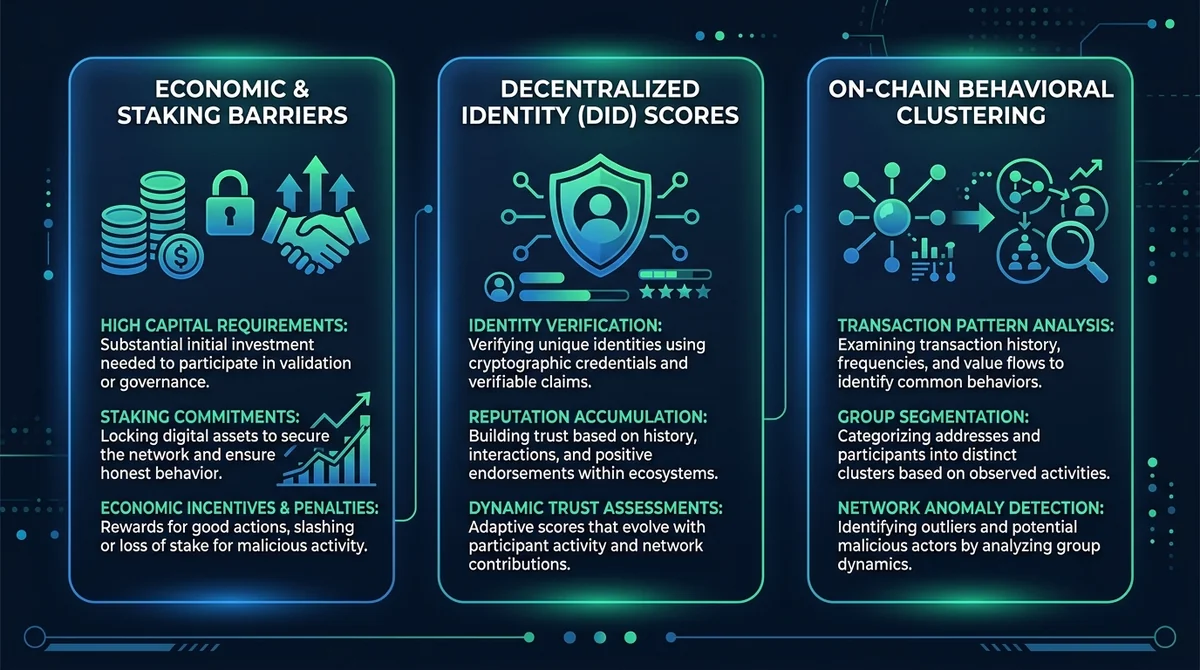
Blockchain networks and Web3 applications build their defensive architectures primarily through the following approaches:
- Economic and Resource Cost Barriers: At the base consensus layer, Proof of Work (PoW, consuming computing power and electricity) or Proof of Stake (PoS, staking token assets) ensures that the cost of forging massive valid identities significantly exceeds any potential profit.
- Decentralized Identity (DID) and Trust Credentials: Using on-chain/off-chain credential aggregation tools (such as Gitcoin Passport), multi-dimensional credentials—such as social media verification, on-chain transaction history, and biometric liveness detection—are converted into comprehensive anti-Sybil trust scores.
- On-Chain Behavioral Graph and Algorithmic Analysis: Clustering algorithms analyze transaction timestamps, fund distribution patterns, and consolidation routes (e.g., multiple addresses funded by the same deposit source) to detect and flag coordinated bot networks in bulk.
#Why Is Anti-Sybil Critical for the Decentralized Ecosystem?
Anti-Sybil mechanisms serve as foundational infrastructure for maintaining fairness and network health in Web3, providing key benefits including:
- Protecting Community Governance Integrity: In DAOs (Decentralized Autonomous Organizations) utilizing "one-person-one-vote" or Quadratic Voting models, it prevents whales or bot operators from splitting addresses to manipulate proposal outcomes.
- Ensuring Precise Ecosystem Incentive Distribution: It protects early project airdrops and liquidity incentives so they reach genuinely active users, preventing tokens from being drained by automated farming scripts.
- Preserving Underlying Network Performance: It mitigates network congestion and abnormal gas fee spikes caused by high-frequency spam transactions broadcasted by bot scripts.
#What Are Common Misconceptions and Real-World Challenges?
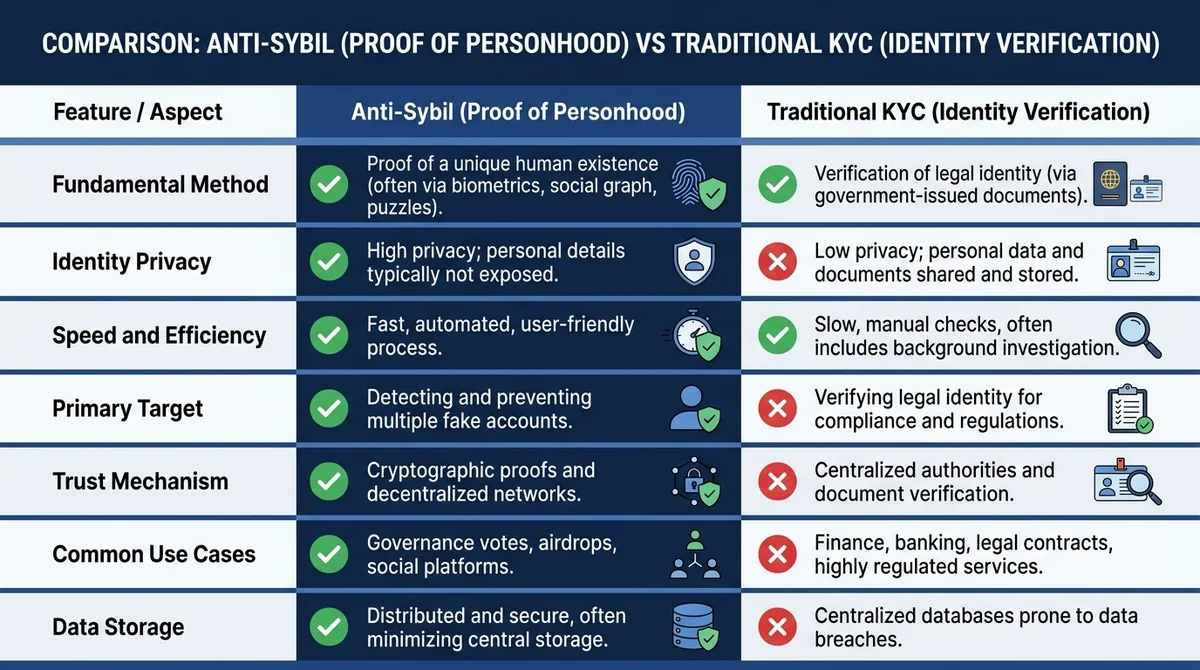
#Is Anti-Sybil the Same as Traditional Real-Name Verification (KYC)?
No. The core objective of anti-Sybil mechanisms is to verify "Proof of Personhood"—proving that an operation corresponds to a unique real human being. This is often achieved using cryptographic technologies like Zero-Knowledge Proofs (ZKP) without requiring users to disclose real names, government IDs, or raw biometric data.
#How Can False Positives on Multi-Wallet Users Be Avoided?
Many legitimate users manage multiple independent addresses within non-custodial wallets for asset isolation, security, or privacy reasons. If project teams deploy overly aggressive on-chain filtering algorithms, genuine users' standard activities might be misclassified as malicious Sybil behavior. Balancing decentralization, privacy preservation, and detection accuracy remains a central challenge in on-chain governance.
Disclaimer: This article is for educational purposes regarding digital assets and does not constitute investment advice, governance recommendations, or operational endorsements.
FAQ
What is a Sybil attack?
A Sybil attack occurs when a single attacker creates and controls a large number of fake identities or puppet addresses to pose as multiple distinct participants, aiming to manipulate consensus, tamper with governance votes, or exploit incentive distributions in a decentralized network.
Do anti-Sybil mechanisms require users to upload ID documents for KYC?
Not necessarily. Anti-Sybil mechanisms focus on verifying unique personhood, often leveraging on-chain behavioral analysis, asset staking, or Zero-Knowledge Proof-based Decentralized Identity (DID), rather than requiring traditional KYC.
How can everyday users minimize the risk of being falsely flagged by anti-Sybil algorithms?
Everyday users should avoid using automated scripts for batch transactions, refrain from executing highly uniform transactions across multiple sub-wallets within short time windows, and avoid consolidating funds from all wallets into the exact same centralized address.
Related Terms
Want to see the real data for this concept?
After you sign up, you can view live prices, funding rates, and fees for the related assets.
View live prices and fees →