Asset Tokenization
Asset tokenization turns real assets like property or stocks into blockchain tokens representing ownership or income rights. Here's how it works, its benefits and risks.
Answer: Asset tokenization is turning real-world assets (like houses, stocks, or art) into digital tokens on a blockchain. Tokens represent ownership or income rights and can be traded on-chain.
#What Is Asset Tokenization?
Asset tokenization is moving real-world assets onto a blockchain.
Traditional assets like property deeds or stock accounts are recorded in centralized systems. Once tokenized, an asset becomes a string of code called a token.
The token represents your ownership or income rights. For example, a house can be tokenized into 1 million tokens; buying 1 token gives you one-millionth ownership of the house.
Analogy: It's like swapping a paper movie ticket for an e-ticket. A paper ticket can only be used at the venue, while an e-ticket can be transferred, split, and traded globally.
#How Is Asset Tokenization Different from Traditional Assets?
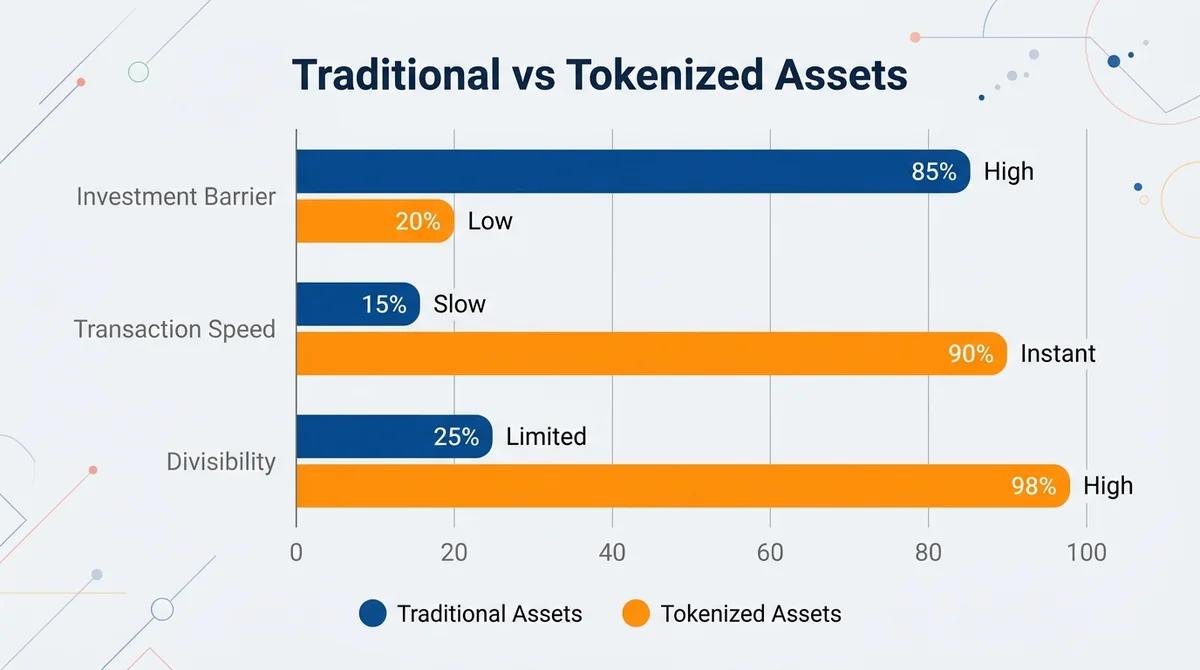
- Traditional assets: paper certificates, slow transactions, high barriers.
- Tokenized assets: digital tokens, fast transactions, divisible.
#What Assets Can Be Tokenized?
In theory, any asset with clear ownership can be tokenized. Common examples include:
- Real estate, land
- Stocks, bonds
- Gold, art
- Intellectual property, accounts receivable
#How Does Asset Tokenization Work?
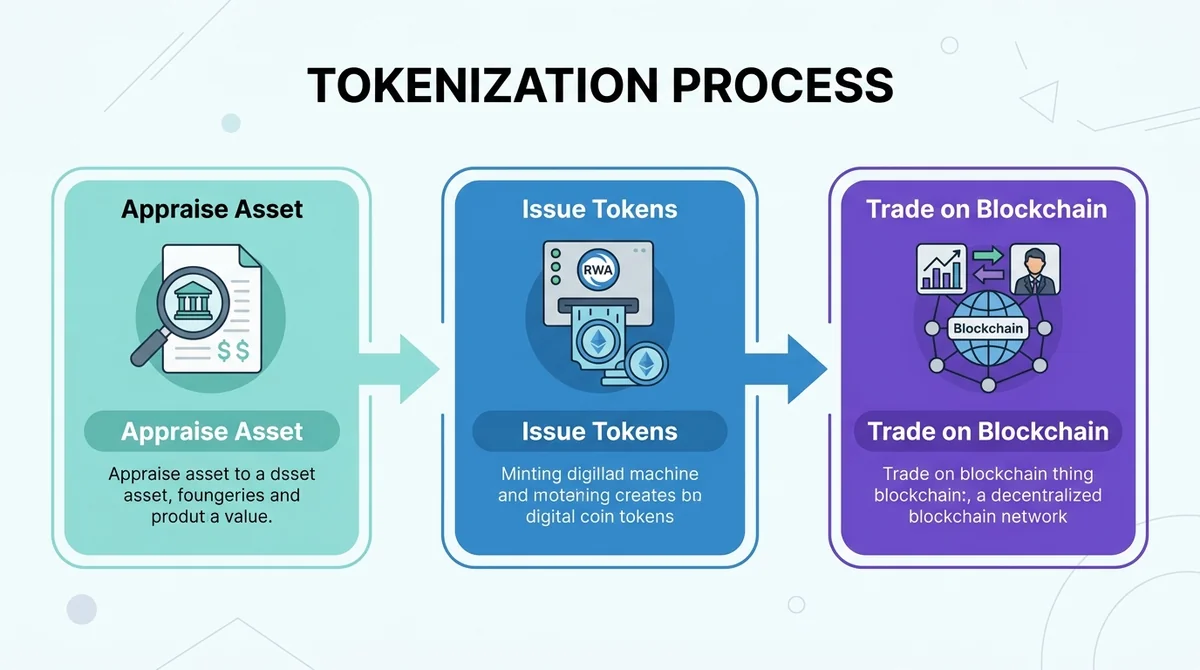
The core is tokenization: mapping asset rights to tokens on a blockchain.
Smart contracts automatically execute rules. For example, when you buy tokens, the contract automatically transfers them to your wallet and records the ownership change.
The blockchain records all transactions, publicly transparent and immutable.
Analogy: A smart contract is like a vending machine. Insert coins (pay) and it dispenses the item (transfers tokens), no human needed.
#How Is Tokenization Implemented?
- Appraise the asset and determine the number of tokens.
- Issue tokens representing shares of the asset.
- Tokens circulate on the blockchain.
#What Role Do Smart Contracts Play in Asset Tokenization?
Smart contracts are self-executing code. They define how tokens are issued, transferred, and how income is distributed.
#Why Is Asset Tokenization Important?
It solves three problems: high barriers, poor liquidity, and opacity.
Traditionally, investing in real estate requires hundreds of thousands to start. Tokenized, you can buy a $100 share, dramatically lowering the barrier.
Tokenized assets trade 24/7 globally, no need to wait for exchange opening hours.
All records are on-chain, visible to anyone, reducing fraud.
#What Problems Can Asset Tokenization Solve?
- Lower investment barriers
- Improve liquidity
- Enhance transparency and security
#What Does Asset Tokenization Mean for Ordinary Investors?
Ordinary people can participate in investments that were previously out of reach. For example, if you can't afford a whole famous painting, you can buy a thousandth of it.
#What Are the Advantages of Asset Tokenization?
Fractional ownership: Assets are split into small parts, lowering barriers.
24/7 global trading: Not limited by geography or time zones.
Lower intermediary costs: Removes middlemen like banks and lawyers.
#How Does Asset Tokenization Lower Barriers?
It splits large assets into small tokens. For example, a $10 million property split into 10 million tokens, each worth $1.
#How Does Asset Tokenization Improve Liquidity?
Tokens can be bought and sold anytime on global exchanges. Unlike a house, which can take months to sell.
#What Are the Risks or Limitations of Asset Tokenization?
Legal and regulatory uncertainty: Many countries have not yet defined clear rules.
Smart contract vulnerabilities: Code may have bugs, leading to asset loss.
Limited market acceptance: The variety and trading volume of tokenized assets are still low.
⚠️ Digital assets carry risk. This article explains concepts only and does not constitute investment advice.
#A Simple Example of Asset Tokenization
Suppose a property worth $1 million is tokenized.
1 million tokens are issued, each representing $1 of equity.
You spend $1,000 to buy 1,000 tokens, giving you one-thousandth ownership of the property.
Later, if the property appreciates or earns rent, you receive income proportionally.
#How Is Real Estate Tokenized?
- Appraise the property and establish legal ownership.
- Issue tokens representing ownership shares.
- Tokens are sold on compliant platforms.
#How Do You Trade After Tokenization?
Tokens are bought and sold on exchanges that support the asset. You can sell your shares at any time.
#FAQ
Is asset tokenization legal?
It depends on the region. Some countries have legislated support, others are still watching. Check local regulations before participating.
Can tokenized assets be cashed out anytime?
Yes, but it depends on finding a buyer. Illiquid assets may be hard to sell.
Is asset tokenization the same as NFTs?
No. NFTs usually represent unique items, while tokenized assets can be fungible shares.
Are tokenized assets safe?
The blockchain itself is secure, but smart contract vulnerabilities and private key loss are the main risks.
How can beginners participate?
Learn first, start with small capital. This article explains concepts only; when ready to practice, check the live tools on the main site MSX.
FAQ
Is asset tokenization legal?
It depends on the region. Some countries have legislated support, others are still watching. Check local regulations before participating.
Can tokenized assets be cashed out anytime?
Yes, but it depends on finding a buyer. Illiquid assets may be hard to sell.
Is asset tokenization the same as NFTs?
No. NFTs usually represent unique items, while tokenized assets can be fungible shares.
Are tokenized assets safe?
The blockchain itself is secure, but smart contract vulnerabilities and private key loss are the main risks.
How can beginners participate?
Learn first, start with small capital. This article explains concepts only; when ready to practice, check the live tools on the main site MSX.
Related Terms
Want to see the real data for this concept?
After you sign up, you can view live prices, funding rates, and fees for the related assets.
View live prices and fees →