What Is an Automated Market Maker (AMM)? Liquidity Mechanism for Decentralized Crypto Trading (2026)
Learn how AMMs use liquidity pools and algorithms to enable decentralized trading, with examples like Uniswap and Curve, plus impermanent loss risks.
An automated market maker (AMM) is a decentralized mechanism that automatically matches trades through algorithms and liquidity pools, allowing users to complete trades without waiting for a counterparty.
#What Is an Automated Market Maker (AMM)?
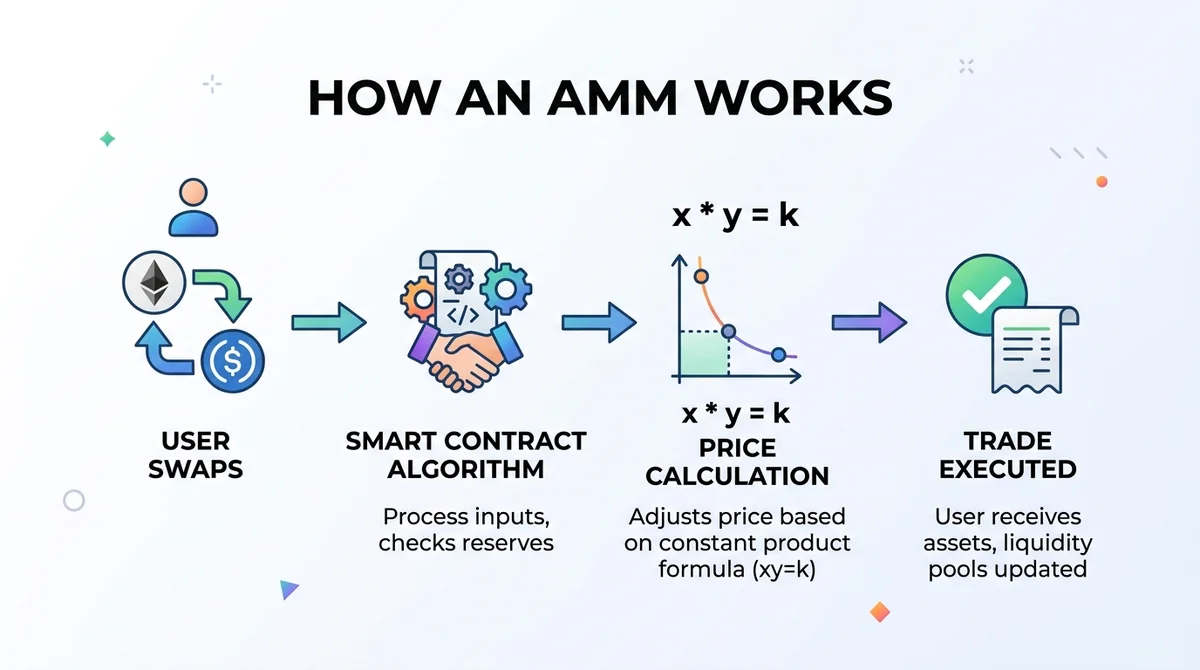
An automated market maker (AMM) is a trading mechanism commonly used by decentralized exchanges (DEXs). Unlike traditional exchanges that rely on an order book and simultaneous buy and sell orders from both sides, it uses algorithms to automatically calculate prices based on the ratio of two tokens in a liquidity pool and executes trades directly with users.
#How Does It Differ from Traditional Order Book Market Making?
- Traditional order book: Buyers and sellers each place limit orders, and a market maker or matching engine matches the orders.
- AMM: There is no order book, only a liquidity pool containing two (or more) assets. Prices are determined by the asset ratio in the pool, and trades are executed instantly.
#Why Is It Called an "Automated" Market Maker?
Because pricing and trade execution do not rely on manual market making or centralized matching, but are automatically completed by algorithms in smart contracts, anyone can deposit assets and become a liquidity provider.
#How Does an Automated Market Maker (AMM) Work?
#What Is a Liquidity Pool?
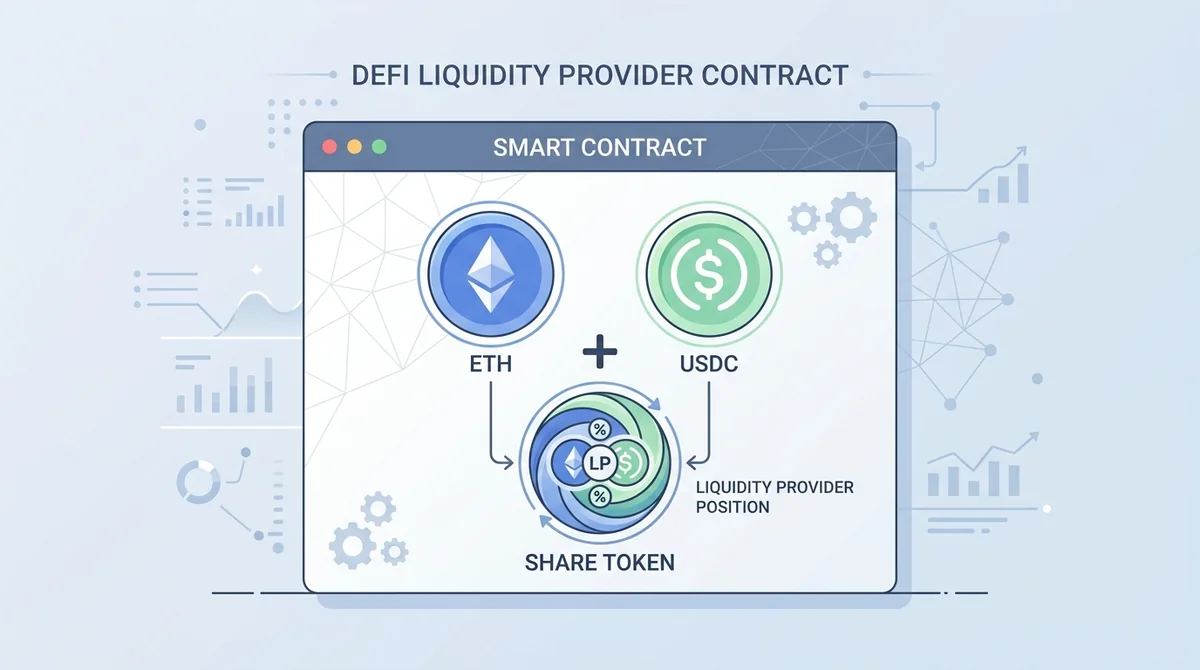
A liquidity pool is a collection of funds locked in a smart contract, usually consisting of two tokens in a certain ratio, such as ETH and USDC. Users who deposit tokens into the pool become liquidity providers (LPs) and receive tokens representing their share.
#How Is the Price Determined by the Pool?
Most AMMs use the constant product formula: x * y = k, where x and y are the quantities of the two tokens in the pool and k is a constant. When someone buys one token, its quantity in the pool decreases while the other token's quantity increases; according to the formula, the price of the purchased token rises accordingly. Selling has the opposite effect.
#How Can Users Provide Liquidity?
Users deposit two tokens into a liquidity pool according to the current pool ratio and can start earning a portion of the pool's trading fees. However, providing liquidity does not guarantee profits; you must bear risks such as impermanent loss.
#What Are Some Real-World Examples of Automated Market Makers (AMMs)?
- Uniswap: The most well-known AMM decentralized exchange, using a constant product model and supporting trading of any ERC-20 tokens.
- Curve: Optimized for stablecoins and similar assets, using a flatter curve to reduce slippage, making it suitable for stablecoin swaps.
- Balancer: Supports multi-asset weighted pools, allowing custom asset ratios and trading fees, providing more flexible liquidity options.
#Why Are Automated Market Makers (AMMs) Important for Crypto?
#How Does It Lower the Barrier to Market Making?
Anyone can become a liquidity provider without professional market-making qualifications or large capital; you only need to deposit two tokens to earn trading fees, democratizing market making.
#How Do AMMs Improve Liquidity for Long-Tail Tokens?
Long-tail tokens do not need to go through a centralized exchange's listing review; as long as someone creates a liquidity pool, a trading market exists, greatly improving liquidity for small-cap tokens.
#What Is the Relationship Between AMMs and Decentralized Finance (DeFi)?
AMMs are one of the foundational infrastructures of DeFi, providing a permissionless liquidity layer for scenarios such as decentralized lending, derivatives, and stablecoin swaps.
#What Are the Risks and Common Misconceptions of Using Automated Market Makers (AMMs)?
#What Is Impermanent Loss?
Impermanent loss refers to the situation where a liquidity provider's asset value becomes lower than if they had simply held the two tokens, due to relative price changes between the two tokens in the pool. The greater the price volatility, the more pronounced the impermanent loss. If prices return, the loss may disappear, but if you withdraw while the loss is present, it becomes a realized loss.
#What Are the Impacts of Slippage and Trading Fees?
Slippage refers to the difference between the actual execution price of a trade and the expected price, and it is more pronounced when the liquidity pool is small or the trade is large. Trading fees are the fees paid to liquidity providers, and different pools have different fee rates. For more details, see slippage.
#Does "Automated Market Making" Mean Guaranteed Profits?
No. AMMs only change the trading mechanism and do not eliminate market risks. Liquidity providers may incur losses due to impermanent loss, smart contract vulnerabilities, token price crashes, or other reasons. Before participating, fully understand the risks and do not invest money you cannot afford to lose.
This article is for educational purposes only and does not constitute investment advice. Before participating in any DeFi protocol, do your own research and make decisions cautiously.
FAQ
What is the difference between an automated market maker and traditional exchange market making?
Traditional market making relies on an order book and manual or professional market makers placing orders. AMMs use algorithms and liquidity pools to automatically price and match trades without centralized intermediaries, and anyone can provide liquidity.
Does providing liquidity guarantee earning trading fees?
Not necessarily. You can earn a share of trading fees, but if token prices fluctuate, impermanent loss may occur, making your total returns lower than simply holding the tokens. Providing liquidity does not guarantee principal protection.
What is impermanent loss?
Impermanent loss is the portion of value that a liquidity provider loses compared to simply holding the two tokens, due to relative price changes between the tokens in the pool. If prices return to the original ratio, the loss may disappear, but if you withdraw before they return, it becomes a realized loss.
What is the difference between Uniswap's and Curve's AMMs?
Uniswap uses a general constant product formula, suitable for various tokens. Curve is optimized for stablecoins, with smaller price changes and lower slippage, making it suitable for stablecoin swaps.
Does AMM have smart contract risks?
Yes. AMMs rely on smart contracts, which may have code vulnerabilities or attack risks. Before participating, check audit reports and assess carefully.
Related Terms
Want to see the real data for this concept?
After you sign up, you can view live prices, funding rates, and fees for the related assets.
View live prices and fees →