What Is Available Margin? 2026 Guide to Account Asset Allocation and Order Restrictions in Crypto
Learn what available margin is in crypto derivatives, how it differs from used margin, dynamic calculations, and trading restriction risks.
Available Margin refers to the unencumbered balance in a crypto derivatives trading account that is not currently locked by any open position margin or unfilled pending orders. It directly determines the maximum size of new positions a trader can open and sets the upper limit for funds that can be transferred out of the account.
#What Is Available Margin?
Available margin is a core metric that measures an account's immediate order-placing capacity and liquidity. In an account's total equity, the remaining freely usable capital after deducting all amounts locked by operational trading logic represents the available margin.
- Basic Formula: Available Margin = Total Account Equity - Used Margin (including position margin and frozen funds from open orders)
- Core Functions: Determines the maximum position size for the next new order and acts as the strict ceiling for outgoing asset transfers.
In the trading interface's asset panel, total equity represents nominal total assets, whereas available margin reflects real-time actionable purchasing power. Understanding the different types of margin helps to systematically grasp account balance structures.
#What Is the Difference Between Available Margin and Used Margin?
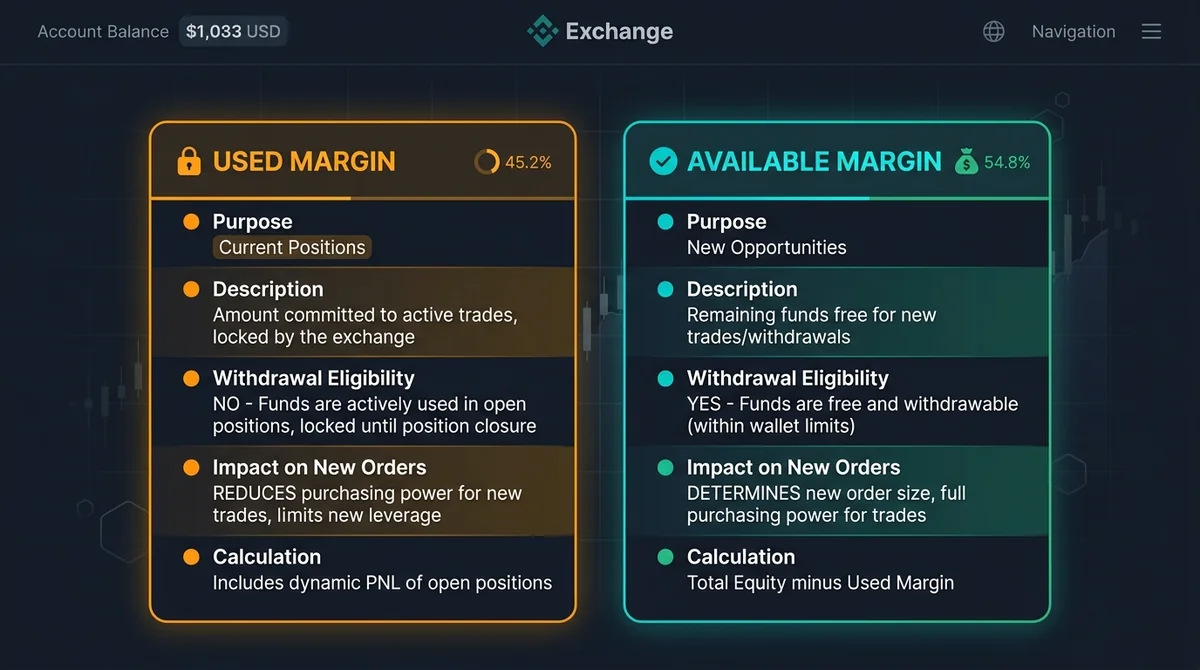
Together, these two components define the capital allocation structure of a derivatives account:
- Used Margin (Position Margin): Refers to the funds frozen by open positions (initial margin requirements) and unfilled open limit orders. Its primary purpose is to secure the performance obligations of active positions or ensure that resting orders can be executed immediately.
- Available Margin: Refers to the remaining unallocated liquid portion after subtracting used margin from account equity. It carries no initial collateral obligations for existing positions and can be used at any time to open new positions or make withdrawals.
Unfilled limit buy or sell orders freeze the corresponding intended initial margin immediately upon submission, which causes available margin to drop in real time while orders remain active.
#How Does Available Margin Fluctuate Dynamically?
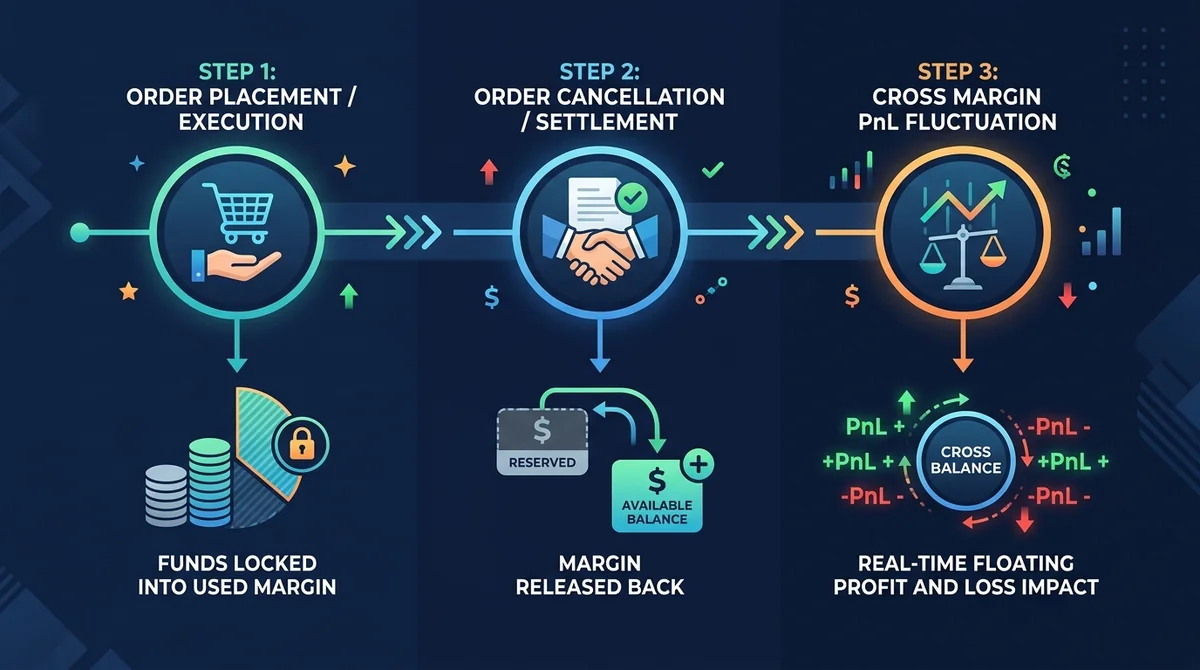
Available margin is continuously recalculated based on market price movements and trading activities:
- Opening Positions and Placing Orders: When you submit a limit/market order or successfully establish a new position, the system instantly reallocates the required capital to used margin, decreasing available margin by an equivalent amount.
- Closing Positions and Canceling Orders: Manually canceling unfilled open orders or closing existing contract positions immediately releases previously locked used margin back into the available balance.
- Treatment of Unrealized PnL: Under cross margin mode, unrealized floating losses directly reduce total account equity, causing an immediate drop in available margin. For unrealized floating profits, some trading platforms allow a percentage to be added to available margin to improve capital efficiency, while other platforms strictly require positions to be closed and settled before profits become available.
For a deeper breakdown of margin formulas and leverage ratios, refer to the crypto futures margin and leverage calculation tutorial.
#Trading Restrictions and Risks When Available Margin Is Insufficient
When account available margin falls below the system's minimum initial margin threshold for a single order, the trading engine automatically triggers protective restrictions:
- Rejection of New Orders: Even if total assets are substantial, if all capital is committed to active positions or resting orders, submitting a new order will return an "insufficient available funds" error and be rejected.
- Zero Available Margin Does Not Mean Liquidation: Reaching zero available margin simply means your purchasing power is exhausted and no new orders can be placed. Liquidation is triggered only when account equity falls below the Maintenance Margin requirement. As long as equity remains above the maintenance margin threshold, existing positions will not be liquidated.
- Liquidity Buffer Management: In leveraged trading, operating at full margin capacity (exhausting all available margin) significantly weakens the account's ability to withstand adverse market moves. Maintaining an adequate buffer of available margin is recommended to avoid forced deleveraging during sharp volatility.
Risk Warning: Derivatives trading carries high risks of leverage and liquidation. Over-utilizing capital may accelerate potential losses. This article is for informational purposes regarding underlying mechanisms only and does not constitute investment advice or trading guidance.
FAQ
Does having zero available margin immediately trigger account liquidation?
No. Zero available margin only means you cannot open new positions or place new orders. Forced liquidation is triggered only when total account equity drops below the maintenance margin requirement set by the platform.
Why does my account show a balance, but my order is rejected for insufficient funds?
This usually occurs because unfilled limit orders have frozen available capital, or active positions have absorbed most of your initial margin. Canceling open orders or closing parts of your existing positions will unlock tied-up funds and restore available margin.
Can unrealized floating profits be used directly as available margin to open new positions?
This depends on the exchange's settlement rules. Some platforms allow unrealized PnL in cross margin mode to count toward available margin at a specified haircut rate, whereas others strictly require positions to be closed and realized before gains can be used.
Related Terms
Want to see the real data for this concept?
After you sign up, you can view live prices, funding rates, and fees for the related assets.
View live prices and fees →