What Is Bidding in an IPO? A Beginner's Guide
IPO bidding lets you apply for shares at a price within the price band before listing. Learn how bid price, cut-off price, and allotment work.
IPO bidding is the process where investors apply to buy shares by specifying the price and quantity they are willing to pay within a price band before the company lists on the stock exchange. In a book-built IPO, the final issue price is determined after all bids are collected, and allotment depends on demand, investor category, and subscription levels.
Key Takeaways
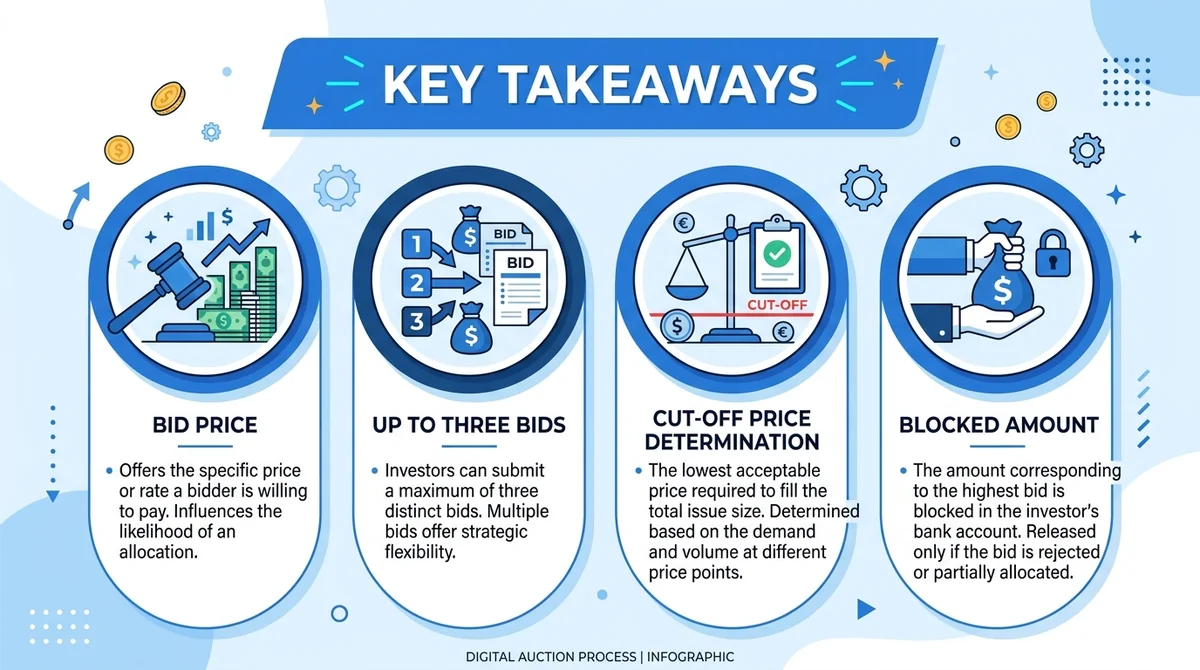
- A bid price is the price you are willing to pay per share within the IPO price band.
- You can place up to three bids in most book-built IPOs, each with a different price and quantity.
- The cut-off price is determined after bidding closes based on demand; if your bid is below it, you may not get shares.
- The highest bid amount is temporarily blocked in your bank account until allotment.
#What Is Bidding in an IPO?
IPO bidding is the process of applying for shares before a company lists on the stock exchange. Investors submit bids by specifying the number of shares and the price they are willing to pay within the prescribed price band. In book-built issues, the final allotment is based on demand received across different price levels.
#What is a bid price in an IPO?
A bid price is the price an investor is willing to pay for shares in an Initial Public Offering (IPO). When you apply for an IPO, you must state this price along with the number of shares you want to buy, which indicates your demand for the stock. For example, if you bid for one lot (25 shares) at ₹570 per share in an IPO with a price band of ₹557–₹585, your bid price is ₹570. The actual allotment depends on whether your bid matches or exceeds the final cut-off price.
#What is the difference between bid price and cut-off price?
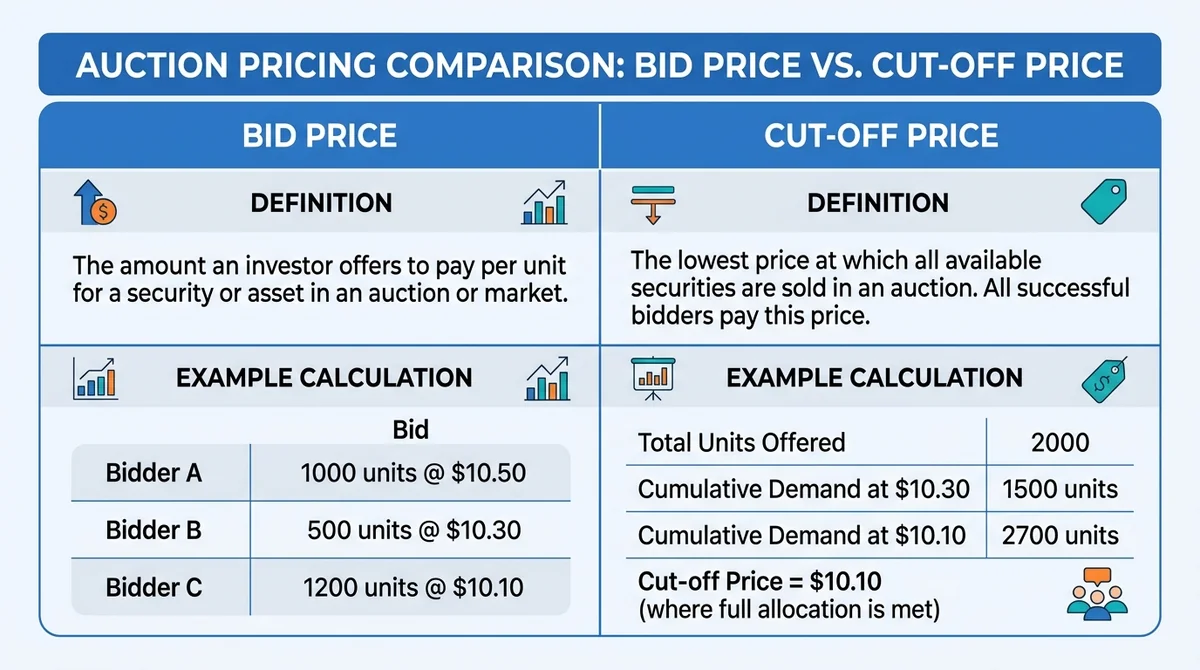
The bid price is the specific price you choose to bid at, while the cut-off price is the final issue price determined after all bids are collected. The cut-off price is based on demand at different price levels; if your bid is below the cut-off, you may not receive shares. For retail investors, bidding at the cut-off price (or simply selecting "cut-off") is often allowed, meaning you agree to pay whatever the final price is.
#How Does IPO Bidding Work?
In a book-built IPO, you bid within a price band; after all bids are collected, the final cut-off price is determined, and shares are allotted based on demand and investor category.
#What are the key components of an IPO bid?
Every IPO bid has three key components: price, quantity, and lot size. The price must be within the price band (floor to cap), the quantity must be in multiples of the minimum lot size, and you may place up to three bids with different price-quantity combinations.
#How does the price band affect your bid?
A company sets a price band with a floor price (minimum) and a cap price (maximum). Your bid must fall within this range. For example, in a ₹100–₹110 price band, ₹100 is the floor and ₹110 is the cap. This band helps the company gauge investor interest at different price points.
#What is the cut-off price and how is it determined?
The cut-off price is determined after all bids are collected based on demand. It is the price at which the company decides to issue shares, often influenced by the distribution of bids across the price band. Allotment depends on demand, investor category, and subscription levels.
#How Many Bids Can You Place in an IPO?
You can place up to 3 bids in an IPO, each with different price and quantity combinations. This allows you to express demand at multiple price points.
#What are bid1, bid2, and bid3 in an IPO application?
In a book-building IPO, an investor can place up to three bids: Bid1, Bid2, and Bid3. Each bid can have a different price (within the price range) and quantity (in multiples of the lot size). For example, for an IPO with a lot size of 195 shares, you might set Bid 1: 1 lot at ₹72, Bid 2: 1 lot at ₹74, and Bid 3: 2 lots at ₹76.
#What is the maximum bid amount that gets blocked?
The highest bid amount among your three bids is temporarily blocked in your bank account to ensure sufficient funds if that bid is accepted. Using the example above, Bid 3 is the highest, so the blocked amount would be (195 shares × 2) × ₹76 = ₹29,640.
#IPO Bidding Example
For example, if you bid for one lot (25 shares) at ₹570 in an IPO with a price band of ₹557–₹585, your bid price is ₹570, and allotment depends on whether this price meets or exceeds the final cut-off price.
#How to calculate the blocked amount for multiple bids?
To calculate the blocked amount, multiply the number of shares in the highest bid by its bid price. For instance, if your highest bid is 2 lots of 195 shares at ₹76, the blocked amount is (195 × 2) × ₹76 = ₹29,640.
#What happens if your bid price is below the cut-off price?
If your bid price is below the final cut-off price, you may not receive any shares because the issue price is higher than what you were willing to pay. In such cases, the blocked amount is typically unblocked after allotment.
#Why Is IPO Bidding Important?
IPO bidding is important because it helps determine the final issue price through demand discovery and influences allotment chances for investors.
#How does bidding influence IPO pricing?
Bidding helps the company gauge investor interest at different price points. The aggregated bids determine the cut-off price, which is the price at which the issue clears. This price discovery mechanism ensures that the final price reflects market demand.
#What is the role of bidding in demand discovery?
Bidding reveals the demand curve for the IPO. If there is high demand at the cap price, the cut-off may be set at or near the cap; if demand is weak, it may be lower. For retail investors, mainboard IPOs allow bidding up to ₹2 lakh at cut-off price, which simplifies participation.
#Common Mistakes and Risks in IPO Bidding
Common mistakes include bidding outside the price band, using incorrect lot sizes, or bidding at a price that may not align with the final cut-off, which can lead to rejection or overpayment.
#What mistakes should you avoid when bidding for an IPO?
Avoid bidding at a price too high, as you may overpay if the cut-off is lower. Also avoid bidding below what you think the cut-off might be, as you may get no allotment. Ensure your quantity is in multiples of the lot size and your price is within the band, or your application may be rejected.
#What are the risks of bidding at the cap price?
Bidding at the cap price may lead to overpaying if the final cut-off is lower. However, it can also increase your chances of allotment in a heavily oversubscribed IPO. Funds are blocked until allotment, which affects liquidity, so consider your cash flow before bidding.
FAQ
What is IPO bidding?
IPO bidding is the process of applying to buy shares before a company lists, by specifying the price and quantity you are willing to pay within a set price band.
Can I place more than 3 bids in an IPO?
No, in most book-built IPOs you can place a maximum of 3 bids, each with a different price and quantity combination.
What happens to the blocked amount if I don't get allotment?
If you do not receive shares, the blocked amount is released back to your bank account after the allotment process is completed.
Should I bid at the cut-off price in an IPO?
Bidding at the cut-off price means you agree to pay the final issue price, which can simplify the process and is a common choice for retail investors.
How is the cut-off price determined?
The cut-off price is determined after all bids are collected, based on the demand at different price levels within the band.
Want to see the real data for this concept?
After you sign up, you can view live prices, funding rates, and fees for the related assets.
View live prices and fees →