Coin-Margined Futures
A coin-margined contract uses crypto itself as margin and settles in that coin, unlike USDT-margined futures. Learn how it works, margin mechanics, and risks.
Coin-margined contract: a futures contract that uses a cryptocurrency itself (such as BTC or ETH) as margin, with profit and loss also denominated and settled in that coin.
It is the counterpart to USDT-margined contracts, which use stablecoins such as USDT as margin.
#What Is a Coin-Margined Contract (Coin-Margined Futures)?
Definition: You deposit BTC as margin, open a contract denominated in BTC, and settlement also returns to BTC. In other words, the margin asset, the profit-and-loss denomination, and the settlement asset are all the same coin.
Analogy: It is like trading stocks through a foreign-currency account, where both principal and profit/loss are calculated in foreign currency and never converted back to your home currency.
It is often called an inverse contract. An inverse contract is one priced in coin quantity with profit and loss settled in coin—the coin-margined contract belongs to this category, and its pricing direction is the opposite of traditional linear contracts.
#How Does a Coin-Margined Contract Work?
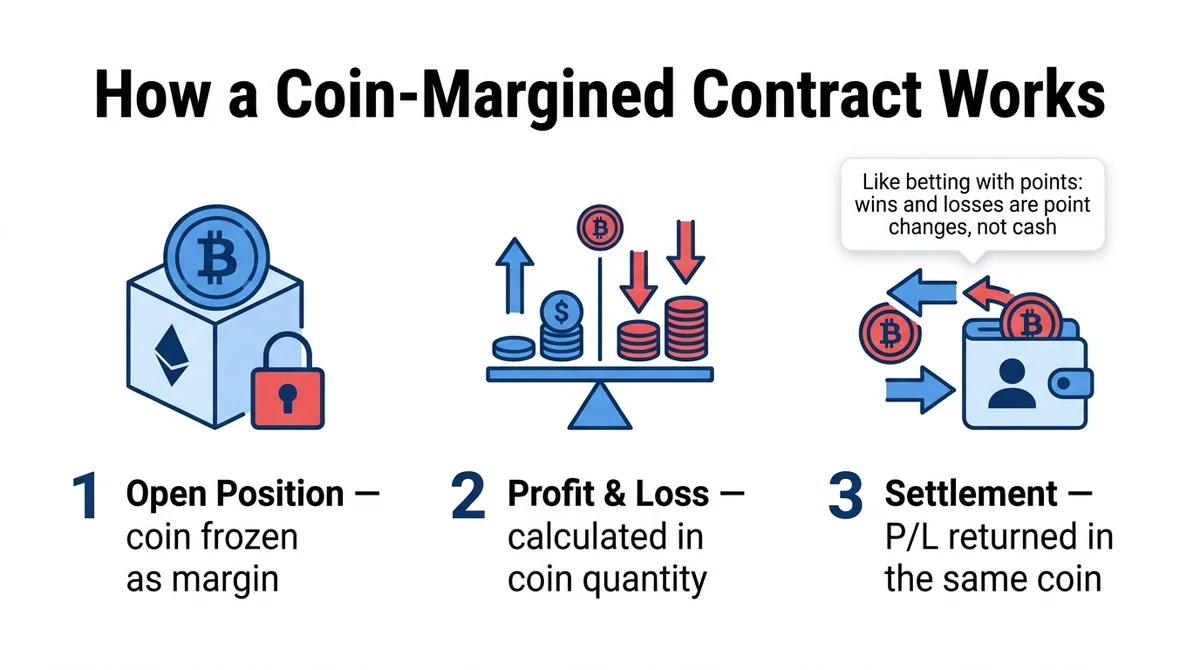
A coin-margined contract works in three steps: freeze the coin as margin when establishing a position, calculate profit and loss in coin quantity, and settle in the same coin after closing or expiry. The principles are broken down below.
Establishing a position (opening): The system freezes the amount of coin you deposit as margin. This describes the mechanism only and is not any kind of operational guidance.
Profit and loss: Calculated in coin quantity rather than in USD amounts. For the same price move, the profit/loss converted into coin changes with the coin price itself.
Settlement: On closing or expiry, profit and loss return to your account in the same coin.
Analogy: It is like betting with points—wins and losses are point increases or decreases, not converted into cash.
#What Is the Difference Between Coin-Margined and USDT-Margined Contracts?
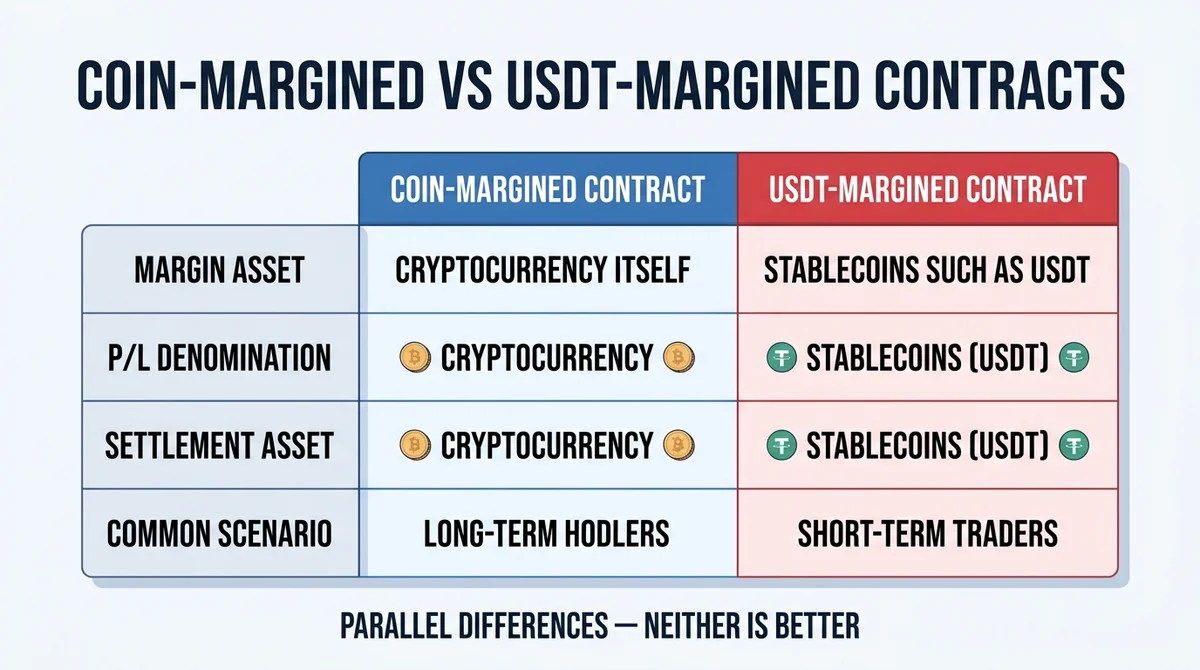
The two are parallel differences; neither is better.
| Dimension | Coin-Margined Contract | USDT-Margined Contract |
|---|---|---|
| Margin asset | Cryptocurrency itself | Stablecoins such as USDT |
| P/L denomination | Quantity of that coin | Stablecoin amount |
| Settlement asset | Same coin | Stablecoin |
| Common understanding scenario | Holders who want to use coin directly as margin | Those who want unified stablecoin pricing |
From an understanding standpoint, coin-margined contracts fit the scenario of "already holding the coin and wanting to participate with it directly," while USDT-margined contracts fit the scenario of "wanting to measure profit and loss uniformly in stablecoins." The two differ only in pricing and settlement methods and do not imply any judgment of superiority.
#How Is Margin Calculated in Crypto Futures?
Initial margin: The funds frozen according to the leverage ratio when establishing a position. The higher the perpetual futures leverage, the lower the proportion of contract value required as initial margin.
Maintenance margin: The minimum funding requirement to keep a position from risk processing, usually lower than the initial margin.
Leverage and margin: The higher the perpetual futures leverage, the less margin is required, but the greater the risk. This relationship is a description of principle and does not involve any specific figures.
Insufficient margin: When account equity falls below the maintenance margin requirement, the position faces risk processing and may be forcibly liquidated.
In the coin-margined scenario, the margin itself is a volatile asset, so the "margin value" changes with the coin price—one of the core differences from stablecoin margin.
⚠️ Digital asset and derivatives trading carries extremely high risk. This article is conceptual education only and does not constitute investment advice.
#What Risks Should You Watch When Using Coin-Margined Contracts?
The margin asset itself fluctuates: The price of the coin you deposit is also changing, which affects margin value. When the coin price falls, the converted margin value declines in tandem and may reach the maintenance margin requirement more quickly.
Leverage amplifies both ways: Profits and losses are both amplified, and the perpetual futures leverage applies in both directions simultaneously.
Pricing and settlement in the same coin: Profit and loss are measured in coin; viewed from a home-currency perspective, actual returns also carry the impact of coin price changes.
Boundaries for beginners: Understand margin and leverage mechanics first, then consider any action; assess your own risk tolerance before any action.
This article covers concepts only and does not constitute investment advice. To learn about related tools, you can consult the public product descriptions on the main MSX site, and for more concepts see MSX Learn.
#FAQ
What is a coin-margined contract? A coin-margined contract is a futures contract that uses a cryptocurrency itself (such as BTC or ETH) as margin and is denominated and settled in that coin, as opposed to a USDT-margined contract that uses stablecoins such as USDT as margin.
How is a coin-margined contract different from a USDT-margined contract? The main differences are the margin asset and the P/L denomination: coin-margined contracts use the cryptocurrency itself as margin and denominate P/L in that coin; USDT-margined contracts use stablecoins such as USDT as margin and denominate P/L in stablecoins. These are parallel differences with no conclusion of superiority.
Why is a coin-margined contract also called an inverse contract? Because such contracts express price relationships in coin quantity, with a pricing direction opposite to traditional linear contracts, they are often called inverse contracts. For the specific mechanism, refer to the inverse contract entry.
How is margin calculated in crypto futures? Margin is divided into initial margin, required to establish a position, and maintenance margin, required to keep it. The higher the perpetual futures leverage, the less margin is required, but the greater the risk; when margin is insufficient, the position faces risk processing and may be forcibly liquidated.
What risks do coin-margined contracts carry? The price of the margin asset itself fluctuates, and combined with leverage this amplifies profit and loss in both directions. Beginners should understand margin and leverage mechanics first, then consider any action; this article does not constitute investment advice.
What does coin-margined contract mean, and where does it differ from USDT-margined? A coin-margined contract is a futures contract where margin, P/L denomination, and settlement all use the same cryptocurrency; the main differences from USDT-margined are the margin asset (coin vs stablecoin) and the P/L unit (coin quantity vs stablecoin amount).
Can the difference between coin-margined and USDT-margined be summed up in one sentence? Yes: coin-margined is "priced in coin, settled in coin," while USDT-margined is "priced in stablecoin, settled in stablecoin." They are two parallel pricing methods, with no conclusion that one is better.
How is margin calculated—do I need to remember a specific formula? This article gives a qualitative explanation only: initial margin relates to the perpetual futures leverage, and maintenance margin is the minimum requirement to keep a position. Specific ratios and formulas follow each platform's public rules; this article provides no specific figures.
FAQ
What is a coin-margined contract?
A coin-margined contract is a futures contract that uses a cryptocurrency itself (such as BTC or ETH) as margin and is denominated and settled in that coin, as opposed to a USDT-margined contract that uses stablecoins such as USDT as margin.
How is a coin-margined contract different from a USDT-margined contract?
The main differences are the margin asset and the P/L denomination: coin-margined contracts use the cryptocurrency itself as margin and denominate P/L in that coin; USDT-margined contracts use stablecoins such as USDT as margin and denominate P/L in stablecoins. These are parallel differences with no conclusion of superiority.
Why is a coin-margined contract also called an inverse contract?
Because such contracts express price relationships in coin quantity, with a pricing direction opposite to traditional linear contracts, they are often called inverse contracts. For the specific mechanism, refer to the inverse contract entry.
How is margin calculated in crypto futures?
Margin is divided into initial margin, required to open a position, and maintenance margin, required to keep it. The higher the perpetual futures leverage, the less margin is required, but the greater the risk; when margin is insufficient, the position faces risk processing and may be forcibly liquidated.
What risks do coin-margined contracts carry?
The price of the margin asset itself fluctuates, and combined with leverage this amplifies profit and loss in both directions. Beginners should understand margin and leverage mechanics first, then consider any action; this article does not constitute investment advice.
Related Terms
Want to see the real data for this concept?
After you sign up, you can view live prices, funding rates, and fees for the related assets.
View live prices and fees →