What Is Cryptocurrency Anti-Money Laundering (AML)? Essential Regulatory Frameworks and Exchange Practices for Beginners (2026)
Cryptocurrency AML prevents illegal funds from being laundered through crypto assets via KYC, transaction monitoring, and suspicious activity reporting. Learn how AML protects users.
Answer: Cryptocurrency anti-money laundering (AML) is a set of laws and processes that exchanges and crypto service providers must follow to prevent criminals from laundering dirty money through cryptocurrency.
#What Is the Simple Definition of Cryptocurrency AML?
AML stands for anti-money laundering. Traditional banks use it to stop criminals from making illegal income look legitimate. Cryptocurrency exchanges must do the same: identify users, monitor transactions, and report suspicious activity.
Analogy: AML is like a residential gate with security patrols. The gate checks identities, and patrols watch for anyone acting suspiciously in the hallways. If something suspicious is found, it's reported to property management.
#What Does AML Mean in Traditional Finance?
In traditional finance, AML requires banks to verify customer identities, monitor large cash transactions, and report suspicious behavior to regulators.
#How Is AML Different in the Cryptocurrency Space?
Cryptocurrency AML adds on-chain analysis. Because transaction records are public on the blockchain, funds can be traced, and addresses linked to crime can be identified.
#How Does Cryptocurrency AML Work?
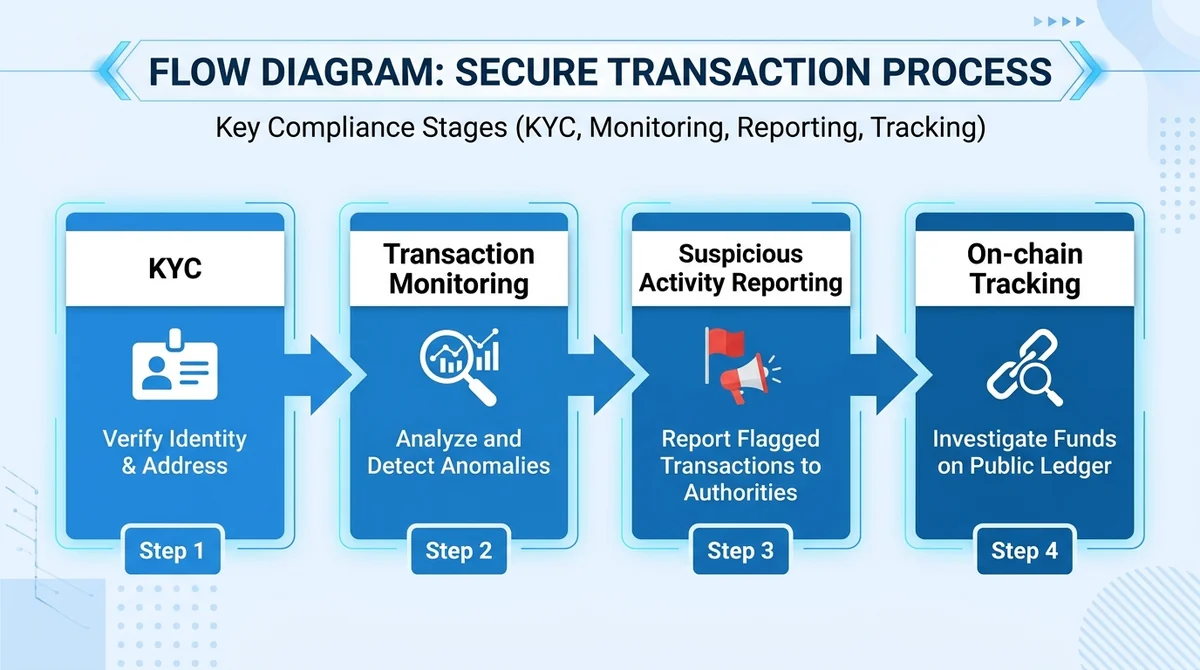
AML works in four steps: KYC to identify users, transaction monitoring, suspicious activity reporting, and on-chain tracking.
#How Does KYC (Know Your Customer) Work in Practice?
When you register on an exchange, you need to submit an ID document, a selfie, and sometimes proof of address. The exchange uses this information to confirm you are a real person, not an impersonator.
#What Are Transaction Monitoring and Suspicious Activity Reports?
Exchange systems watch all transactions. If they detect frequent large transfers, interaction with mixers, or funds from high-risk addresses, they flag them as suspicious.
Suspicious transactions must be reported to financial intelligence units. Failure to report can result in heavy fines.
#How Do On-Chain Analysis Tools Help AML?
On-chain analysis companies (such as Chainalysis) provide tools to exchanges that label addresses and identify which ones are linked to hackers, scams, or darknet markets.
#What Are Some Real-World Examples of Cryptocurrency AML?
#Is Mandatory Identity Verification on Exchanges Part of AML?
Yes. When you submit your ID and selfie during exchange registration, that's the KYC step of AML. Without verification, you cannot withdraw funds or increase your trading limits.
#What Behaviors Trigger an Exchange's AML Review?
- Frequent large transfers in a short period
- Interaction with mixers or privacy coins
- Funds coming from flagged high-risk addresses
- Account activity inconsistent with identity information
After a trigger, the exchange may freeze the account and ask you to explain the source of funds.
#Why Is Cryptocurrency AML Important?
#How Does AML Protect Ordinary Users?
AML makes it harder for scammers and hackers to launder stolen funds. If all exchanges take AML seriously, the cost for criminals to use cryptocurrency increases, making ordinary users safer.
#What Happens to Exchanges That Don't Comply with AML?
Exchanges that fail to comply with AML may be cut off from banking services and unable to process fiat deposits and withdrawals. They also face massive fines, and executives may go to jail.
Compliant exchanges are more likely to obtain banking support and regulatory licenses, allowing them to operate long-term.
#What Are Common Misconceptions or Risks About Cryptocurrency AML?
#Does AML Only Apply to Large Transactions?
No. Small transactions are also subject to AML rules. Many exchanges review suspicious activity of any amount.
#Do Decentralized Exchanges (DEXs) Not Need AML?
Many DEXs currently do not have KYC, but the regulatory trend is to require DEXs to comply with AML as well. Some DEXs have already begun introducing compliance measures.
#Does AML Compromise User Privacy?
There is tension between AML and privacy protection. KYC requires users to provide personal information, but exchanges must protect that data. Users should choose exchanges with a good security track record.
#What Terms Are Related to Cryptocurrency AML?
#What Is the Difference Between KYC and AML?
KYC is a component of AML. KYC focuses on identifying customers, while AML also includes transaction monitoring, reporting, and on-chain analysis.
#What Is the Relationship Between CFT (Counter-Financing of Terrorism) and AML?
CFT stands for counter-financing of terrorism, and it is often mentioned alongside AML as AML/CFT. Both share a similar goal: preventing illegal funds from entering the financial system.
Travel Rule: Requires exchanges to share identity information of both parties in a transfer, similar to how bank transfers require the recipient's name.
#Frequently Asked Questions
FAQ:
What is cryptocurrency AML? AML stands for anti-money laundering rules that require exchanges to identify users, monitor transactions, and report suspicious activity to prevent cryptocurrency from being used for money laundering.
What is the difference between KYC and AML? KYC is a part of AML and focuses on customer identification; AML also includes transaction monitoring, suspicious reporting, and on-chain analysis.
Do DEXs need to comply with AML? Currently many DEXs do not have KYC, but the regulatory trend is to require DEXs to comply with AML. Some DEXs have already started introducing compliance measures.
Does AML compromise my privacy? AML requires personal information, but exchanges must protect data. Choosing an exchange with a good security record can reduce risk.
What behaviors trigger an AML review? Frequent large transfers, interaction with mixers, funds from high-risk addresses, and similar behaviors may trigger a review, and the exchange may freeze the account and ask for an explanation.
FAQ
What is cryptocurrency AML?
AML stands for anti-money laundering rules that require exchanges to identify users, monitor transactions, and report suspicious activity to prevent cryptocurrency from being used for money laundering.
What is the difference between KYC and AML?
KYC is a part of AML and focuses on customer identification; AML also includes transaction monitoring, suspicious reporting, and on-chain analysis.
Do DEXs need to comply with AML?
Currently many DEXs do not have KYC, but the regulatory trend is to require DEXs to comply with AML. Some DEXs have already started introducing compliance measures.
Does AML compromise my privacy?
AML requires personal information, but exchanges must protect data. Choosing an exchange with a good security record can reduce risk.
What behaviors trigger an AML review?
Frequent large transfers, interaction with mixers, funds from high-risk addresses, and similar behaviors may trigger a review, and the exchange may freeze the account and ask for an explanation.
Related Terms
Want to see the real data for this concept?
After you sign up, you can view live prices, funding rates, and fees for the related assets.
View live prices and fees →