Custody
Digital asset custody is a secure storage model where third parties hold private keys. Learn how custody works, key differences, and security risks.
Digital asset custody refers to a security mechanism where users entrust their asset private keys to a professional third-party institution or exchange for safekeeping. The custodian manages asset storage and transaction signature verification, while users manage their assets through credentials such as account passwords and two-factor authentication (2FA).
#What Is Digital Asset Custody?
Everyday Analogy: Digital asset custody is similar to depositing cash in a commercial bank. The bank manages vault security, clearing, and settlement, while users deposit and withdraw funds using account credentials or identification, eliminating the need to install a home safe to store physical cash.
Under fundamental blockchain rules, holding the private key grants ultimate control over the on-chain address assets. The custody model abstracts complex private key management and blockchain node interactions, lowering the technical barrier to entry for everyday users managing crypto assets.
#How Does Digital Asset Custody Work?
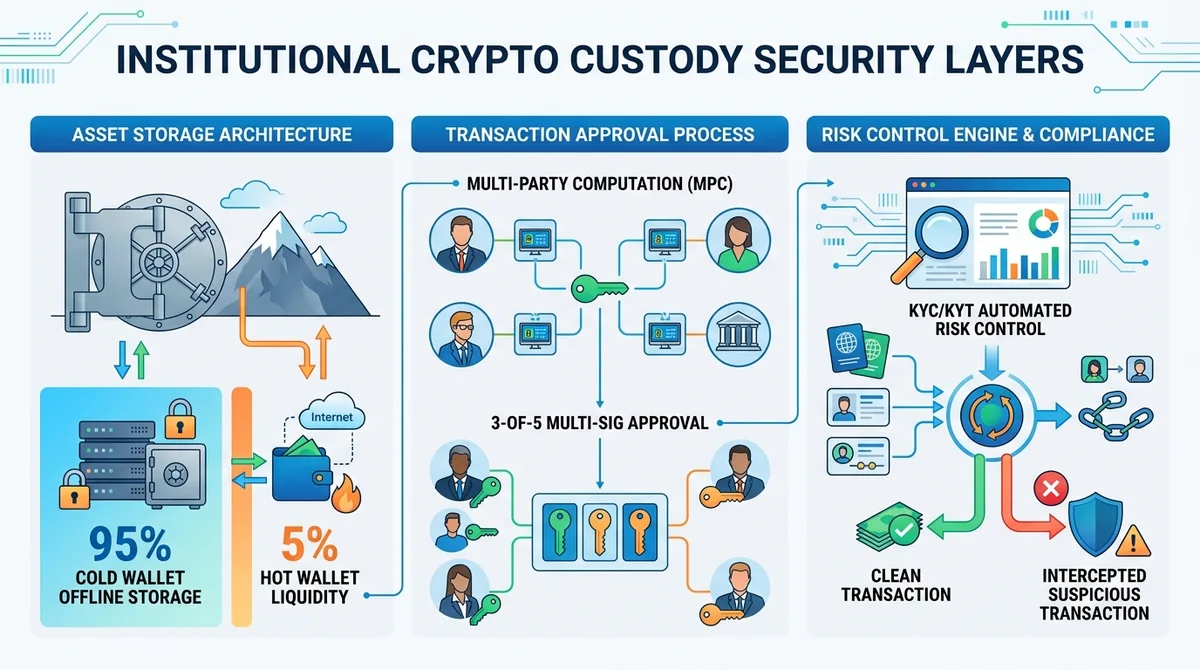
Institutional-grade custodians typically implement layered risk management architectures to safeguard funds:
- Cold and Hot Wallet Separation: The vast majority of assets are stored in physically isolated, offline cold wallets to withstand cyberattacks, while only a small amount of liquidity is maintained in internet-connected hot wallets to support routine deposits and withdrawals.
- Multi-Signature and MPC: Using Multi-Signature (Multi-Sig) or Multi-Party Computation (MPC) technologies, large asset transfers require multi-party authorization, preventing single points of failure and unauthorized internal fund diversion.
- Risk Controls and Identity Verification: Integrating Know Your Customer (KYC), Know Your Transaction (KYT) on-chain monitoring, and anomaly detection to intercept and re-verify suspicious withdrawal requests.
#Custodial vs. Non-Custodial: What Is the Difference?
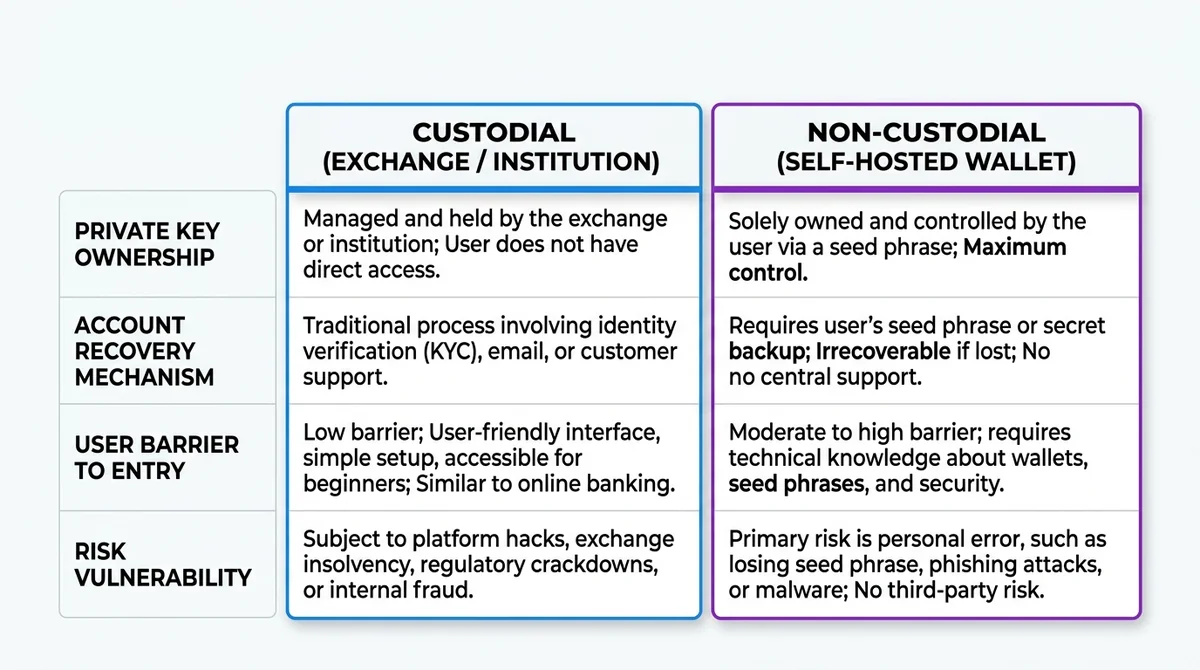
The fundamental difference lies in private key ownership and error tolerance:
- Custodial Model: Private keys are centrally managed by the platform. If users forget their login credentials, they can recover access through verified identity recovery workflows; however, they bear the platform's counterparty and operational risks.
- Non-Custodial Model: Users maintain complete, sole ownership of their private keys and recovery phrases (seed phrases). While users hold absolute sovereignty over their assets, losing or compromising the seed phrase results in irreversible asset loss with no possibility of customer support recovery.
#Why Is Digital Asset Custody Important for Beginners?
- Lowers the Cognitive Barrier: Beginners do not need prior technical knowledge of asymmetric cryptography, public-private key pairs, or gas fee configurations.
- Mitigates Single-Point User Errors: It eliminates the risk of permanent asset loss caused by local malware infections, phishing attacks, or physical destruction of paper seed phrase backups.
#What Risks Should You Consider When Choosing a Custody Service?
The primary risk of custody lies in relying entirely on the third party's regulatory compliance and technical defense capabilities. If the custodian suffers security vulnerabilities, internal misappropriation, or insolvency, user assets may face liquidity shortages or complete loss.
When evaluating custody providers, focus on whether the platform holds compliant operating licenses, regularly releases third-party audited Proof of Reserves (PoR), and maintains robust cold/hot wallet separation mechanisms.
Risk Warning: Digital assets carry high volatility and operational risks. This article is for educational purposes only and does not constitute investment advice or asset custody recommendations.
FAQ
What is the core difference between digital asset custody and non-custodial wallets?
The core difference lies in private key ownership. In a custodial setup, the platform holds the private keys and offers account recovery options. In a non-custodial wallet, the user holds their own private keys, and lost keys cannot be recovered.
Are assets held by a custodial platform completely safe?
They carry institutional credit and operational risks. Although platforms typically deploy cold storage and multi-sig security, users remain exposed to potential counterparty risks such as insolvency or regulatory actions.
Do I need to back up a seed phrase when using a custodial wallet?
No. The underlying private keys in a custodial wallet are managed by the custody provider. Users access and manage their accounts using standard credentials such as email, phone number, and 2FA.
What should I do if I forget my password on a custodial platform?
You can reset your password and restore account access via the platform's standard identity verification procedures, such as email codes, SMS verification, or KYC manual review.
Related Terms
Want to see the real data for this concept?
After you sign up, you can view live prices, funding rates, and fees for the related assets.
View live prices and fees →