Delivery Contract
A delivery contract is a derivative with a fixed expiry date, settled at an agreed price with no funding rate. Learn the differences from spot and perpetual contracts.
Delivery Contract: A contract with a fixed expiry date, settled at the agreed price on expiry.
#What Is a Delivery Contract?
A delivery contract is a financial contract. It specifies a future date on which the buyer and seller will trade the underlying asset at an agreed price.
Analogy: It's like agreeing in advance with a fruit farmer to buy 100 pounds of apples at $5 per pound three months from now. On that day, regardless of the market price, you must complete the transaction at $5.
#How Does It Differ from Spot Trading?
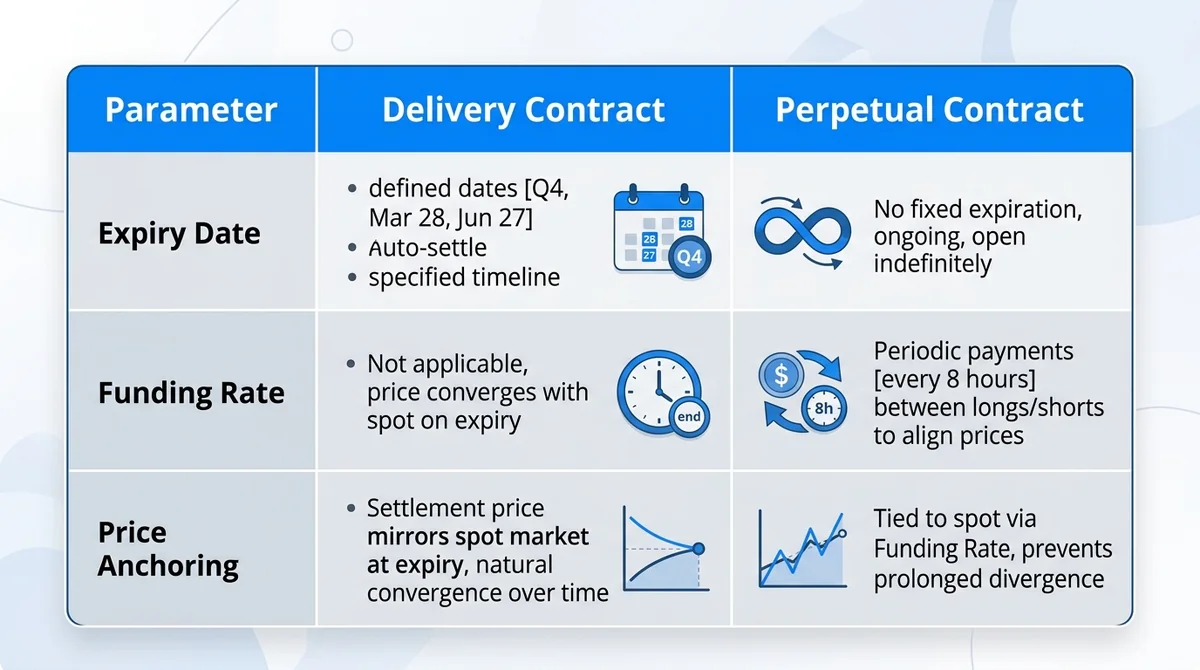
Spot trading is immediate: you pay and receive the asset right away. A delivery contract is an agreement for a future trade; you only sign the contract now.
- Spot: Exchange money and asset on the spot.
- Delivery contract: Agree now, settle on expiry.
#How Does It Differ from Perpetual Contracts?
Perpetual contracts have no expiry date and can be held indefinitely. Delivery contracts have a fixed expiry date and must be settled on expiry.
- Perpetual contracts: No expiry date, have a funding rate.
- Delivery contracts: Have an expiry date, no funding rate.
#How Does a Delivery Contract Work?
A delivery contract settles on the expiry date. There are two settlement methods: physical delivery or cash settlement.
Analogy: Like signing a contract to buy apples three months later. On expiry, either you actually take delivery of the apples (physical delivery) or settle the price difference in cash (cash settlement).
#What Happens on the Delivery Date?
On the expiry date, position holders either close their positions or enter the delivery process. Closing a position means ending the contract early.
#How Is the Delivery Price Determined?
The delivery price is typically based on a spot index. For example, for Bitcoin delivery contracts, the delivery price references the average spot price of Bitcoin across several exchanges.
#What Are the Differences Between Delivery Contracts and Perpetual Contracts?
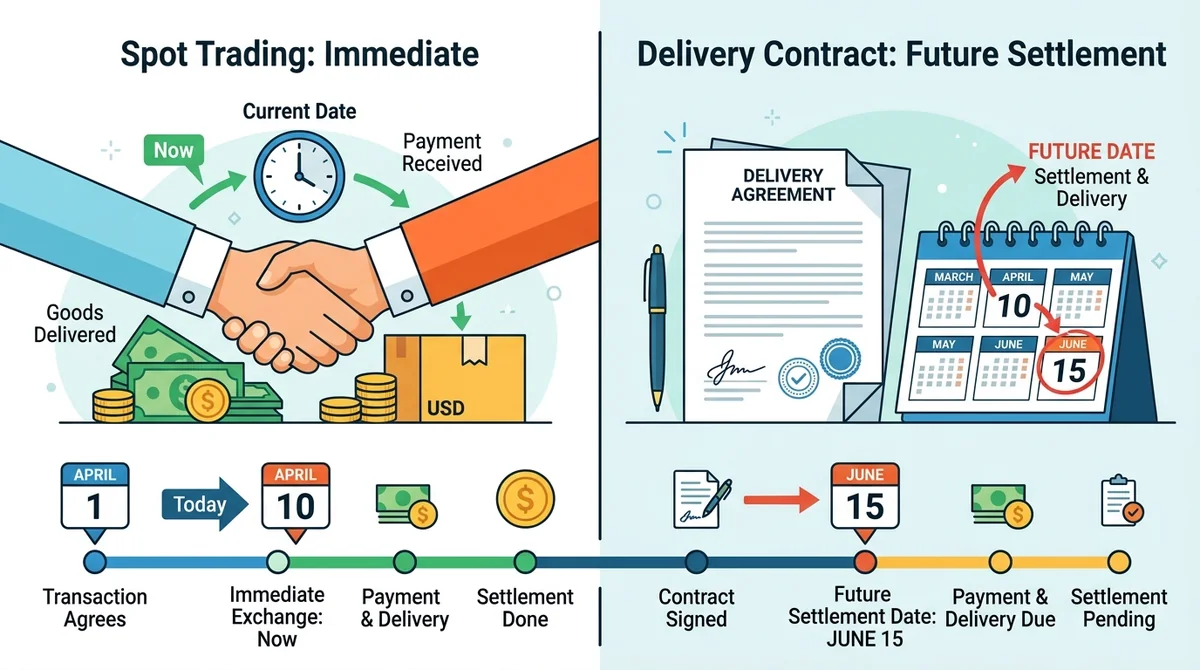
| Comparison | Delivery Contract | Perpetual Contract |
|---|---|---|
| Expiry Date | Has a fixed expiry date | No expiry date |
| Funding Rate | None | Yes, charged periodically |
| Price Anchoring | Converges to spot price at expiry | Uses funding rate to stay close to spot price |
Analogy: A delivery contract is like a fixed deposit; you must handle it at maturity. A perpetual contract is like a demand deposit; you can keep it indefinitely, but the bank may charge a management fee (funding rate).
#Expiry Date
Delivery contracts have a clear expiry date, such as the last Friday of each quarter. Perpetual contracts have no expiry date.
#Funding Rate
Delivery contracts have no funding rate. Perpetual contracts use the perpetual futures funding rate settlement schedule to keep their price close to the spot price.
#Price Convergence Mechanism
At expiry, the delivery contract price converges to the spot price. Perpetual contracts rely on the funding rate mechanism to maintain continuous anchoring.
#What Are the Risks and Considerations of Using Delivery Contracts?
The main risk of delivery contracts is being forced to settle at an unfavorable price on expiry.
#What Is Expiry Risk?
If you forget the expiry date, your position may be forcibly settled. The settlement price may be unfavorable to you.
#How to Avoid Passive Settlement?
Close your position early or roll over. Rolling over means closing the current contract and opening a new one with a later expiry date.
Risk Warning: Digital asset derivatives are high risk and may result in the loss of your entire principal. This article is for educational purposes only and does not constitute investment advice.
#FAQ
Which is more suitable for beginners: delivery contracts or perpetual contracts? Perpetual contracts have no expiry date and are more flexible. However, both involve high leverage risk. Beginners should first understand the basics.
Will a delivery contract automatically close after expiry? Not necessarily. Some platforms automatically settle in cash, while others require manual action. Always check the platform's rules.
Do delivery contracts have a funding rate? No. The funding rate is a mechanism of perpetual contracts, used to anchor the price to the spot market.
Can I close a delivery contract early? Yes. You can close the position at any time before expiry to avoid entering the delivery process.
Why is the price of a delivery contract different from the spot price? Because a delivery contract includes expectations of future prices plus time value, so the price differs. At expiry, the price converges to the spot price.
FAQ
Which is more suitable for beginners: delivery contracts or perpetual contracts?
Perpetual contracts have no expiry date and are more flexible. However, both involve high leverage risk. Beginners should first understand the basics and start with spot trading.
Will a delivery contract automatically close after expiry?
Not necessarily. Some platforms automatically settle in cash, while others require manual action. Always check the platform's rules to avoid passive settlement.
Do delivery contracts have a funding rate?
No. The funding rate is a mechanism of perpetual contracts, used to anchor the price to the spot market. Delivery contracts rely on convergence at expiry.
Can I close a delivery contract early?
Yes. You can close the position at any time before expiry to avoid entering the delivery process. This is the main way to manage expiry risk.
Why is the price of a delivery contract different from the spot price?
Because a delivery contract includes expectations of future prices plus time value, so the price differs. At expiry, the price converges to the spot price.
Related Terms
Want to see the real data for this concept?
After you sign up, you can view live prices, funding rates, and fees for the related assets.
View live prices and fees →