What Is Funding Rate? Perpetual Futures Long-Short Cost Swap Mechanism (2026)
Funding rate: periodic fee between longs and shorts in perpetual futures to anchor spot price. Positive = longs pay shorts, negative = opposite. Not investment advice.
Funding rate is a fee regularly exchanged between longs and shorts in perpetual futures to pull the contract price toward the spot price, not an exchange trading fee. This article is compiled by MSX Learn for educational purposes only and does not constitute investment advice; futures trading involves risk, so please make decisions cautiously.
#What Is Funding Rate?
Funding rate is a mechanism unique to perpetual futures: longs and shorts periodically pay each other a fee, causing the contract price to converge toward the spot price. When the contract price is above the spot price, longs pay shorts; conversely, shorts pay longs. It differs from trading fees: trading fees are paid to the exchange, while funding rate is transferred between longs and shorts.
Think of funding rate like a rent adjustment in a rental market: when market rent is above the guide price, tenants subsidize landlords; when below, landlords subsidize tenants, eventually bringing rent back near the guide price. Funding rate works through fund transfers between longs and shorts to converge the perpetual futures price toward the spot price.
Funding rate is the key mechanism that keeps the perpetual futures price anchored to the spot price over the long term; for traders, it is part of the holding cost and can also serve as a reference indicator of market sentiment.
#How Funding Rate Works and Is Calculated?
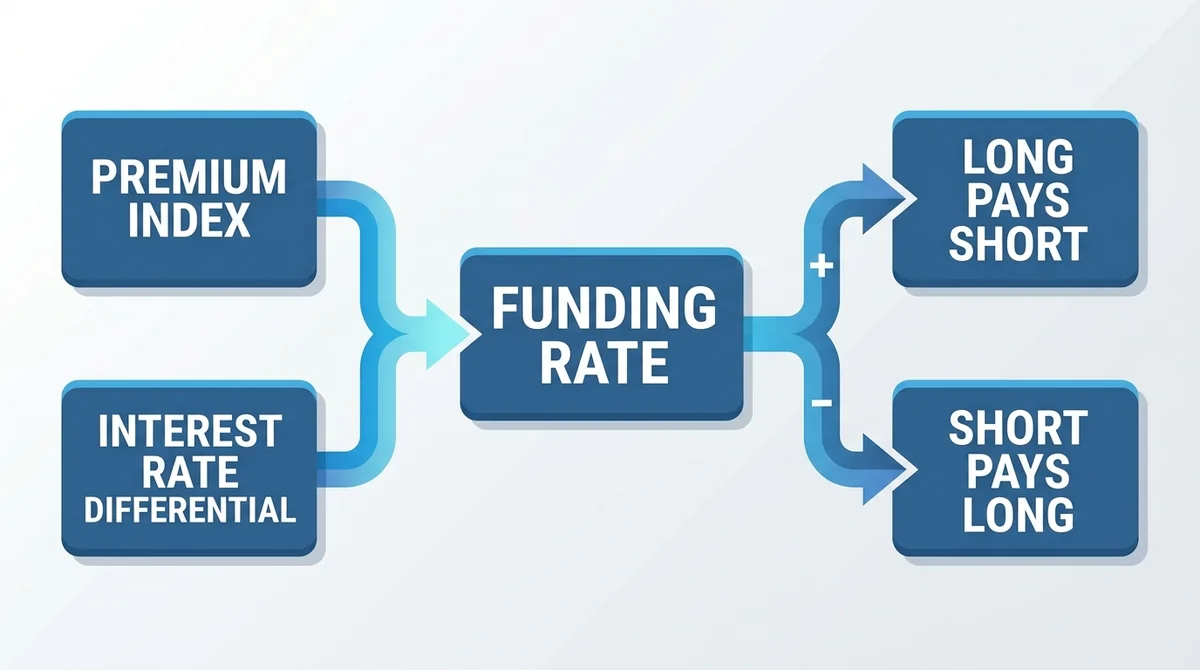
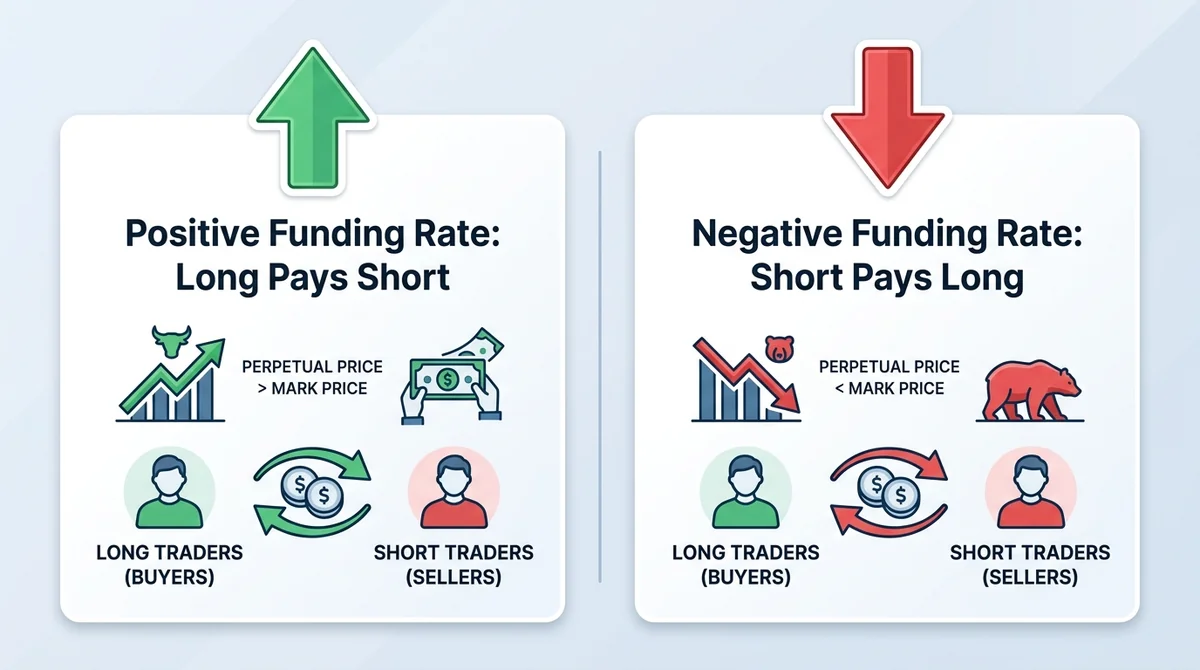
- Direction: A positive funding rate means longs pay shorts, usually reflecting that the contract price is above the spot price or bullish sentiment is strong; a negative rate is the opposite.
- Settlement interval: It is commonly settled every 8 hours, but may vary by platform; positions held through the settlement time will pay or receive the corresponding fee.
Funding rate is typically composed of two parts: the interest rate differential and the premium index. The exact formula varies by exchange, but the goal is to reflect the degree of deviation between the perpetual futures price and the spot price. Simple example: if the premium index is positive and the interest rate differential is also positive, the rate is positive, and longs need to pay shorts.
#What Are the Risks and Common Misconceptions of Funding Rate?
- Risk: During sharp market volatility, the rate may rise significantly, increasing holding costs; long-term holdings will accumulate payments or receipts, requiring continuous attention.
- Common misconception: Treating funding rate as an exchange trading fee; in reality, it is a transfer payment between longs and shorts, not paid to the exchange.
- Note: Futures trading carries high risk. Please participate cautiously based on your own risk tolerance; this article does not constitute investment advice.
#FAQ
What is the difference between funding rate and trading fee? Trading fee is a transaction cost paid to the exchange; funding rate is a fee exchanged periodically between longs and shorts to anchor the spot price, not paid to the exchange.
How often is funding rate settled? It is commonly settled every 8 hours, but may vary by platform; positions held through the settlement time will pay or receive the corresponding fee.
What does a positive or negative funding rate mean? A positive rate usually means longs pay shorts, reflecting that the contract price is at a premium to the spot price or bullish sentiment is strong; a negative rate is the opposite.
How is funding rate calculated? It is generally composed of two parts: the interest rate differential and the premium index. The specific formula varies by exchange, and the core is to measure the degree of deviation between the perpetual futures price and the spot price.
Can funding rate cause me to lose money? It may increase holding costs, especially during sharp market volatility when the rate may spike; it does not directly create profit or loss, but it can affect actual returns, so please be aware of the risk.
FAQ
What is the difference between funding rate and trading fee?
Trading fee is a transaction cost paid to the exchange; funding rate is a fee exchanged periodically between longs and shorts to anchor the spot price, not paid to the exchange.
How often is funding rate settled?
It is commonly settled every 8 hours, but may vary by platform; positions held through the settlement time will pay or receive the corresponding fee.
What does a positive or negative funding rate mean?
A positive rate usually means longs pay shorts, reflecting that the contract price is at a premium to the spot price or bullish sentiment is strong; a negative rate is the opposite.
How is funding rate calculated?
It is generally composed of two parts: the interest rate differential and the premium index. The specific formula varies by exchange, and the core is to measure the degree of deviation between the perpetual futures price and the spot price.
Can funding rate cause me to lose money?
It may increase holding costs, especially during sharp market volatility when the rate may spike; it does not directly create profit or loss, but it can affect actual returns, so please be aware of the risk.
Related Terms
Want to see the real data for this concept?
After you sign up, you can view live prices, funding rates, and fees for the related assets.
View live prices and fees →