What Is Leverage? Amplification Effects and Risks in Crypto Trading (2026)
Leverage is borrowing funds to amplify trade size, magnifying both profits and losses. This guide explains crypto leverage, margin, liquidation risk, and common misconceptions.
Leverage is trading with borrowed money. You use $100 of your own capital, borrow $900, and trade with $1,000. Profits are calculated on $1,000, and so are losses.
#What Is Leverage in Crypto Trading?
Regular trading means buying coins with your own money. Leverage trading means borrowing funds from the exchange to amplify your position size.
Leverage multiple: The more you borrow, the higher the multiple. For example, with 10x leverage, $100 of your own capital lets you control a $1,000 position.
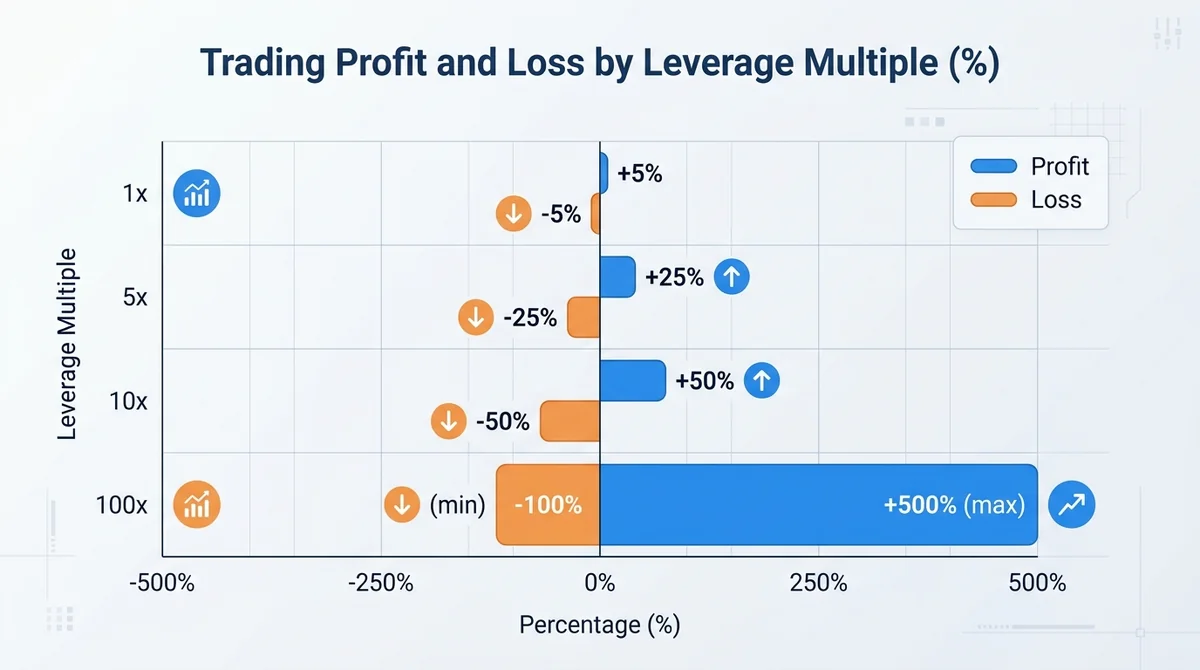
Profits and losses are magnified proportionally: If the price rises 1%, 10x leverage yields a 10% profit; if it falls 1%, you lose 10%.
Analogy: Leverage is like using a ladder to reach apples high up. The taller the ladder, the further you can reach, but the harder you fall.
#How Does Crypto Leverage Work?
Exchanges don't lend money for free. You must first deposit margin as collateral for potential losses.
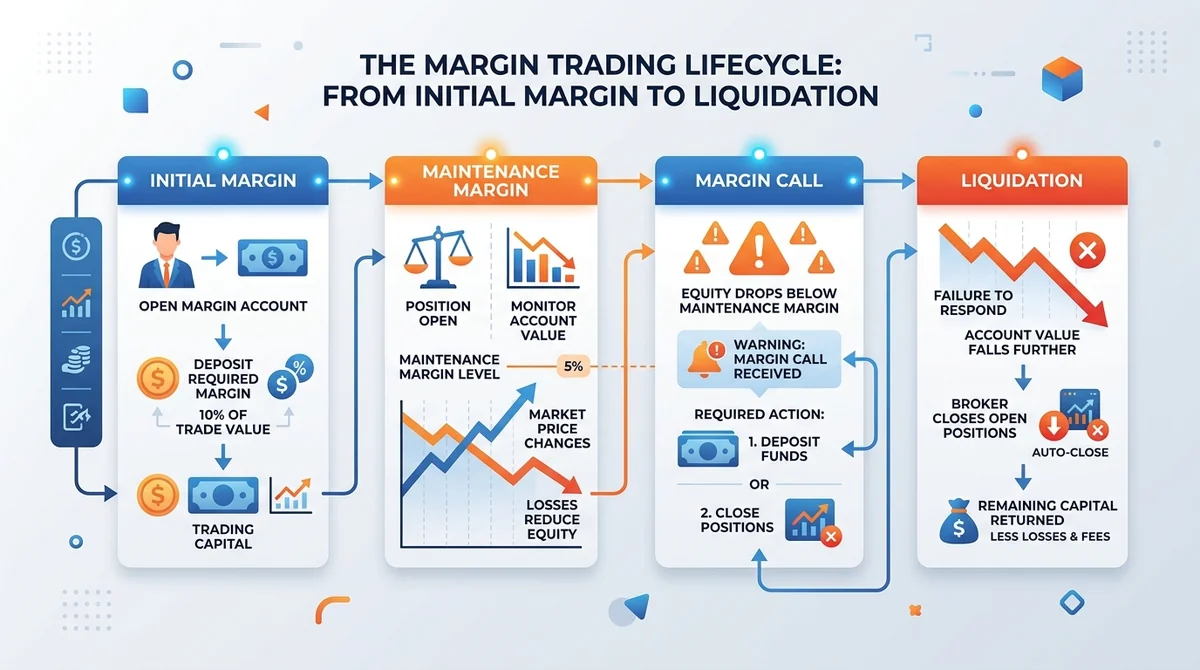
Margin: The money you pledge to the exchange. For example, 10x leverage means $100 margin supports a $1,000 position.
Liquidation mechanism: If the price moves against you and losses approach your margin, the exchange will force-close your position to recover the borrowed funds.
- Initial margin: The minimum amount required to open a position.
- Maintenance margin: The minimum balance you must maintain while holding a position.
- If margin falls below requirements, you'll receive a margin call; otherwise, your position will be liquidated.
#What Are the Risks of Leverage Trading?
Liquidation occurs when your margin is wiped out and your position is force-closed.
The higher the leverage, the less price movement you can withstand. With 10x leverage, a 10% adverse price move triggers liquidation; with 100x leverage, just 1% against you triggers it.
Beginners should avoid high leverage. Start with low leverage or a demo account to understand the mechanics.
Risk warning: Leverage trading can result in total loss of your principal. This article is for educational purposes only and does not constitute investment advice.
#What Are Common Misconceptions About Leverage Trading?
Misconception 1: Higher leverage means more profit.
High leverage also means higher risk of loss. A single adverse move can liquidate your position.
Misconception 2: Leverage is only for professional traders.
Beginners can try it with small positions, but must control risk.
Misconception 3: All assets are suitable for leverage.
Assets with low liquidity or extreme volatility carry higher leverage risk.
#Frequently Asked Questions
What is the difference between leverage trading and regular trading?
Regular trading uses your own money, and profits/losses are based on the actual amount. Leverage trading uses borrowed funds, and profits/losses are based on the amplified amount.
What does leverage multiple mean?
It indicates how many times your principal you have borrowed. For example, 5x leverage means using 1 part of your own capital to borrow 4 parts, totaling 5 parts of position size.
What is liquidation?
Liquidation is when your margin is exhausted and the exchange force-closes your position. It is triggered when the price moves against you by a certain percentage.
How much leverage should beginners use?
There is no standard answer. It is recommended to start with 2-3x leverage, get familiar with the mechanics, and then consider increasing.
Can you owe money in leverage trading?
On reputable exchanges, the liquidation mechanism prevents you from owing money. However, in extreme market conditions, negative equity can occur, and some platforms have clawback mechanisms.
FAQ
What is the difference between leverage trading and regular trading?
Regular trading uses your own money, and profits/losses are based on the actual amount. Leverage trading uses borrowed funds, and profits/losses are based on the amplified amount.
What does leverage multiple mean?
It indicates how many times your principal you have borrowed. For example, 5x leverage means using 1 part of your own capital to borrow 4 parts, totaling 5 parts of position size.
What is liquidation?
Liquidation is when your margin is exhausted and the exchange force-closes your position. It is triggered when the price moves against you by a certain percentage.
How much leverage should beginners use?
There is no standard answer. It is recommended to start with 2-3x leverage, get familiar with the mechanics, and then consider increasing.
Can you owe money in leverage trading?
On reputable exchanges, the liquidation mechanism prevents you from owing money. However, in extreme market conditions, negative equity can occur, and some platforms have clawback mechanisms.
Related Terms
Want to see the real data for this concept?
After you sign up, you can view live prices, funding rates, and fees for the related assets.
View live prices and fees →