What Is a Limit Order? Order Placement Mechanism and Execution in Crypto Trading (2026)
A limit order is a pending order to buy or sell at your set price. It only fills when the market reaches that price. Learn the mechanism and risks.
Answer: A limit order is a pending order instruction where the trader specifies a price. It only executes when the market price reaches that price. It helps control the execution price, but there is a risk of non-execution.
#What Is a Limit Order?
A limit order differs from a market order. A market order executes immediately at the current market price, while a limit order waits for the price you set to appear before executing. Analogy: A limit order is like fishing—you place a price "bait" and wait for the market to swim over and "bite". The limit order enters the exchange's order book and stays until it is filled or canceled.
#How Does a Limit Order Work?
Once a limit order enters the order book, the exchange matches it based on price priority and time priority. Orders with better prices are executed first (higher bid prices and lower ask prices). When prices are the same, earlier orders are executed first. A limit order may only be partially filled, with the remaining portion staying in the order book to wait.
#Practical Examples and Risks
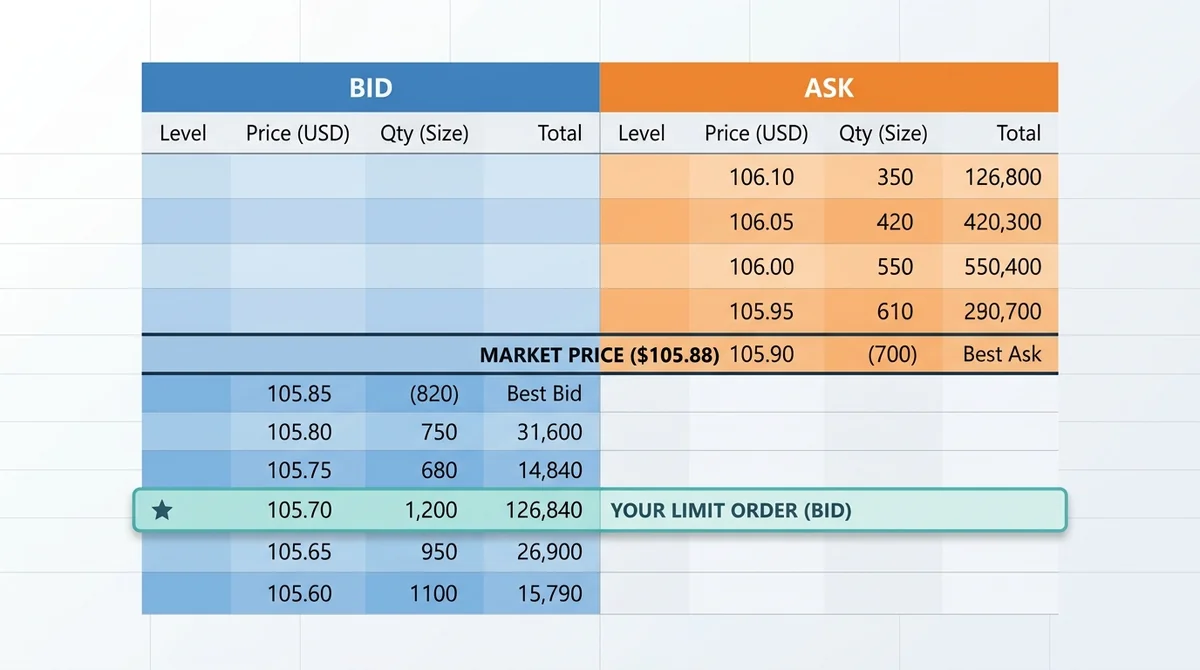
- Buy limit order: Set a buy price below the current market price, hoping the price drops to that level and executes.
- Sell limit order: Set a sell price above the current market price, hoping the price rises to that level and executes.
The main risk is that the market price may never reach your specified price, causing the order to remain unfilled and causing you to miss trading opportunities. You can cancel the limit order at any time before it is filled.
#Why Are Limit Orders Important?
Limit orders allow you to execute at your desired price, effectively controlling the execution price and avoiding adverse slippage caused by market volatility. They are suitable for setting target price levels. To understand limit orders, you also need to understand the order book.
FAQ
What is a limit order?
A limit order is a pending order where a trader specifies a price to buy or sell a cryptocurrency. It only executes when the market price reaches that price. Unlike a market order that executes immediately, a limit order waits for the specified price.
What is the difference between a limit order and a market order?
A market order executes immediately at the current market price, while a limit order waits for the price you set to appear before executing. A limit order can control the execution price, but there is a risk of non-execution.
Can a limit order fail to execute?
Yes. If the market price never reaches the price you set, the limit order will remain on the order book and will not execute. You can cancel it at any time before it is filled.
Can a limit order avoid slippage?
Yes. A limit order executes at your specified price and will not incur adverse slippage due to market volatility. However, if the price gaps past your level, it may also fail to execute or only be partially filled.
What do price priority and time priority mean in the order book?
Price priority means orders with better prices are executed first—for example, higher buy prices take priority. Time priority means when prices are the same, earlier orders are executed first.
Related Terms
Want to see the real data for this concept?
After you sign up, you can view live prices, funding rates, and fees for the related assets.
View live prices and fees →