Liquidation
Liquidation is the platform's auto-close risk control when margin runs low. Learn what sets liquidation price, cross vs isolated, and wallet safety.
Liquidation: When your account margin is no longer enough to maintain a position, the trading platform automatically force-closes your position. This is liquidation (forced liquidation).
#What Is Liquidation (Forced Liquidation)?
Liquidation (forced liquidation) is a risk-control action in which the trading platform automatically closes a position when account equity falls below the maintenance margin requirement. Its purpose is to prevent losses from growing, not to punish users.
Analogy: It's like a landlord taking back the apartment when your deposit can no longer cover the rent, so you don't fall further into debt.
Are liquidation and "blowing up" the same thing? In everyday speech they're basically used interchangeably. Strictly speaking, liquidation is the action, and blowing up is the result — margin is almost entirely wiped out.
What happens to the position and funds after liquidation? The position is closed, and the remaining margin is handled according to the platform's rules; in extreme cases it may be lost entirely.
What can you do before liquidation is triggered? After receiving a margin call, adding margin promptly or actively reducing your position can lower liquidation risk; some platforms also let you set stop-loss orders to exit early. The specific options available depend on the rules of the platform you use.
#What Is Liquidation Price and How Is It Calculated?
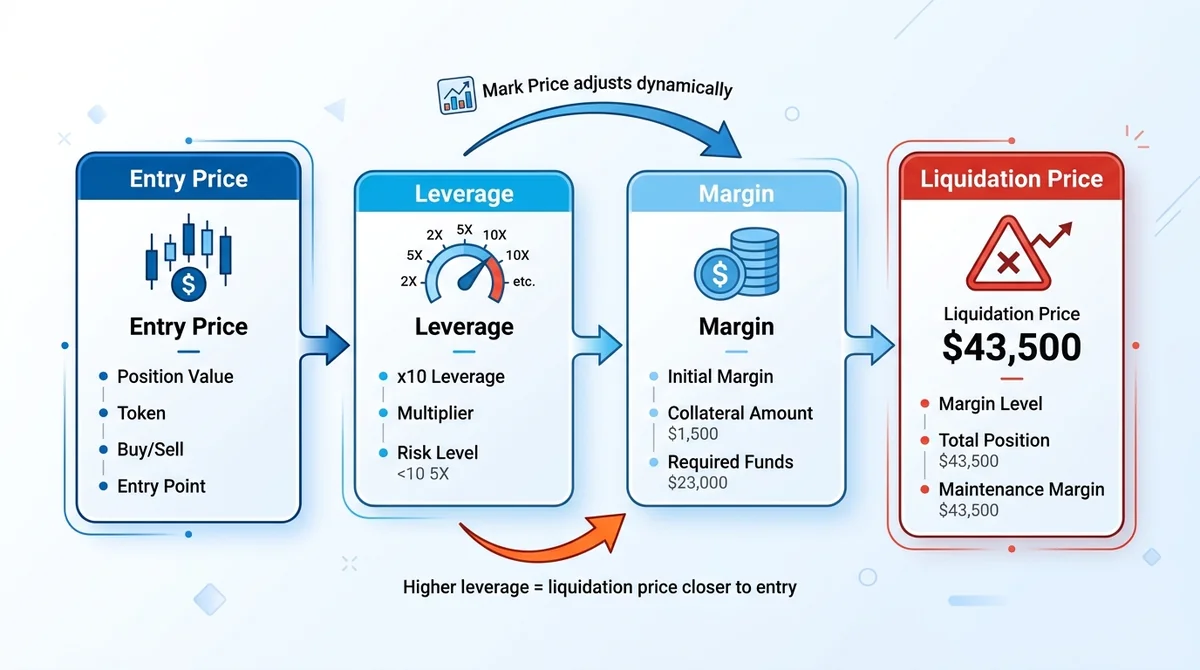
The liquidation price is the reference price at which a position is force-closed. It is mainly determined by the entry price, the leverage multiple, and the amount of margin.
- The higher the leverage, the smaller the price range the position can absorb, so the liquidation price is usually closer to the entry price.
- Adding margin or reducing the position changes the liquidation price.
- The liquidation price shown by the platform changes with parameters such as the mark price.
Analogy: Leverage is like extending a ladder — you stand higher, but a gust of wind knocks you over more easily.
Why does the mark price affect the liquidation price? The mark price is the reference price the platform uses to calculate unrealized PnL and liquidations. It typically incorporates factors such as the spot index to avoid unnecessary liquidations triggered by price manipulation at a single point in time; the liquidation price adjusts dynamically as the mark price changes.
Specific calculation formulas and parameter settings differ across platforms. Please refer to the rule documentation of the platform you use.
#What Is the Difference Between Cross Margin and Isolated Margin?
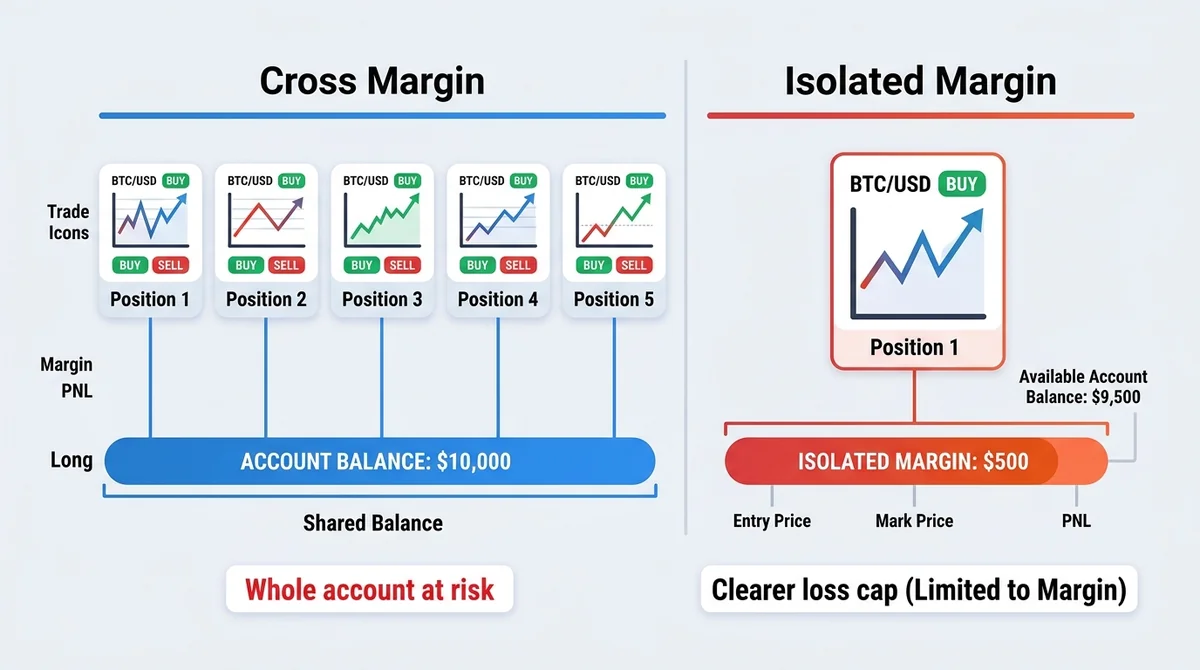
| Mode | Collateral scope | Liquidation impact |
|---|---|---|
| Cross margin | The entire available account balance backs multiple positions | May affect the whole account |
| Isolated margin | Only the margin allocated to that position backs it | Clearer loss cap |
Cross margin is like several people sharing one savings account — when one gets into trouble, everyone is affected; isolated margin is like separate wallets — once one is drained, it stops there.
#What Does Liquidation Have to Do With Wallets?
A wallet is only a custody tool and does not itself create leveraged positions, so it cannot be liquidated.
- Hardware wallet: stores private keys offline; not subject to liquidation.
- Paper wallet: writing your private key on paper; likewise not subject to liquidation.
- Custodial wallet: held by a third party; the risk lies with the platform, not with liquidation.
- Non-custodial wallet: you hold your own private keys; it also does not create leverage.
Liquidation only occurs at the level of contract positions on a trading platform.
#Is Liquidation Related to Asset Types Such as Commodity Tokens?
Commodity tokens held in spot do not involve liquidation. The liquidation mechanism is triggered only when they are held as leveraged positions.
Asset type does not change the liquidation mechanism itself; what changes is whether you use leverage.
#How Should Beginners Understand Liquidation Risk?
Leverage amplifies both gains and losses and also compresses the price range a position can absorb, so liquidation happens more easily.
Suggested order: first understand margin and perpetual futures leverage, then consider whether to use leveraged products. This article is for conceptual education only and does not constitute any operational advice. Digital assets carry risk; please act with caution.
This article was compiled by MSX Learn for conceptual education only.
#FAQ
Q: Are liquidation and "blowing up" the same thing? A: In everyday speech they're often used interchangeably. Strictly speaking, liquidation is the platform's action of force-closing a position, while blowing up is the result after liquidation — margin is almost entirely wiped out. The two describe different sides of the same event.
Q: How is the liquidation price calculated? A: The liquidation price is mainly determined by the entry price, the leverage multiple, and the amount of margin. The higher the leverage, the smaller the price range the position can absorb, and the liquidation price is usually closer to the entry price. Adding margin or reducing the position also changes the liquidation price; the specific formula depends on the rules of the platform you use.
Q: How do cross margin and isolated margin affect liquidation differently? A: Cross margin uses the entire available account balance to back multiple positions together, so a loss on one position may drag down the whole account. Isolated margin uses only the margin allocated to that position as collateral, giving a clearer loss cap and isolating risk within a single position.
Q: Can hardware wallets or paper wallets be liquidated? A: No. Hardware wallets and paper wallets are only ways of storing assets and do not themselves create leveraged positions. Liquidation only occurs at the level of contract positions on a trading platform and has nothing to do with wallet type.
Q: Can holding commodity tokens lead to liquidation? A: Commodity tokens held in spot do not involve liquidation. The liquidation mechanism is triggered only when they are held as leveraged positions. The asset type itself does not change liquidation rules; the key is whether leverage is used.
Q: What can you do before liquidation is triggered? A: After receiving a margin call, adding margin promptly or actively reducing your position can lower liquidation risk; some platforms also let you set stop-loss orders to exit early. The specific options available depend on the rules of the platform you use.
Q: Why does the mark price affect the liquidation price? A: The mark price is the reference price the platform uses to calculate unrealized PnL and liquidations. It typically incorporates factors such as the spot index to avoid unnecessary liquidations triggered by price manipulation at a single point in time; the liquidation price adjusts dynamically as the mark price changes.
FAQ
Are liquidation and "blowing up" the same thing?
In everyday speech they're often used interchangeably. Strictly speaking, liquidation is the platform's action of force-closing a position, while blowing up is the result after liquidation — margin is almost entirely wiped out. The two describe different sides of the same event.
How is the liquidation price calculated?
The liquidation price is mainly determined by the entry price, the leverage multiple, and the amount of margin. The higher the leverage, the smaller the price range the position can absorb, and the liquidation price is usually closer to the entry price. Adding margin or reducing the position also changes the liquidation price; the specific formula depends on the rules of the platform you use.
How do cross margin and isolated margin affect liquidation differently?
Cross margin uses the entire available account balance to back multiple positions together, so a loss on one position may drag down the whole account. Isolated margin uses only the margin allocated to that position as collateral, giving a clearer loss cap and isolating risk within a single position.
Can hardware wallets or paper wallets be liquidated?
No. Hardware wallets and paper wallets are only ways of storing assets and do not themselves create leveraged positions. Liquidation only occurs at the level of contract positions on a trading platform and has nothing to do with wallet type.
Can holding commodity tokens lead to liquidation?
Commodity tokens held in spot do not involve liquidation. The liquidation mechanism is triggered only when they are held as leveraged positions. The asset type itself does not change liquidation rules; the key is whether leverage is used.
Related Terms
Want to see the real data for this concept?
After you sign up, you can view live prices, funding rates, and fees for the related assets.
View live prices and fees →