What Is Liquidity Mining? A Beginner's Guide to DeFi (2026)
Liquidity mining is depositing crypto into DeFi pools to earn fees and token rewards. Learn how it works, risks, and how it compares to staking.
Answer: Liquidity mining is depositing your crypto assets into a DeFi liquidity pool to help others trade, earning trading fees and extra token rewards.
#What Is Liquidity Mining?
How is it different from depositing money in a traditional bank? With a bank, the bank lends out your money and gives you a little interest. With liquidity mining, you put your money into a decentralized exchange's liquidity pool for others to buy and sell tokens. You earn trading fees and reward tokens issued by the project.
Why does DeFi need liquidity mining? Decentralized exchanges don't have middlemen like banks. They rely on user-supplied liquidity pools to complete trades. Without anyone providing funds, trading can't happen. So projects use rewards to attract people to deposit funds.
Analogy: It's like putting your car into a car-sharing fleet. Others rent it and you collect rental fees. The fleet also gives you bonus points, which might be valuable later.
#How Does Liquidity Mining Work?
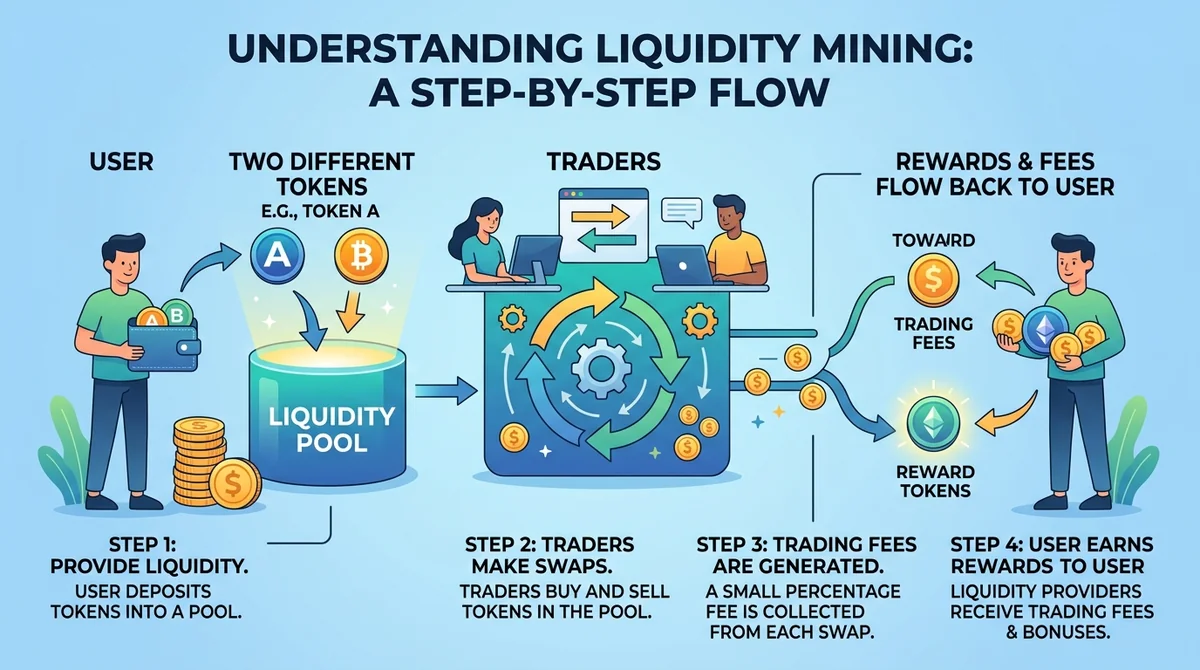
Users deposit two tokens in proportion, such as ETH and USDC, to form a trading pair pool. An automated market maker (AMM) uses a formula to price these two tokens. Traders trade directly with the pool, without waiting for someone to place an order.
Where does the yield come from? Each trade charges a small fee, distributed proportionally to liquidity providers. In addition, the project issues extra token rewards—this is the "mining".
Analogy: A liquidity pool is like a big bowl. You pour in two ingredients. Others come to buy a mixed drink; you collect a small service fee, and also give out drink coupons.
#What Are the Risks of Liquidity Mining?
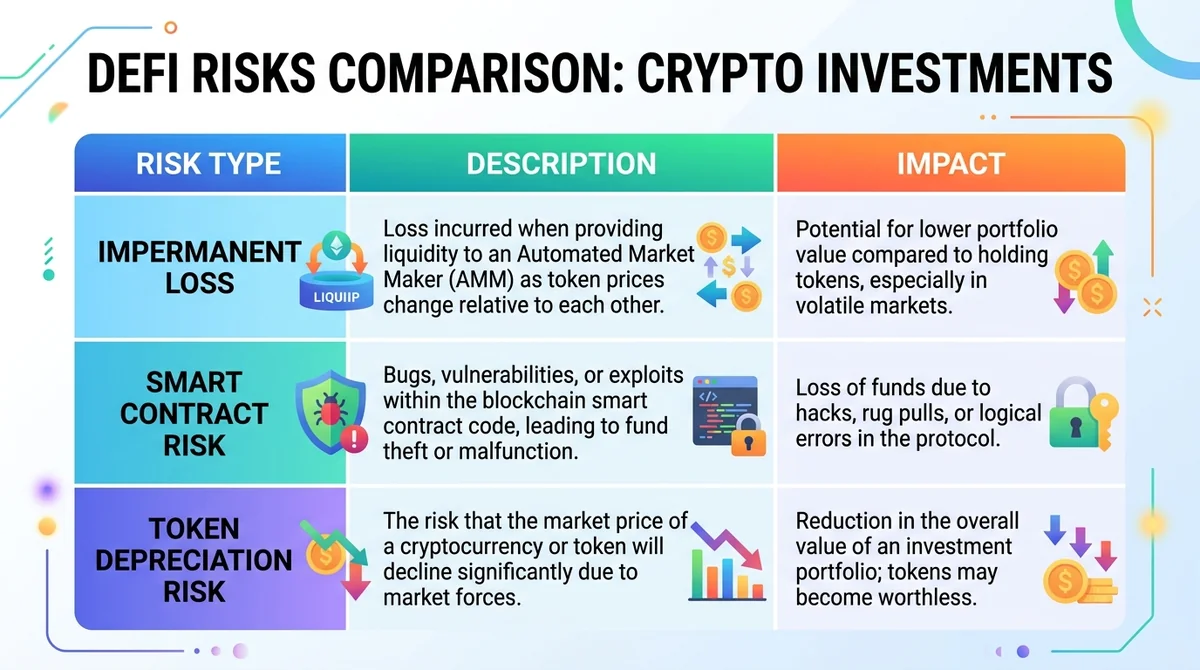
Impermanent loss: The prices of the two tokens you deposited change, and their ratio changes. In the end, the money you withdraw may be less than if you had simply held the tokens.
Smart contract risk: The code may have vulnerabilities, and hackers could steal the funds in the pool.
Token depreciation risk: The reward tokens you receive may crash, and the trading fees may not be enough to cover the loss.
Before participating, only use spare money that won't affect your life if lost. Digital assets are extremely volatile, and there is no guarantee of principal.
#What's the Difference Between Liquidity Mining and Staking?
| Comparison | Liquidity Mining | Staking |
|---|---|---|
| Asset type | Requires two tokens to form a trading pair | Usually only one token |
| Main purpose | Provide liquidity for trading | Support network consensus or governance |
| Yield source | Trading fees + mining rewards | Block rewards or governance rewards |
| Additional risk | Has impermanent loss | Mainly token price volatility |
Both involve locking up assets to earn rewards, but the mechanisms are different. Staking is more like a fixed deposit, while liquidity mining is more like running a currency exchange booth.
#What Should Beginners Know Before Participating in Liquidity Mining?
- Choose pools with high trading volume, transparent project teams, and audited code.
- First understand impermanent loss and the token economic model; don't just look at high yields.
- Only use spare money to test the waters on a small scale; don't put in your living expenses.
Note: This article only explains concepts and does not recommend any projects. Digital assets are high risk; do your own research before making decisions.
#Related Terms
- Automated Market Maker (AMM): A decentralized trading mechanism that uses algorithms to automatically set prices.
- Governance token: A token whose holders can participate in project voting.
- Liquidity pool: A collection of assets locked in a smart contract.
#FAQ
Is liquidity mining a guaranteed profit? No. There are risks such as impermanent loss, contract vulnerabilities, and token price drops, which could result in losing your principal.
Is liquidity mining the same as depositing money in a bank? No. Banks have deposit insurance; liquidity mining does not. Your assets are in a smart contract, and you bear the risk yourself.
Should beginners directly participate in liquidity mining? It's recommended to first learn the basic concepts and test with a small amount of money. Don't be swayed by high-yield promotions.
FAQ
Is liquidity mining a guaranteed profit?
No. Liquidity mining has risks such as impermanent loss, smart contract vulnerabilities, and reward token depreciation. In extreme cases, you could lose most of your principal. Returns are not guaranteed, and you bear the risk yourself.
What's the difference between liquidity mining and depositing money in a bank?
Bank deposits have deposit insurance, so the principal is relatively safe. Liquidity mining has no insurance; your assets are locked in a smart contract and may lose value due to code vulnerabilities or market volatility. The yield comes from trading fees and token rewards, which are highly volatile.
What is impermanent loss?
Impermanent loss is the loss incurred when the relative prices of the two tokens in a pool change. Compared to directly holding the two tokens, the value of the funds you withdraw from the pool may be less. The greater the price volatility, the more severe the impermanent loss.
Are liquidity mining and staking the same thing?
No. Staking usually involves only a single asset, used for network consensus or governance, with returns mainly from block rewards. Liquidity mining requires providing a trading pair of two assets to provide liquidity for trading, with returns including trading fees and mining rewards, and carries impermanent loss risk.
How can beginners reduce the risks of liquidity mining?
Choose pools with high trading volume, trustworthy project teams, and audited code; fully understand impermanent loss and the token economic model; only use spare money to participate, test on a small scale, and do not invest funds you cannot afford to lose.
Related Terms
Want to see the real data for this concept?
After you sign up, you can view live prices, funding rates, and fees for the related assets.
View live prices and fees →