What Is a Liquidity Pool? A Beginner's Guide to DeFi Basics
A liquidity pool is a collection of tokens locked in a smart contract, enabling decentralized exchanges to trade without an order book. Learn how it works.
What is a liquidity pool? A liquidity pool locks many people's tokens into a smart contract to form a shared fund. Anyone who wants to trade can swap directly with the pool, without waiting for someone else to place an order.
#What is a liquidity pool?
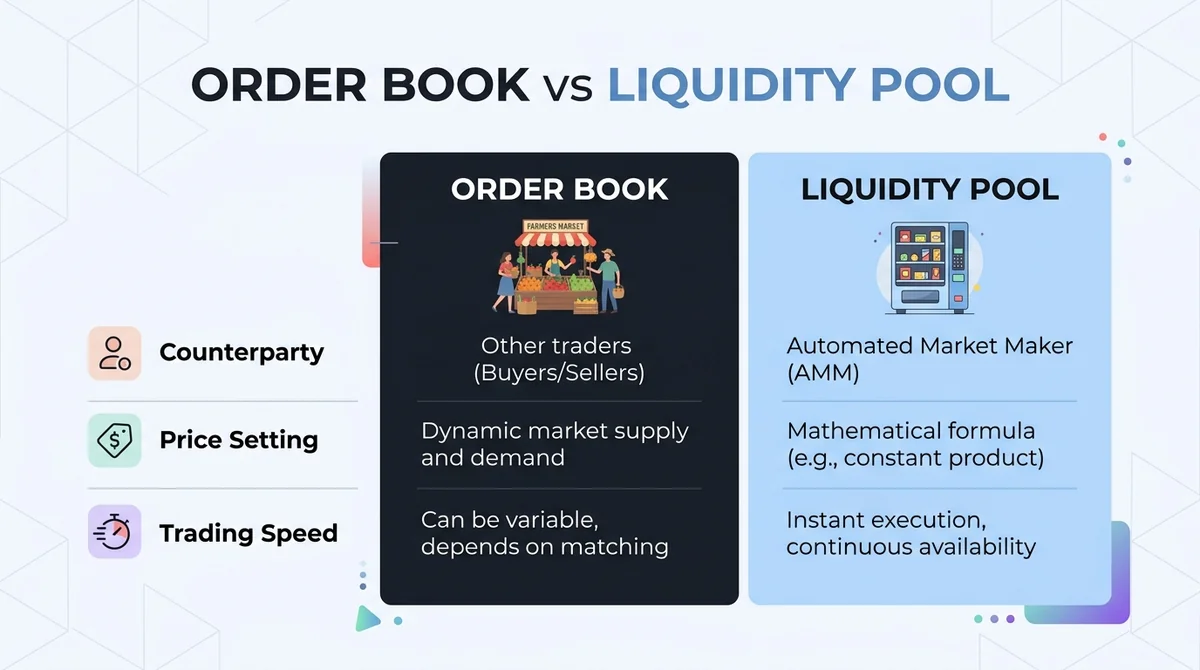
It is completely different from the order book used by traditional exchanges. An order book is like a farmers market: you need to find someone willing to sell. A liquidity pool is like a vending machine: insert a coin and the product comes out, with the machine fully stocked.
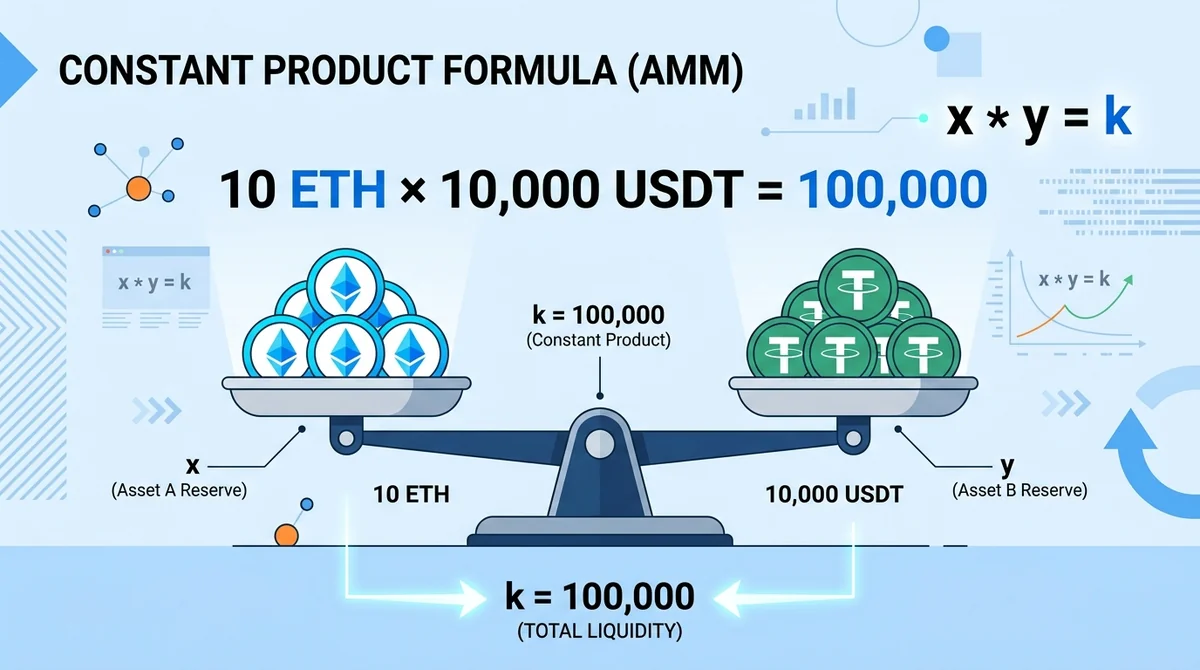
This pool works thanks to an automated market maker (AMM). The AMM uses a formula to set prices automatically, such as the constant product formula. The quantities of the two tokens in the pool are multiplied together and always equal a fixed value.
#How does a liquidity pool work?
How does an automated market maker set prices? Suppose the pool contains 10 ETH and 10,000 USDT, so the product is 100,000. If you want to buy 1 ETH, the pool calculates how much USDT you need to pay so that the product remains 100,000.
How are trading fees distributed? Every trade charges a small fee, for example 0.3%. These fees are distributed proportionally to everyone who has deposited funds into the pool. The higher your share, the more fees you receive.
#Why are liquidity pools important for decentralized finance (DeFi)?
Without liquidity pools, decentralized exchanges would struggle to match trades for low-cap tokens. With pools, any token can be traded instantly, without waiting for a counterparty.
They lower the barrier to trading. Previously you had to find a buyer or seller; now you trade directly with the pool. This enables the DeFi ecosystem to function, with lending and derivatives all depending on it.
#What are the benefits of providing liquidity?
How are fee earnings calculated? When you deposit two tokens into a pool, such as ETH and USDT, you earn trading fees in proportion to your share. The more active the pool's trading, the more you earn.
What other rewards are available? Some projects also issue extra token rewards, known as liquidity mining. By depositing funds, you can earn both trading fees and new tokens. This is a passive income opportunity, but returns are not fixed.
#What are the risks of providing liquidity?
What is impermanent loss? The prices of the two tokens you deposit will change. If one rises a lot and the other rises little, the pool automatically adjusts the ratio. When you withdraw, the total value may be lower than if you had simply held both tokens. This loss is called impermanent loss.
Can smart contracts fail? Smart contracts may have vulnerabilities, and hackers may attack the pool and steal the funds inside. Token price volatility can also cause you to lose money. Providing liquidity is not a guaranteed profit.
#A simple liquidity pool example
Suppose you deposit 1 ETH and 2,000 USDT into an ETH/USDT pool, with a total value of 4,000 USDT. Later, someone buys a large amount of ETH, so the pool has less ETH and more USDT.
When you withdraw, you may receive 0.8 ETH and 2,500 USDT. If the price of ETH rises to 3,000 USDT, your total value is 0.8*3,000 + 2,500 = 4,900 USDT. This is 100 USDT less than holding 1 ETH and 2,000 USDT directly (total value 5,000 USDT). That is impermanent loss.
#FAQ
What is the difference between a liquidity pool and an order book?
An order book requires buyers and sellers to place matching orders, while a liquidity pool uses a smart contract to set prices automatically and allows trading at any time.
Is providing liquidity guaranteed to make money?
No. You may lose money due to impermanent loss or falling token prices, and fee earnings may not cover the losses.
Can impermanent loss be avoided?
It is very difficult to avoid completely. Choosing token pairs with low price volatility or using stablecoin pools can reduce the risk.
Can anyone create a liquidity pool?
On most decentralized exchanges, anyone can create a pool, but they need to provide the initial liquidity.
Are liquidity pools suitable for beginners?
Beginners should first understand impermanent loss and smart contract risks, start with small amounts, and never invest funds they cannot afford to lose.
FAQ
What is a liquidity pool?
A liquidity pool is a collection of tokens locked in a smart contract that enables a decentralized exchange to match trades automatically without an order book. Users deposit tokens to provide liquidity and earn trading fees.
What are the risks of providing liquidity?
The main risks are impermanent loss and smart contract vulnerabilities. Impermanent loss occurs when price changes cause the total value at withdrawal to be lower than simply holding the tokens; contract vulnerabilities can be exploited by hackers, leading to asset losses.
How does an automated market maker (AMM) set prices?
An AMM uses a constant product formula, keeping the product of the quantities of the two tokens in the pool constant. Trades change the pool ratio, and the price is calculated automatically by the formula without an order book.
How do liquidity providers earn returns?
They earn trading fees in proportion to their deposited share, and some projects also distribute additional token rewards (liquidity mining). Returns depend on trading volume and project rules.
Can impermanent loss be avoided?
It cannot be completely avoided, but you can reduce the risk by choosing stablecoin pairs or token pairs with low price volatility. Impermanent loss is an inherent risk of providing liquidity.
Want to see the real data for this concept?
After you sign up, you can view live prices, funding rates, and fees for the related assets.
View live prices and fees →